Thursday, July 23, 2009

$$ Questions that don’t get asked

Where on earth are we going to get the money to go back to the moon? to bail out another big bank? to continue paying for the wars in Iraq and in Afghanistan?
Instead of those pressing questions, we hear this one over and over and over again: Where we going to find the money to pay for health reform?

When you constantly repeat that question, to the exclusion of other budgetary questions, you disclose your priorities. When politicians and the media focus on that question, as they do, they are judging health care in a negative way: health reform is less important and needs a greater justification for the expenditure of federal dollars.

July 20, the 40th anniversary of the America’s successful landing on the moon, was a time of prideful celebration. But it should also have been good time to raise questions about the wisdom, financial and otherwise, of continuing our programs of human spaceflight.

At present NASA is on an outer space path that will cost taxpayers an estimated $100,000,000,000. In my view, it is a crazy luxury to spend that kind of money to plant a flag on Mars when we have so many urgent things to do right here on earth.

Print Page Read more!

Tuesday, July 21, 2009

Toxic $$ Fight Health Care Reform

A cool $177,000,000 -- that's how much the health care industry has contributed since 1989 to members of Congressional committees now drafting bills to reform the nation's health system. What kind of reform can you expect especially when the key lawmaker on health issues, Senator Max Baucus of Montana, alone collected nearly $1.500,000 from health-related companies in 2007 and 2008?
“What’s on your mind?” That’s the question my Facebook page asked me today, as on every day. And I answered with the above paragraph. The information in it is from an investigative report in this morning’s Washington Post.

The report depressed me. What a way for me to start July 21, my birthday! But thank God, I have a few ways to sound off. I need to enhance my ways of doing so. You should too.

Health care in the United States is sick, in desperate need of a comprehensive cure. But comprehensive reforms usually manage to rally private interests into well-financed coalitions against the public interest.

Where, for God’s sake, are the voices for a health care system that serves the common good? Still far too weak to overcome the power of $177,000,000.

Print Page Read more!

Wednesday, July 15, 2009

The Failure of the Economy -- and of the Economists

So Wall Street’s Goldman Sachs reports the highest profits in the firm’s 140-year history -- $3,440,000,000 for the second quarter of this year – and earmarks an average of about $770,000 in bonuses for each of its 29,400 employees. Meanwhile, 14,700,000 men and women in the United States are jobless, triggering an unemployment rate of 9.5 percent, the highest level in more than a quarter century.

That’s an example of an imbalance in our economic system – an imbalance that favors workers who manipulate money over those who actually produce something. In a May 29 New York Review of Books article, a leading economist, Benjamin M. Friedman, fills in some of the details of this imbalance.

Friedman does so by using a favorite tool of economists: efficiency. His article, “The Failure of the Economy & the Economists,” tracks performance in several ways, starting with profit-making:

“In recent years the financial industry has accounted for an unusually large share of all profits earned in the US economy. The share of the ‘finance’ sector in total corporate profits rose from 10 percent on average from the 1950s through the 1980s, to 22 percent in the 1990s, and an astonishing 34 percent in the first half of this decade.”
Moreover: “The finance industry’s share of U.S. wages and salaries has likewise been rising from 3 percent in the early 1950s to 7 percent in the current decade. An important question … is what fraction of the economy’s total returns to productively invested capital is absorbed up front by the financial industry as the costs of allocating that capital.”

Friedman, author of “The Moral Consequences of Economic Growth," insists that the question is important, since the total cost of the industry goes up “if this system also exposes the economy at large to episodic losses in production and incomes and to the need for taxpayer subsidies.” And that’s what’s happening now. “Today those losses are mounting, and so are the subsidies.”

Why, Friedman asks, is there so little discussion of this fundamental reality?

One reason, he says, is intellectual: the systematic failure of thinking on the part of economists. He explains that failure at some length, and presents one solution offered by economists George Akerlof and Robert Shiller: “fire the weather forecaster.”

Just to be clear: I don’t support firing economists guilty of intellectual failures. That would be inefficient. We should first give them the opportunity to participate in intensive retraining programs.

Are you laughing? I am not.

Print Page Read more!

Saturday, July 11, 2009

Speaking out against nuclear weapons

There are currently almost 24,000 nuclear warheads in existence, with a destructive power equivalent to 400,000 times the power of the bomb dropped on Hiroshima in 1945. Nuclear arms account for a significant portion of global arms expenditure, which reached an all-time high of US $1,400,000,000,000 in 2008, an increase of 45% over the preceding decade.
So said the International Trade Union Confederation (ITUC), the global voice of workers in 157 countries, in launching a worldwide campaign against nuclear weapons. The campaign, run in cooperation with “Mayors for Peace,” which groups more than 2,000 cities in 130 countries, is a lead-up to the May 2010 UN review of the Nuclear Non-Proliferation Treaty (NPT).

Guy Ryder, ITUC general secretary, expressed labor’s concern “about the prospect of further nuclear proliferation, particularly in North Asia, South Asia, and the Middle East,“ and added: “The only way to deal with this is through multilateral negotiations, and the 2010 NPT review is tremendously important in that regard.”

A petition to UN Secretary General Ban Ki-moon, as well as other information, can be found on the campaign website http://www.ituc-csi.org/.

Print Page Read more!

Thursday, July 09, 2009

This job market is not ‘race neutral’

In contrast to whites and Hispanics of the same age group, the wages of black workers 25 to 54 years old are continuing to sink, according to an “economic snapshot” issued July 8 by the Economic Policy Institute.

Over the last two years the weekly media wage of black workers in their prime working years dropped by 3.7% or about $23, while that of whites, Hispanics, and Asian groups of the same ages actually rose. This continues the pay shrinkage of blacks that marked the 2000-2007 business cycle, when the weekly median wage of blacks dropped 0.6%, while other groups received small increases.

The downward trend in income is a crucial element in an overall decline in the social wellbeing of African-American communities since 2000.

That development was described last year in an EPI briefing paper, “Reversal of Fortune,” by Algernon Austin, who heads the EPI program on race, ethnicity, and the economy.

Austin there emphasized the need for “a national strategy for black full employment,” with the goal of having black unemployment sustained below 5%. In May the black jobless figure was 14.7%, 16.6% for black men over 20.

Meanwhile, a popular slogan demands “race-neutral policies.” Too bad that the job market does not conform to slogans.

Print Page Read more!

Tuesday, July 07, 2009

Ten Challenges for American Catholics Implicit In Pope's New Encyclical

Pope Benedict XVI’s new encyclical, “Love in Truth,” like all Papal encyclicals, is not country-specific in the issues that it raises. Nor is it addressed only to Catholics. Rather, the Pope’s analysis deals with the “challenges of today’s world.” Nevertheless, many of those challenges ought to be of special concern to American Catholics, both as office-holders and as ordinary citizens of the world’s leading power.

Here is my partial list of such challenges, 10 of them, selected from among those that fall within the province of this Weblog, Human Rights for Workers. The quotes, italics included, are directly from the Vatican text.

Globalization

“The processes of globalization, suitably understood and directed, open up the unprecedented possibility of large-scale redistribution of wealth on a world-wide scale; if badly directed, however, they can lead to an increase in poverty and inequality, and could even lead to a global crisis. It is necessary to correct its malfunctions, some of them serious, that cause new divisions between peoples and within peoples, and also to ensure that the redistribution of wealth does not come about through the redistribution or increase of poverty…”

Inequalities

“The world’s wealth is growing in absolute terms, but inequalities are on the increase. In rich countries, new sectors of society are succumbing to poverty and new forms of poverty are emerging. In poorer areas, some groups enjoy a sort of ‘superdevelopment’ of a wasteful and consumerist kind which forms an unacceptable contrast with the ongoing situations of dehumanizing deprivation.”

Unemployment

“Unemployment today provokes new forms of economic marginalization, and the current crisis can only make that situation worse. Being out of work or dependent on public or private assistance for a prolonged period undermines the freedom and creativity of the person and his family and social relationships, causing great psychological and spiritual suffering. I would like to remind everyone, especially governments engaged in boosting the world’s economic and social assets, that the primary capital to be safeguarded is man, the human person in his or her integrity.”

Role of government

“The integrated economy of the present day does not make the role of States redundant, but rather it commits governments to greater collaboration with one another. Both wisdom and prudence suggest not being too precipitous in declaring the demise of the State. In terms of the resolution of the present crisis, the State’s role seems destined to grow, as it regains many of its competences.”

Unions

“Through the combination of social and economic change, trade union organizations experience greater difficulty in carrying out their task in representing the interests of workers, partly because Governments, for reasons of economic utility, often limit the freedom or the negotiating capacity of labor unions. Hence traditional networks of solidarity have more and more obstacles to overcome. The repeated calls issued within the Chuch’s social doctrine…for the promotion of workers’ associations that can defend their rights must therefore be honored today even more than in the past.”


The Market and Ethics

“Efforts are needed – and it is essential to say this – not only to create ‘ethical’ sectors or segments of the economy or the world of finance, but to ensure that the whole economy – the whole of finance – is ethical, not merely by virtue of an external label, but by its respect for requirements intrinsic to its very nature.

Rights and Duties

“Many people today would claim that they owe nothing to anyone, except themselves. They are concerned only with their rights, and they often have great difficulty in taking responsibility for their own and other people’s integral development. Hence, it is important to call for a renewed reflection on how rights presuppose duties, if they are not lo become mere license.”

Intellectual property protection

“On the part of rich countries there is an excessive zeal for protecting knowledge through an unduly rigid assertion of the right to protect intellectual property, especially in the field of health care.”

Investor responsibility

“Both the regulation of the financial sector, so as to safeguard weaker parties and discourage scandalous speculation, and the experimentation with new forms of finance, designed to support development projects, are positive experiences that should be further explored and encouraged, highlighting the responsibility of the investor.”

The Environment

“The environment is God’s gift to everyone, and in our use of it we have a responsibility towards the poor, toward future generations, and toward humanity as a whole.”
* * *
To repeat: that’s my list of 10. There certainly are other challenges that demand attention, but 10 is a nice round number, and for a blog this posting is already overly long.

Print Page Read more!

Monday, July 06, 2009

Happy Birthday, My Dear!


The birthday I’m celebrating here is that of my wife, Dzung, the 37th of her birthdays that we’ve celebrated since we married. The image on this e-card is the cover of the Vietnamese literary quarterly that she edits and publishes with a team that includes Vu Tha Hoa, an artist in Paris who contributed the cover’s painting.

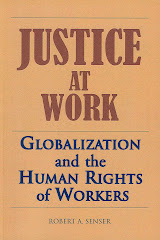
Dzung and I are both writers, but she is also a poet, and much more prolific than I am. To my one book (see cover at right), she has published six. Two of her books are so moving that some people read them straight through, without even stopping for sleep. Who would ever read a book on globalization in one sitting.

Dzung felt that Co Thom’s cover doesn’t quite blend in with this blog. Yet, more technologically advanced than I am, she created a JPG file of the cover for me.

A full-page ad for Justice at Work appears in the current issue of Co Thom. As an old friend of mine has said, nepotism is okay if it stays within the family.

Print Page Read more!

Saturday, July 04, 2009

Reviving the anti-sweatshop movement


“Nearly 20 years of anti-sweatshop activism has come to naught,” says a veteran campaigner against sweatshops, Jeff Ballinger. He contends, therefore, that it is urgent to try a new, more effective, strategy.

In the lead article of Dissent magazine’s summer issue, Ballinger lays out his thoughts on such a strategy. The article's title: “Finding an Anti-Sweatshop Strategy That Works.”

As an illustration of the anti-sweatshop movement’s failure, he cites a who-got-how-much breakdown of the $38 price of hoodie sold in the University of Connecticut bookstore a couple of years ago. Out of that $38, the workers in Mexico who produced it received a meager l8 cents. “The workers’ share could hardly have been lower when the movement began,” writes Ballinger, who himself helped create the movement.

From his own experience working with workers in the United States and Asia, he is convinced that to get rid of sweatshops, you have to start by helping workers “empower” themselves – get them involved in learning the facts of their vulnerable situation and the way to do something about it.

How to help under current circumstances? In Ballinger’s view, “fighting sweatshop abuses here and abroad will not be key policy undertakings of Barack Obama and his team.” He presumably means that strong anti-sweatshop legislation may get sidetracked by other priorities, such as battling for health care and financial reforms.

But even so, Ballinger insists, the executive branch has available a wide set of initiatives that it could take on its own – initiatives that “would at least begin an assault on global sweatshop practices.” That beginning should be launched by President Obama himself: “Addressing the rule of law as applied to the workplace ought to be a slam-dunk for the President and the recently re-energized State Department.”

Among the specific initiatives that Ballinger proposes for a “no-nonsense strategy” are these:

-- Expand the Bush administration’s “Trafficking in Persons” program to include workers lured to leave their Asian home countries for sweatshop jobs elsewhere in Asia.
-- Be sure to connect with real labor activists, in Asia and Central America especially.
-- Have AID missions adopt “worker empowerment” projects, such as those that involve workers themselves in using survey-research tools to gather information useful to local legal aid groups as well as to unions.
-- Have U.S. Embassies gather labor and environmental information in a more focused and systematic way, for example, by reporting meaningful details on enforcement by labor inspections.
-- In addition to raw data, gather wiki-style narratives on recent strikes, the human effect of sub-par wages, outright wage-cheating, and other pressing issues, as well as local academic papers on these issues.
-- Share information on these subjects with U.S. corporations that contract out work to local factories and offices.

Ballinger is currently finishing up work on a PhD degree, aided by a grant from the Laborers International Union. For the full text of Ballinger’s article, click here.

Print Page Read more!

Friday, July 03, 2009

The Durability of Nike’s Sweatshops

Nike is turning a blind eye to labor abuses in Vietnam factories that mass produce Nike’s athletic shoes and other sports equipment for export. That’s a finding of on-site research in Vietnam conducted after a strike last year by 20,000 workers in Nike’s supplier factories there.

A three-person team from Denmark that did the investigation spoke directly, and secretly, with the workers, including a low-level supervisor, “Mr. T,” who had presented the worker demand for a pay increase to management.

The Danish Consumer Council, which sponsored the investigation jointly with 10 other organisations, published a feature article on the research in its magazine. One specific finding is really nothing new: that the government/Communist Party apparatus of the Socialist Republic of Vietnam has its own “union,” and is hostile to any organization and worker activity independent of the government/party-run union.

What is new in the report is evidence that the Nike’s business operation within the Communist system conflicts with Nike’s own code of conduct and tarnishes its own self-image as a decent company.

A company like Nike ought to “make sure that no workers are inappropriately punished for their participation in a strike,” says Tim Connor, labor rights coordinator for Oxfam/Australia.

In Vietnam, uniformed police, called in by management, successfully broke the strike through ruthless tactics that included firing 100 leaders of an underground movement that promoted it. (Nike says there were no firings.} According to an internal Nike document and the testimony of Mr. T and others, Nike stayed on the sidelines while the police quashed the strike and the movement.

On the surface, the strike was triggered only by the demand for a living wage. Yet, as usual in such circumstances, other grievances fueled the walkout. When a worker fails to meet her production quota, for example, she is hit with a 15% deduction of her monthly pay. Workers assemble shoes with toxic glue, with a bonus for tolerating headaches and other possible effects.

For more information on the conduct of Nike and other brand-name companies, see http://www.consumersinternational.org/.

I learned of the Danish report through one of the regular contributions that Jeff Ballinger makes to lists maintained by Oxfam Australia.

Print Page Read more!

Wednesday, July 01, 2009

A Pope Speaks Truth to Power, But Who Listens?

In formally signing his new encyclical letter on June 29, Pope Benedict XVI said that it will return to social themes expressed by Pope Paul Vl in his encyclical “On the Development of Peoples” (Populorum Progressio) four decades ago.

That should mean that Benedict’s document, to be released July 7, during the summit meeting of G8 powers in Italy, will raise controversial issues about globalization, as Paul VI did about development. The new encyclical, Caritas in Veritas (Love in Truth), promises to be an eye-opener.

In Pope Paul’s 1987 assessment, healthy development embraces both economic and social progress. The separation of economics from “human realities” is unacceptable and results in a wide range of evils.

Among them are the “flagrant inequalities” not just in wealth but also in power among individuals. Instead, the goods of the earth should flow freely for all. All people have the “right to glean” what they need from the earth. To that basic right, “all other rights whatever they may be, including the rights of property and free trade, are to be subordinated.”

In support, Paul VI quoted the words of St. Ambrose:

“You are not making a gift of what is yours to the poor man, but you are giving him back what is his. You have been appropriating things that are meant to be for the common use of everyone. The earth belongs to everyone."
Paul VI condemned “certain concepts [that have] insinuated themselves into the fabric of human society. These concepts present profit as the chief spur to economic progress, free competition as the guiding norm of economics, and private ownership of the means of production as an absolute right, having no limits nor concomitant social obligations.”

“This unbridled liberalism,” he added, “paves the way for a particular type of tyranny, rightly condemned by our predecessor, Pius XI, for its results in the ‘international imperialism of money’.”

For Paul VI, “trade relations can no longer be based solely on the principle of free trade, unchecked competition, for it very often creates an economic dictatorship. Free trade can be called just only when it conforms to the demands of social justice.”

Just because a poor country has signed a trade deal with a rich country does not make the agreement legitimate. “When two parties are in very unequal positions, their mutual consent does not guarantee a fair contract; the rule of free consent remains subservient to the demands of the natural law.”

In his closing summary of the crisis “in all its dimensions,” Pope Paul wrote: “The moment for action has reached a critical juncture.”

That appeal was soon forgotten. If Pope Benedict returns to Pope Paul’s principles and applies them to globalization, will he receive a more positive result? Will his analysis and counsel find a place on the G8 agenda? Or on the agenda of the Catholic hierarchy of the United States?

The full text of Papal encyclicals, past and present, can be found in several languages on the Vatican website (www.vatican.va), which has a superior search engine.

Print Page Read more!

Tuesday, June 30, 2009

Employee Free Choice Act 'supported by Catholic social teaching'

“The present legal and moral framework that is intended to assist workers to form unions is badly broken,” a group of Catholic scholars declare in a public statement. Consequently, they are lending their support to the proposed Employee Free Choice Act for its being “rooted in and supported by Catholic Social Teaching.”

The statement, signed by more than 140 members of the Catholic Scholars for Worker Justice, was published in the June 28 issue of the National Catholic Reporter and will appear in America magazine in July.

“An a priori presumption for unions” is embedded in Catholic social teaching, according to the statement. “Catholic teaching states that the right to organize belongs to workers alone and cannot be abridged or annulled by civil or ecclesiastical authorities. The method or venue that workers choose to form a union is also their choice: workers may say yea or nay, stand or sit, sign statements or cards, or hold a secret ballot election.”

Provisions of the Employee Free Choice Act “strongly reflect the Catholic position that the decision to form or join unions is always the workers’ choice,” the group says, and lists the bill’s chief provisions, all of which business groups vigorously oppose.

The full text of the statement and its signers can be found here


Print Page Read more!

Wednesday, June 24, 2009

Double standard on labor standards

You are an employer under pressure from corporate stockholders to increase the returns on their investment. You decide the way to do so is to slash your present and future labor costs by firing your current workers en masse and recruiting a set of new ones, people among the unemployed so anxious for a job that they accept anything you impose: sub-minimum pay, no vacations, a seven-day workweek, no sick pay, and other drastically lower labor standards associated with a sweatshop.

As an American employer, you would not be able to implement so radical a decision. It would be illegal. It would be bad public relations. It would also, in the eyes of most people, be immoral. You couldn’t get away with it.

But what if instead of hiring other workers in America, you hire workers overseas – foreign men, women, and children willing to work in the real sweatshops of the kind that dot the Asian industrial landscape.

In both cases you impose harm on Americans, and you undermine the progressive U.S. labor market practices built up over decades. Oddly, however, you would be judged harshly in one case and not the other. That’s because we draw a sharp line between the two radical moves, even though the effect in the United States is exactly the same.

Why does an illegitimate and unacceptable radical change in one case become legitimate and acceptable in the other? Simply because one radical change is consummated across borders under the protection of international trade laws that are deemed superior and not be interfered with.

The above paragraphs reformulate a crucial policy inconsistency conveyed by Dani Rodrik, professor of international political economy, in his June 16 talk at the London School of Economics. In outlining the possible future of capitalism (see my June 21 posting) he briefly discussed labor standards as an important globalization issue that needs to be much better understood.

“And yet,” he added, “we have no good way of even talking about this.”

Why is the labor standards issue so little talked about in Washington power circles these days?

Mostly, I think, because the agenda-setting power circle has made up its collective mind on this issue. The unspoken assumption is that today’s trade rules, despite some flaws, are sufficiently legitimate and really have nothing to do with the grave harm imposed on American workers.

Rodrik’s 90-minute talk, as recorded on video, is a good short overview of why the flaws are threats to globalization itself. His video presentation on “Capitalism.3.0” can be found on the London School’s Website. The quickest way to access it is through Rodrik’s June 18 posting on his Weblog at http://rodrik.typepad.com/

Print Page Read more!

Sunday, June 21, 2009

Envisioning a Reborn Capitalism

The present global economic crisis has shaken capitalism down to its roots. What will, or should, replace it? Dani Rodrik, professor of political economy at Harvard’s school of government, dealt with that question on June 16 in a public lecture at the London School of Economics.

Rodrik warned against making two opposite mistakes in reacting to the crisis: returning to the protectionism of the 1930s (unlikely, unless the U.S. succumbs to even deeper recession) or making “an ambitious effort to take economic globalization to the next level.”

But neither approach would address what Rodrik rightly considers the fundamental problem of the world economy: “the imbalance between the reach of markets (global) and the scope of their governance (mostly national).”

For a Moderate, Moderated Globalization

The scenario that Rodrik advocates is “an intermediate level of globalization.” Its key element: allowing countries to retain much greater domestic “policy space” when domestic requirements conflict with the requirements of international integration. (In other words, a serious need of a country’s own citizenry should trump WTO rules.)

Rodrik’s intermediate level of globalization would not be “a retreat from globalization per se” but a retreat from the gung-ho globalization of the post-1990 years. Unfettered financial globalization and free capital mobility would lose their power as driving forces under his vision of Capitalism 3.0, the assigned title of his London talk.

A major reality that Rodrik recognizes is that “democratic governance and political communities are organized within nation states, and are likely to remain so in the immediate future.” So it is still up to nation-states to act in concert toward Capitalism 3.0 under "guidelines" such as the following:

There is no “one way” of globalization: institutional designs that underpin market economies will differ according to domestic preferences and needs.

Non-democratic countries may be subject to more restrictive global trade/investment rules “since it cannot be presumed that their choices reflect the needs of their citizenry.”

“Like-minded” nations would be able to “deep integrate” (pursue a high degree of free trade and other mutual economic arrangements).

Where deep integration is not feasible or desirable, the countries would rely on “traffic rules” to manage the interface among the various national institutional arrangements.
It is in his “traffic rules” that Rodrik offers some details on putting the “guidelines,” or general principles, into specific rules. What might such traffic rules look like? In the Power Point presentation of his talk, he offers two sets of traffic rules – “illustrations,” not blueprints.

-- Regarding WTO trade rules, for example, he proposes a special “development box” for developing countries to exempt them from some currently prohibited practices that don’t fit their situation.

-- Among the traffic rules for finance, he proposes recognition of the right of governments to interfere in cross-border financial flows that undermine a country’s own regulations.

A video of Rodrik's presentation can be accessed through the June 18 posting on his Weblog at http://rodrik.typepad.com.

Rodrik’s latest book is "One Economics, Many Recipes: Globalization, Institutions, and Economic Growth." His writings appear regularly in the world press through an international press service called Project Syndicate.

The Vatican is expected to release a new document (called an encyclical) by Pope Benedict XVI late in June. Once scheduled to be released in September last year, the encyclical’s publication was delayed to take into account the economic crisis. Judging by previews given orally and in writings by the Pope, its analysis of globalization will be remarkably similar to Rodrik’s.

Print Page Read more!

Thursday, June 18, 2009

‘Globalization and Us’ in Blueprint

“Globalization and Us,” the concluding chapter of my book, Justice at Work, is featured in the current issue of Blueprint for Social Justice, published by the Twomey Center for Peace Through Justice at Loyola University in New Orleans.

The chapter
includes 15 propositions that form a proposed paradigm for dealing with globalization issues confronting us. Blueprint highlights one of the 15 in large type:

“The heart of the [globalization] reform movement should be to make the Universal Declaration of Human Rights more universal in international business, with close attention to the rights of workers, particularly women workers, who are more vulnerable to exploitation than are men.”
An article of mine, “Human Rights: Ten Objections Answered,” appeared in the December 1993 Blueprint. I wrote it to respond to major criticisms of human rights, especially worker rights. At the time I was working at the AFL-CIO’s Asian-American Free Labor Institute, which is now part of the federation’s Solidarity Center.

Loyola’s Twomey Center is named after the late Rev. Louis J. Twomey, S.J., a battle-scarred Southern champion of human rights for all.

Print Page Read more!

Tuesday, June 16, 2009

Save Capitalism? Well, that depends…

...That depends on the kind of capitalism. Some kinds aren't worth saving.

Not the kind that, as a result of the current financial crises, is inflicting more than $2,000,000,000,000 in total losses on the United States and the world.

Not the kind that values the manipulation of money over the production of goods and services.

Not the kind that treats labor as a commodity, a thing like shipload of coal or garbage.

Not the kind that furiously opposes legislation such as the proposed Employee Free Choice Act, which would help give workers and their organizations a right now enjoyed by business people and their organizations.

Not the kind that uses free trade and investment agreements to grant global rights and privileges to business and business organizations without any commensurate responsibilities.

Not the kind that uses its money and muscle to acquire and exploit vast tracts of land in distant lands no matter the harm done to indigenous peoples.

Not the kind that generates unprecedented luxuries for the few while millions and millions live in misery.

“Greed Is Good (to a point)” is the title of an essay by Fareed Zakaria in the current Newsweek. That’s catchy but grossly misleading. It’s like writing an essay on teen-age pregnancy and titling it “Lust Is Good (to a point).”

But Zakaria wisely recognizes that “the fundamental crisis we face is of globalization itself.” He goes on to explain:

“Technology has created worldwide supply chains, companies, and customers. But our politics [i.e., policymaking] remains resolutely national. The tension is at the heart of the many crashes of this era – a mismatch between interconnected economies that are producing global problems but no matching political process that can effect global solutions.”

For the ful text of Zakaria’s essay, see News Week on line at
http://www.newsweek.com/id/201935.

Print Page Read more!

Friday, June 12, 2009

20,000,000 girls under 12 work fulltime


About 100,000,000 girls in the world go to work instead of to school, according to estimates of the UN International Labor Organization. More than half of these, or 53,000,000, work in hazardous jobs in agriculture, manufacturing, mining, domestic services, and commercial sex, and 20,000,000 of these girls are under 12.

To remind people of this stain on the 21st century, unions and human rights organizations throughout the world observed June 12 as World Day Against Child Labor, with special emphasis on the goal of Give Girls a Chance.

This year marks the 10th anniversary of the ILO convention 182, which is dedicated to eliminate the worst forms of child labor.
What can you do? The International Labor Rights Forum suggests pressuring Hershey, Mars, and Nestle to stop using child labor. For specifics, see the ILRF Website at http://www.ilrf.org/."

Print Page Read more!

Thursday, June 11, 2009

Protesting Very Foreign Investments

Led by an indigenous organization, tens of thousands of Peruvian Indians have for many months been engaging in non-violent protests against gas and oil exploitation of their ancestral lands. Then on June 5, when government forces in helicopters and on foot clashed with protesters blocking a road in an Amazonian province, at least 11 police officers and 30 Indians were killed and many more were wounded.

The specific aim of the protest is to cancel government legislation enacted in implementing the investment provisions of the Peru-U.S. free trade agreement, signed by President Bush in December 2007.

President Alan Garcia says the legislation will spur development. Indian opponents say it opens up communal lands and water resources to exploitation by foreign investors. Last month the nine Roman Catholic bishops in the Amazon issued a declaration calling the Indians’ complaints legitimate.

They condemned the “cruel and inhuman effort to make decisions about the possessions of riverine and Amazonian communities because they lack the legal means to defend their just demands, even in their own country.”

Thirsting for Distant Lands

The conflict in Peru comes amid an international surge in foreign investment not just by multinational corporations but also by governments and various others entities, including hedge funds and commodity traders.

“A Thirst for Distant Lands: Foreign investment in agricultural land and water,” a report released in May by the International Institute for Sustainable Development, notes that the Gulf States, China, Japan, and South Korea are also acquiring vast plots of land abroad to produce food, animal feed, and energy crops for home consumption.

As in Peru, these foreign acquisitions are generally legal, as legal is traditionally understood, that is, in accord with domestic law, even when adopted under foreign government pressure in negotiations for free trade/investment agreements. But that justification overlooks two modern realities: that rich countries promoting those agreements also advertise human rights, freedom, and democracy, and that those advertisements now instruct far-away people whose rights are violated.

More and more, then, there comes into play a factor that John Ruggie, UN special representative on human rights and business, calls a “social license.” Human rights violations can become so egregious, so intolerable that, no matter the legal license, victimized people get themselves organized to protest and to shout loud and clear Stop! No More!

That has happened in Peru.

One more challenge testing the Obama administration’s policy on foreign trade and investment.

Print Page Read more!

Saturday, June 06, 2009

Balance investor rights with responsibilities

It’s time to replace a foreign trade/investment model that has not worked, as Thea Mai Lee, AFL-CIO policy director, has repeatedly emphasized in Congressional testimony and talks at conferences dealing with the current economic crisis.

In Congressional testimony on May 14, she singled out a critical but often ignored element that belongs in a new trade/investment model: a “balanced” treatment of foreign investment.

“While we understand and support the importance of protecting the rights of investors,” she said, “we believe that existing investment provisions in U.S. investment and trade agreements are imbalanced in two crucial aspects:

“First, they significantly enhance the rights of investors vis-à-vis governments, but they fail to establish commensurate responsibilities for investors, particularly with respect to workers’ rights and the environment.

“Second, they give substantive rights and procedural advantages to foreign investors that are not available to domestic investors. This raises the possibility that investment tribunals can be used to circumvent the democratic process and to achieve regulatory outcomes in a secretive and inaccessible forum. Certainly the experience with the investment chapter of the North American Free Trade Agreement (NAFTA) and current BITs [bilateral investment treaties] reinforces these concerns.”
As now written, she said, the pro-investor language “facilitates and accelerates the offshoring of American jobs – precisely because for the most part there has been no commensurate set of investor obligations.”

Lee is co-chairing a subcommittee of the State Department’s advisory committee on international economic policy to review and critique the draft model BIT.

The United States has 40 BITs in force and 10 Free Trade Agreements with provisions protecting investment, plus a separate multilateral agreement under the World Trade Organization for the same purpose.

Print Page Read more!

Friday, June 05, 2009

Black poverty and globalization

Why is it that so many millions of blacks in Detroit, Philadelphia, Los Angeles, and other American cities are mired in poverty? Don’t put blame exclusively on past and present policies designed to discriminate against blacks. There are also other reasons, much neglected and very durable: policies that, on their face, are non-racial but actually do contribute indirectly and yet effectively to the plight of urban blacks in the United States.

That summarizes the main message that William Julius Wilson, Harvard’s distinguished professor of sociology, projects in his new book, More Than Race: Being Black and Poor in the Inner City. He himself calls it the most important point of the book.

Here is one example of the seemingly race-neutral government policies (i.e., not motivated to control or exclude persons by race) that he cites: “Mortgage-interest tax exemptions and mortgages for veterans jointly facilitated the out-migration of working- and middle-class families from inner-city neighborhoods, leaving blacks isolated in central cities.”

In a class all by itself is globalization. Wilson prefers terms like “complex global economic transformations” and tracks the profound negative impacts on urban blacks.

One impact is the creation of greatly increased demand for workers at the two poles of the labor market. Wilson describes the unintended racial consequences in documented detail.

At the bottom end of the pay and skill scales, the increased demand for workers should have been a boon for inner-city blacks, who generally rank low in job skills. However, the urban manufacturing industries that once provided equal job opportunities by the millions have largely moved abroad, thanks to the combination of U.S. free trade and investment policies and the foreign attractions of low wages and weak labor protection laws weakly enforced.

Meanwhile, at the top end of the expanded labor market, thanks to a decline in racial discrimination, many better educated blacks landed well paying suburban jobs, as managers and professionals, for example. They and their kin joined the general exodus of American urbanites into the suburbs.

The black poor who were left behind thereby became more concentrated in poor communities, and more isolated from the rest of America. For the army of unemployed and underemployed black men, this was a double whammy. Black women, who have traditionally had jobs in the service industries, were more fortunate. Most service industries can’t escape to other countries.

Wilson, who is black, used to believe that public policy should be color blind-. He felt that race-neutral agendas would be the most realistic way to win the necessary broad political support for improving the lot of the poor, blacks included.

He has changed his mind. He now sees that the special situation of urban blacks justifies a special approach and that it is urgent to educate the public accordingly. More Than Just Race (meaning More Than Just Overt Racism) is part of that education.


Print Page Read more!

Wednesday, June 03, 2009

Coming: a new U.S. ‘framework’ for trade

President Obama will soon be outlining a new “framework” for international trade. Ambassador Ron Kirk, the President’s trade representative, confirmed that on June 2 in remarks to the U.S.-China Business Council in Washington.

Recognizing that trade “has the potential to lift up workers in America and around the world,” Obama holds that future trade agreements need to have strong, enforceable labor and environmental standards, Kirk said.

Hanging over U.S.-China relations is the fact that China alone accounts for about half of the U.S. trade deficit with the whole world. In the first quarter of this year, the United States imported $64,810,000,000 in goods from China, while exporting only $14,426,000,000.

Ambassador Kirk did not cite these figures, but spoke of “the extraordinary opportunities for job creation here in the United States if we shrink our trade imbalance with China, and if China further opens its market to U.S. goods and services.”

Complicating those two if’s is that about a quarter of the U.S. imports from China is in “intra-firm” trade, that is, cross-border transactions between different branches of the same firm.

Print Page Read more!