Children form about one-third of the world’s population, so it’s about time that their rights get the concerted attention of global agencies, public and private. A significant sign of the new focus is the on-line portal on “Business and Children” launched on June 14 by the non-profit Business & Human Rights Resource Center.
Broad in its perspective, the new portal covers issues such as child labor, parental leave, education, and sexual exploitation; its publisher, the Center, is an active participant in human rights initiatives of other global institutions.
Currently, the Center participates in an important UN Human Rights Council initiative: developing a set of principles to guide companies on the full range of actions they may take in the workplace, marketplace, and community to respect and support children’s rights. A few weeks ago, UNICEF and two other agencies invited businesses and civil societies to join on-line consultations to shape those principles, with the goal of promulgating them in November.
Meanwhile, the International Labor Organization (ILO), a pioneer in the struggle against child labor, was agitating for activities across the globe to mark the World Day against Child Labor Day, June 12. Also, in a new report, it warned that “a staggeringly high number of children” – estimated at 115,000,000 – are involved in hazardous work, with adolescents suffering injury rates akin to those of adults.
That information added to the reasons for the June session of the International Labor Conference to adopt a Convention on Decent Work for Domestic Workers, the first to set global standards for domestic workers, about a third of whom are children. The proposed convention is scheduled for discussion and (probable) adoption on June 16.
Print Page
Read more!
Tuesday, June 14, 2011
Children's rights on global agenda


Thursday, June 02, 2011
Business, labor embrace UN human rights program
In time for the UN Human Rights Council meeting in June, the world’s leaving union and business organizations have given their endorsements to UN guiding principles for universalizing human rights in the global marketplace.
The guiding principles are the fruition of six years of work by Professor John Ruggie as Special Representative to the UN Secretary General on business and human rights. The International Trade Union Confederation (ITUC) praised the result in a letter May 27 from Sharon Burrow, general secretary. Three business groups – the International Organization of Employers, the International Chamber of Commerce, and the OECD Business and Industry Advisory Committee – expressed their approval in a joint statement on May 30.
All the organizations renewed praise for the Ruggie-devised Framework that the Council adopted two years ago. Ms. Burrow wrote: “An early effect of the powerful set of ideas in the Framework is the recently adopted revision Guidelines for Multinational Enterprises.”
“The powerful set of ideas” didn’t look so powerful a few years ago. In their original, mandatory form, they were almost buried in 2004. Its supporters, including me, assumed that countries would, on the international level, adopt measures they wouldn’t consider on the national level.
Ruggie went to work discovering – and shaping – what those countries were ready for. He did so by consulting not just governments but a wide range of stakeholders, including business. For one example of a recent meeting with business, see the issue of this blog dated March 4, 2010, at
http://humanrightsforworkers.blogspot.com/2010/03/human-rights-due-diligence.html
"Print Page
Read more!
Thursday, March 24, 2011
Guidelines for business and human rights
It’s a new paradigm on business and human rights that “recognizes the central role that States need to play, gives business predictability in what is expected of them, and provides other stakeholders, including civil society and investors, the tools to measure progress where it matters most – in the daily lives of people.”
That’s how Harvard Professor John Ruggie, UN Special Representative for business and human rights, describes a set of “Guiding Principles for Business and Human Rights,” which he is presenting to the June session of the UN Human Rights Council for approval.
The Guiding Principles are the product of six years of research and extensive consultations involving governments, companies, business associations, civil society (including unions), affected individuals and groups, investors, and others around the world. The 27-page document outlines how the UN “Protect, Respect, and Remedy” Framework, proposed by Ruggie in 2008 and unanimously approved by the Council the same year, should be implemented.
For details, see http://www.business-humanrights.org/.
Print Page
Read more!
Saturday, December 18, 2010
Who are the world’s top 100 global thinkers?
Foreign Policy (FP) magazine’s December issue publishes its list of the world’s top 100 global thinkers for 2010. It honors President Obama as No. 3 “for charting a course through criticism.”
I for one would not rate Mr. Obama quite that high in what FP calls “this very smart crowd.” He lacks the necessary policy understanding of the 21st century global economy, as seems clear from his wobbly course on global trade and investment issues.
Missing from the FP list is a bold thinker and quiet doer, John Ruggie, a professor whom a 2005 FP survey called one of the most influential academics in the field of international relations. Since 2005, his main occupation has been as UN Special Representative for Business and Human Rights. During three years of work, he developed a new “Framework” on the duty of the State to protect against human rights abuses, on the Corporate responsibility to respect human rights, and on the need to provide remedies for violations – all toward better managing 21st century business and human rights challenges.
As a self-styled “principled pragmatist,” Ruggie establishes a “foundational principle” that corporate responsibility includes respecting the ILO’s eight core conventions,” but doesn’t leave it there. That commitment, he adds, belongs in the corporation’s own human rights policy statement to show it is exercising human rights “due diligence” in-house but also in relationships with partners, suppliers, and other entities.
In 2008 the Human Rights Council unanimously approved that “Protect, Respect, and Remedy” Framework. But how apply its principles in a world of 192 UN member states, 80,000 multinational enterprises, 800,000 subsidiaries, and countless millions of national firms, most of which are small and medium-sized enterprises.
Ruggie has now posted a 27-page-long set of Guiding Principles for implementing the framework. To gather feedback, he has created a special website, http://www.srsgconsultation.org/, which remains open until January 31. After that, the document will undergo final editing and translating in time for the June meeting of the Human Rights Council.
Wide acceptance of the new paradigm would mean a historic change in the culture of globalization. Just reading a brief summary like this one will not convert skeptics. A careful reading of the Framework and key supporting documents, however. will be instructive even to those who already support what constitutes the beginning of a social movement.
"Print Page
Read more!
Monday, June 14, 2010
UN quizzes nations on CSR policies
“Has your national government… adopted a corporate social responsibility (CSR) policy or policies?”
That was the first of 16 questions in a survey that the UN sent last year to all 192 UN member countries. A report on the survey, prepared for John Ruggie, the UN Special Representative for business and human rights, was issued early this month under the title “Survey of State Corporate Social Responsibility Policies: Summary of Key Trends.”
During the five months after the survey’s distribution in April last year, only 29 States responded, and of these, only 10 indicated that they had, or were drafting, some form of national CSR policy. Two others said they had no intention to adopt such a policy.
It was a “low overall response rate,” the report conceded. Yet there was enough substance in the 10 responses to produce a 10-page report summarizing key trends, which do not necessarily reflect practices around the world.
Without divulging whether they had responded to the survey, the report notes that six States – Canada, China, Denmark, India, the Netherlands, and Norway – have recently adopted some specific form of CSR policy. Here are a few CSR details on three of them.
Canada, a world leader in mining at home and abroad, in 2009 released a strategy paper for the country’s international extractive sector. A CSR Counselor for that sector, reporting directly to the Minister of International Trade, monitors the practices of Canadian companies operating outside Canada and advises stakeholders on corporate performance.
China issued guidance in 2008 for its state-owned enterprises recommending a system of CSR reporting and protecting labor rights. The government has similar guidelines in the works for foreign-invested firms.
Norway last year adopted a White Paper on the government’s expectation that Norwegian companies operating abroad will respect human rights.
More than half of the report describes the many ways that the 10 nations (unnamed) responded to the survey’s specific questions. Examples:
Does the CSR policy:
-- cover the subsidiaries of corporations? Five do.
-- provide guidance on how companies integrate CSR into their operations? Six do.
-- refer to any binding legal operations on companies? Three do.
The survey provides only a partial snapshot of how the UN’s framework on business and human rights has penetrated the culture of its Member States. Second, it serves as a reminder to States of the specific CSR duties that the Human Rights Council’s 47 member States embraced two years ago. (For background on that event, see “Multinationals, Human Rights, and UN” at
http://humanrightsforworkers.blogspot.com/2008/04/multinationals-human-rights-and-un.html.)
Print Page
Read more!
Wednesday, June 02, 2010
Towards a ‘win-win’ situation on globalization and human rights
Corporations generally are in a “lose-lose situation” regarding human rights. They “are not adequately monetizing and aggregating the costs of conflicts with communities in which they operate, typically involving environmental and human rights concerns.” The result: harm to human rights and to the company itself.
That‘s a key finding discussed in a report to the UN Human Rights Council on June 1 by Professor John Ruggie, special representative for the UN Secretary General for business and human rights.
From his own studies and those of other experts, Ruggie has found that the harm to the corporation included revenue losses due to delays and disruptions; higher costs of financing, insurance, and security; and possible project cancellation.
Governments, through judicial and non-judicial mechanisms, “should form the foundation of a system of remedy for corporate-related system human rights abuse,” Ruggie writes, but these mechanisms all “remain underdeveloped – and too many judicial systems are inaccessible to those who need them most.”
Ruggie, whose day job is professor at the John F. Kennedy School of Government, has another year to go on a UN mandate that began in 2005. In the next 12 months, he and the team he assembled will put the finishing touches on a UN Framework for business and human rights -- essentially a paradigm to integrate human rights and globalization. As he recognizes in this report, however, “the international community is still in the early stags of adapting the human rights regime to provide more effective protection to individual and communities against corporate-related harm.” Print Page
Read more!
Thursday, March 04, 2010
Businness, human rights, and due diligence
You’re an employer, and want to avoid any unnecessary risks in your global production business. You certainly don’t want to become liable for failing to exercise due diligence in your human rights practices.
But what is due diligence?
An authoritative answer to that question has come from John Ruggie, the UN Secretary General’s special representative on human rights and business. Ruggie gave the keynote address to a conference sponsored on February 25 in Atlanta by the U.S. Council for International Business, the U.S. Chamber of Commerce, and the International Organization of Employers.
Ruggie identifies four components of human rights due diligence for companies:
1. A statement of policy articulating the company’s commitment to respect human rights;
2. Periodic assessments of actual and potential human rights impacts of company activities and relationships;
3. Integrating those commitments and assessments into internal control and oversight systems; and
4. Tracking as well as reporting performance.
The process “has to go beyond simply identifying and managing material risks to the company itself, to include the risks a company’s activities and associated relationships may pose to the rights of affected individuals and companies,” Ruggie points out, adding:
“In a world of 80,000 multinationals, ten times as many subsidiaries, and countless national firms,…[the process] necessarily will vary with circumstances.”
Ruggie offers several reasons why following a meaningful process of due diligence is well worth the effort it requires. One advantage is that it offers a corporate board “strong protection against mismanagement claims by shareholders, [which in the context of lawsuits]…can only count in its favor.”
In carrying out his mandate from the UN Human Rights Council, Ruggie will in the coming months be working with a number of organizations, including:
• The OECD as it updates its "Guidelines for Multinational Enterprises."
• The International Finance Corporation as it revises its Performance Standards.
• The European Commission, as it explores new approaches to ensuring responsible behavior overseas by European firms.
For the full text of Ruggie’s address, click
http://www.business-humanrights.org/Links/Repository/153835/
Print Page
Read more!
Saturday, December 19, 2009
Regulate corporate conduct abroad: UK parliamentary report
In a gentle but persuasive manner, a report by a British Parliamentary committee is telling the government how it must do more to embed human rights into the overseas operations of British multinationals.
Using forced labor, polluting neighborhoods, collaborating with repressive regimes, and helping in projects that force people out of their homes – these were among the serious corporate human rights violations that demonstrated the need for government action, according to the committee chair, Andrew Dismore.
The 129-page committee report, issued December 16, criticizes the Labor government for relying on voluntary codes of conduct and other non-enforceable measures instead of using tougher tools it has available to improve the global conduct of British corporations.
Leading a list of specific recommendations is that the government use its own “immense power as a purchaser [to] take responsibility for human rights impacts on its supply chain.” This would require “clear and detailed measures to ensure that the UK takes a lead as an ethical consumer.”
Among the other items on the report’s “to do” list:
-- Public investment: as in public procurement, “there is clear merit in encouraging public authorities to adopt an ethical or social responsible approach.”
-- Export credit guarantees: if the Export Credit Guarantee Department continues to resist requiring applicants to perform “due diligence of human rights impacts,” then the requirement should be written into law.
-- Company law: although the Company Act of 2006 was an improvement, it should be amended to require an annual human rights impact assessment.
Above all, the report urges the government to be “more proactive” in providing clearer guidance and support in the above and other areas.
The Parliamentary inquiry followed the framework established by John Ruggie, UN special representative on business and human rights, and quotes his 2009 UN report throughout. In fact, Ruggie testified at committee hearings, as did experts from a wide range of other organizations, including the Trades Union Congress.
For links to the report and related material, check the Business & Human Rights Resources Center website at:
http://www.business-humanrights.org/Links/Repository/886314
Print Page
Read more!
Thursday, December 10, 2009
Topmost business and human rights challenge for 2010
What is the No. 1 priority among the human rights challenges that business and governments must address next year?
The London-based Institute for Human Rights and Business says that governments face this challenge as the topmost among 10: “clarifying responsibilities ‘beyond borders.’” The Institute explains why:
“Pressure is mounting to lift the ‘corporate veil’which shields parent companies from liability for activities of their subsidiaries through stronger national and extraterritorial legal mechanisms. How should governments exercise jurisdiction beyond their borders when companies based in their countries or their subsidiaries transgress internationally recognized human rights standards abroad? How should companies operate in countries with weaker protection of human rights?”I agree with the Institute’s position and said so in the following comment I posted on the Institute’s Website today:
“This is indeed the topmost challenge. Specifically, for example, the U.S. government, as part of its duty to protect human rights, needs to determine what that duty means in the case of U.S. corporations operating abroad. Those global corporations have the right to the protection of the United States in their extraterritorial operations. At present that right has no matching legal responsibilities. It is time to correct that anomaly. Doing so would end the risks that the present vacuum now poses to the corporation itself.”On Human Rights Day, December 10, the Institute launched a “top 10 for 2010” campaign “as a reminder of the ongoing and emerging governance gaps and operational challenges requiring action by governments, business leaders, and civil society,” says Mary Robinson, former UN High Commissioner for Human Rights and chair of the Institute’s advisory board. (For the full list of 10 challenges, see the Institute’s Website at http://www.instittehrb.org.)
“Extraterritorial jurisdiction” stands out in the No. 1 challenge. John G. Ruggie, UN Senior Representative for Business and Human Rights, calls extraterritorial jurisdiction “the elephant in the room that polite people prefer not to talk about.” Talk about it he did last month in Stockholm, where he gave the keynote presentation at the European Union Presidency conference.
In his lengthy analysis, Professor Ruggie made an important distinction between
-- “true extraterritorial jurisdiction,” such as criminal legislation on child sex tourism, which has a clear nationality link to the perpetrator as the basis of jurisdiction, and
-- “domestic measures that have extraterritorial implications,” such as a human rights reporting requirement for the corporate parent and its foreign subsidiaries as well, the jurisdictional basis for which is territorial.
In the expanding global economy, governments have increasingly relied on both types, but have been delinquent in applying either to the area of business and human rights -- even when governments are supporting a business enterprise, such as providers of export credit or investment insurance.
“And so we have the oddity of home states promoting investments abroad – extraterritorially, if you will – often in conflict affected zones where bad things are known to happen,” Ruggie pointed out, “but not requiring due diligence from companies because doing so may be perceived as exercising extraterritorial jurisdiction.”
The European Commission has launched its study of the issue. So has the Netherlands. Ruggie, as part of his UN mandate, hopes “to promote an honest and non-doctrinal discussion.”
Print Page Read more!
Monday, November 16, 2009
Glaring contradictions in corporate social responsibility movement
Global corporations based in Europe are almost twice more likely than those based in the United States to have labor and human rights policies covering their global supply chains. But that doesn’t mean that the Europeans do better than their American counterparts in implementing their corporate social responsibilities.
The U.S.-Europe statistical discrepancy is revealed in a study released November 11 by the IRRC Institute: 43 percent of European companies have labor/human rights policies for their worldwide operations, whereas only 23 percent of American multinationals do. Moreover, those European corporate polices are more likely that the Americans’ to describe monitoring procedures, targets for improvement, and enforcement mechanisms.
At a conference on corporate social responsibility held in Stockholm on November 11, an international trade union leader, Jim Baker, gave concrete examples of glaring internal contradictions in the CSR movement. He cited this experience in particular:
“We have spoken with some European companies with interests in the U.S. who say they are committed to human rights, including a couple here in Sweden. We have asked them to disassociate themselves from the anti-union propaganda being used against modest legislation, the Employee Free Choice Act, to correct some of the abuses in U.S. labor law.Baker also described contradictatory behavior in the country of Georgia. There the government and trade unions, working with the most representative employers’ organization, proposed pro-worker reforms in the labor code.
“Although they say they are shocked by what is being said and done, not one has yet distanced itself from that anti-human rights corporate campaign.”
“Who is now blocking the reforms? The U.S. Chamber of Commerce in Georgia,” Baker said, adding that one of that chamber’s large patrons is a firm that, some years ago, made a lot of money doing CSR audits.
Baker, coordinator of the Council of Global Unions, was a speaker at a conference of the Swedish Presidency of the European Union, where John G. Ruggie, the UN Special Representative for Business and Human Rights, made the keynote presentation.
The Swedish Presidency formally renewed its support for Ruggie’s “Protect, Respect, Remedy” framework that the UN Human Right Council unanimously approved in June 2008. (For background, see my June 4, 2008. blog report on “This UN Work Seems Back on Track.)
“The Protect, Respect, Remedy framework gives us a path out of the make-believe world of CSR,” Baker said in his remarks. He went on to explain:
“The Ruggie framework makes it clear that business responsibility includes the respect of laws and international standards related to human rights….[It] is a good way to make sure that rights are respected in supply chains, in small and medium-sized enterprises and by competitors.”
Print Page Read more!
Saturday, May 09, 2009
It's no time to relax worker rights pressures
The current economic crisis has the potential of exposing and correcting two “fatal flaws” of the corporate social responsibility programs, says Garrett Brown, a health and safety expert and longtime campaigner for worker rights.
In a May 7 article for a professional health and safety publication, Brown identifies those flaws as follows:
1. “The schizophrenic business model that demands the lowest possible production costs at the same time [demanding] full compliance with national laws and corporate ‘codes of conduct,’ andThat’s the potentially good news. The bad news, Brown writes, is that the deepening economic crisis “threatens to accelerate to light speed the ‘race to the bottom’ in working conditions that two decades of globalized production has meant for most workers around the world.”
2. “The lack of any meaningful participation by workers.”
He argues that the economic crisis is all the more reason to pressure governments and companies to develop worker participation, particularly in enforcing occupational safety and health standards in offices and plants.
In the May 7 column he writes: “Even in the best of times, safe workplaces are next to impossible without genuinely empowered workers –and are completely impossible at times of economic crisis when downward pressures intensify.”
As one example of downward pressures, he cites recent actions taken by China’s government to appeal to foreign investors: freezing scheduled increases in minimum wages, reducing or suspending employer payments into the social insurance system, restoring export tax credits, and passing word that the new labor protection laws of 2008 won’t be seriously enforced.
Brown has been the coordinator of a health and safety support network with projects in Central America, China, Mexico, and Indonesia since 1993. His article, titled “Corporate Social Responsibility,” appears in the Industrial Safety and Health News.
Print Page Read more!
Sunday, March 15, 2009
Business schools’ guilt for our financial mess
Could it be that “the way business students are taught may have contributed to the most serious economic crisis in decades?”
That question is now on the minds of analysts, “and even educators themselves,” reports Kelley Holland in the March 15 business section of the New York Times.
For one educator, Rakesh Khurana , a professor at Harvard Business School, business schools are at fault for failing to teach students that they are professionals, stewards with long-term economic goals, not agents of shareholders responsible for maximizing shareholder wealth.
“A kind of market fundamentalism took hold in business education,” Khurana said. “The new logic of shareholder primacy absolved management of any responsibility for anything but financial results.”
Holland’s quick survey did not uncover a consensus on whether business schools contributed to the current disorder in the global market. One professor of finance does plan to incorporate the changed world into his class this fall. Among other things, he will add a discussion of whether the market is always right when it values things. “You would not have had that discussion three years ago,” he said, inadvertently revealing that business school educators are part of A.I.G.’s backstory.
The Times article fell short of the clarity of a 2002 Washington Post article titled “When It Comes to Ethics, B-Schools Get an F” by Amitai Etzioni of George Washington University. Etzioni based his criticism on his own experience and on an Aspen Institute study of 2,000 graduates of the top business schools.
“B-school education not only fails to improve the moral character of the students; it actually weakens it,” he wrote. For more, see my Website article, “How Business Schools Teach Enron Ethics.”
Print Page
Read more!
Friday, March 06, 2009
Parliament probing business and human rights
A joint committee of the British Parliament today issued a “call for evidence” on how corporations have complied with their responsibility to respect human rights.
The inquiry covers “the way in which businesses can affect human rights both positively and negatively, how business activities engage the relative responsibilities of the UK Government and individual businesses; and whether the existing UK regulatory, legal and voluntary framework provides adequate guidance and clarity to business as well as adequate protection to individual rights.”
Not just corporations but also “interested persons and bodies are invited to submit written evidence” of not more than 2,500 words by May 1, 2009.
The two-page long decision issued by the Parliamentary committee on human rights lists a page of questions that the committee “would particularly welcome evidence.” For this list, the committee uses the framework on human rights and business adopted by the UN Human Rights Council in June 2008.
The committee is requesting views for making its own proposals for possible legislation and for the on-going work of the UN special representative on human rights, John Ruggie. The Bush administration opposed this UN program, which has been ignored by the U.S. media.
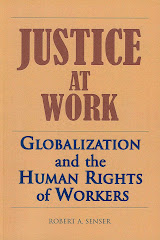
For background, see my reports under the category of John Ruggie. Also my new book, Justice at Work: Globalization and the Human Rights of Workers, has a long chapter on Ruggie’s work titled “Business and Human Rights.”
Print Page
Read more!
Thursday, August 07, 2008
Business and Human Rights To the Fore
An International Seminar on Business and Human Rights will be held in Paris December 4 and 5 to celebrate the 60th anniversary of the UN Universal Declaration of Human Rights.
Mary Robinson, former UN High Commissioner for Human Rights and chair of the Ethical Globalization Initiative, will chair the two-day seminar. Speakers will include Irene Khan, secretary general of Amnesty International, and John Ruggie, the UN General Secretary’s Special Representative on Human Rights and Business.
The purpose of the seminar, according to its announcement, is to review progress made on business and human rights and to “chart developments ahead.” Participants are expected to include “business, political, civil society, and trade union leaders as well as diverse learning from around the world.”
The December seminar is different from a “multi-stakeholder” consultation to be sponsored by the Human Rights Council at a date not yet determined. Its purpose, under the mandate for Ruggie that the Council adopted in June, is “to discuss ways and means to operationalize” the conceptual and action plan that the Council also adopted in June.
In the words of that mandate, the consultation will bring together Ruggie, “States, and business representatives and all relevant stakeholders, including non-governmental organizations and representatives of victims of corporate abuse.”
The agendas of the two meetings overlap, without duplicating each other. Many leaders will participate in both events.
As described in its newly released paper, Amnesty International, whose French branch belongs to the steering committee organizing the December seminar, endorses the work of Special Representative Ruggie and also offers him a full agenda of work that still needs to be done.
One important area is that of “extraterritorial dimensions of the state duty to protect,” which Ruggie has already studied at length. Amnesty urges him to plunge in further, and explains why:“The protection of human rights is undermined, because both company structure and globalized company operations facilitate corporate evasion of state jurisdiction…The legal framework regulating TNCs has not kept pace with the realities of globalization. This is in contrast to economic law, which is increasingly protecting economic interests beyond individual states’ jurisdictions.”
“Amnesty International,” it says in its paper, “is skeptical of the arguments of group that oppose extra-territorial regulation on the one hand, while fully supporting the development of international law and enforcement mechanisms in the areas of trade and investment on the other.”
Print Page
Read more!

 Posts
Posts