He was less than two years into a heart-wrenching job – leader of a global union whose workers endure the worst excesses of globalization. He had already visited more than 150 garment factories and textile mills on every continent.
That was in March 1990, when I first met Neil Kearney, general secretary of the International Textile, Garment, and Leather Workers Federation (ITGLWF). By chance, we were then both in Bangladesh, where he had meetings with the fledgling trade unions, some affiliates of his federation, some not.
I was there researching the country’s sweatshops. He was there to eliminate them, much to the anger of the owners and managers of the country’s garment factories, even though he wasn’t trying to eliminate the shops, just the “sweat,” or grueling conditions, in them.
This month Kearney once again visited Bangladesh, for the 50th time in 20 years, some said. But he didn't complete his tight four-day schedule, which included an investigation into reports, publicized in Europe, that a large factory was in gross violation of its worker rights commitments.
Early on the morning of Thursday, November 19, the heart of tireless Neil Kearney stopped beating. He was 59 years old.
The Bangladesh Garment Manufacturers and Owners Association (BGMEA), and several union leaders held a Thursday press conference at the employers’ headquarters to announce Kearney’s death. Together, the BGMEA and the unions started a three-day mourning period on Friday.
“We lost a great friend of Bangladesh who fought for the welfare of the core segment of our country,” Shafiul Islam Mohiuddin, the BGMEA’s acting president, said.
In Brussels, the shocked headquarters staff of the ITGLWF announced that the Federation’s congress will, as scheduled, hold its world congress in Frankfurt, Germany, on December 2-4. The planned theme, “Unionize = Decent Work = Decent Life,” will be supplemented by a celebration of how much Neil Kearney’s life has contributed to decent work and to the decent life of workers throughout the world.
* * *
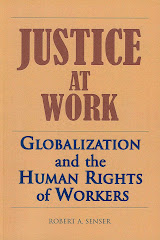
My book, “Justice at Work: Globalization and the Human Rights of Workers,” mentions Neil Kearney at points in four different chapters, but of course that falls far short of telling the full story. His action-packed life has story material for a dramatic movie, even if, or especially if, it focused on Bangladesh alone.
Print Page
Read more!
Saturday, November 21, 2009
A Tribute to Neil Kearney 1950-2009


Wednesday, April 09, 2008
Life After Corporate Codes of Conduct?
Even with factory monitoring, corporate codes of conduct can’t be relied on as the tool to eliminate sweatshops, and must be replaced by a new way to achieve that purpose. That’s the conviction of two pioneers in the anti-sweatshop movement:
-- Neil Kearney, head since 1988 of the global labor federation that now represents 10,000,000 garment and shoe workers in 110 countries, and
-- the United Students against Sweatshops (USAS), whose affiliates in more than 200 universities, colleges, and high schools just celebrated their national organization’s 10th anniversary.
Kearney, who has visited sweatshops in more than 140 countries, assesses the current working conditions in his industry as worse than they were a decade ago. In a talk to a recent European Union conference on corporate social responsibility, Kearney painted what he called “all in all, a pretty depressing picture.” The specifics he cited, according to a press release of his organization, the International Textile, Garment, and Leather Workers’ Federation (ITGLWF):
“While some reduction in child labor had occurred and health and safety had improved, wages in the sector had fallen by 25 percent in real terms over the past decade, and working hours had increased with a 60-hour work week now widely accepted as the norm…Employment was less secure, and abusive treatment of workers was more common.
“On key compliance issues like freedom of association and collective bargaining no progress had been achieved. Indeed, in some cases social auditors are promoting employer-dominated worker committees as alternatives to genuine trade unions.”
Meantime, USAS and the implementing arm it founded, the Worker Rights Consortium, have also been disappointed about achieving their anti-sweatshop goals. Factory violations of codes of conduct persisted. More serious, some key factories adhering to the code closed down in recent years. In the highly competitive global marketplace, they were not rewarded with enough business to keep them afloat.
Increasingly, therefore, especially over the past year or two, both the global garment union and USAS/WRC became convinced that code-dependent systems are too fragile. Instead of just tightening up the language and enforcement of the codes, they concluded that a new approach was needed. Both are preparing for a life beyond corporate codes of conduct. Each is working on a successor system adapted to its own environment.
But could the international labor market of the garment and shoe industries be such a jungle that it can never be civilized? Kearney and his ITGLWF are well into the process of finding out.Global Cooperation Born of a Tragedy in Bangladesh
It started during a garment factory disaster in Bangladesh in mid-2005. There Kearney had his first direct contact with Inditex, the giant Spain-based global clothing retailer, which imported from a factory whose collapse killed over 61 workers and injured many more. From low-key cooperation to bring relief to families of the dead and to the injured, Inditex and the global union went on to deal with labor problems elsewhere in the multinational’s supply chain.
“Inditex and ITGLWF soon concluded that global problems required global solutions, implemented locally,” says Kearney Late last year the two sides signed what Kearney calls a “trail-blazing international framework agreement.” Under it, Inditex recognizes the ITGLWF as the chain’s global trade union partners throughout its supply chain.
The agreement has typical code provisions -- no child labor, no forced labor, no discrimination, no excessive working hours, no unsafe or unhealthy workplaces – adds another, “payment of a living wage,” and affirms a stronger “right of all workers to unionize and bargain collectively as the cornerstone of decent work.” But to insure that the standards aren’t empty words, the agreement also puts in place a: a labor-management relationship that extends beyond the domestic and into global levels, including not only direct suppliers but contractors and subcontractors.
Does it work? The Inditex Framework Agreement now has five major garment manufacturing companies under its umbrella. About 1,100 workers dismissed for union membership or activity have been reinstated. Moreover, in February, two Inditex suppliers signed company-level agreements with ITGLWF affiliates in Cambodia. Significantly, Kearney outlined these achievements in a presentation in Phnom Penh before Her Majesty, Queen Sophie of Spain, during her visit to Cambodia..
For its part, United Students against Sweatshops has been working for two years on a plan to transform how its anti-sweatshop policies are implemented. Its “Designated Suppliers Program” would require that university logo apparel be made only in factories producing mainly for the collegiate market and certified as paying a living wage and meeting other labor standards. Moreover, it would require licensees, such as Nike, adidas, Wal-Mart) to pay those factories a price sufficient to meet those standards.
Those responsibilities of course need more than a one or two-page code of conduct. In fact, the Designated Suppliers Program needs 11 pages to spell out its requirements on transparency, the living wage standard and how it is determined, licensee obligations, implementation, and enforcement, including binding arbitration.
So far 40 major universities – including Duke, Georgetown, the University of Wisconsin-Madison, and other 1990s pioneers in adopting codes of conduct – have given written support to DSP. So far, that support has not yet reached the critical mass needed to put DSP into operation.
Both ITGLWF and USAS/WRD are engaged in heroic struggles that pit modern Davids against today’s Goliaths. What side is the U.S. government on? In a contorted act, it is on both sides. The rhetoric aims to cheer David and his side. But the administraion’s zeal for Free Trade Agreements puts it firmly on the side of multinational Goliaths.
Print Page Read more!

 Posts
Posts