So you support the right to property. Fine. But there are two kinds of right to property. Though often confused, they are so distinctly different that they are in conflict with each other.
-- One is the fundamental right of every human being to own property. (See article 17 of the Universal Declaration of Human Rights)
-- The other is the unrestricted right asserted by property owners to exploit their property to the detriment of others.
President Obama announced on September 20 that the U.S. government is joining a global effort seeking to ensure that the vast riches of the world’s extractive industries are not limited to property owners alone. Named the Extractive Industries Transparency Initiative (EITI), it a coalition of governments, civil society, and companies
About 3,500,000,000 people live in countries rich in oil, gas, and minerals – natural resources that can, under good governance, generate large revenues to foster economic growth and reduce poverty. “However,” as EITI points out, “when transparency and accountability is low, such resource revenue may result in poverty, corruption, and conflict.”
EITI has a set of 21 requirements that a government must meet to achieve EITI Compliant status. A board and international secretariat administer the standard for companies to publish what they pay and for governments to disclose what they receive. So far 29 countries have met that transparency standard. Norway was the first OECD country to do so.
The EITI Website explains:
“Transparency alone will not guarantee sound management of extractive resources but is very likely to lead to greater benefits for the people and more efficient management of the sector. The challenges for North Africa and the Middle East and other resource rich countries are immense, but the EITI is a good place to start – focusing on the industries and the revenues that could be harnessed to transform these societies.”
Read more!
Tuesday, September 27, 2011
Distinguishing your right to property


Tuesday, September 06, 2011
Exploring human rights and global economy
The New School for Social Research will hold a conference on Human Rights and the Global Economy November 9 and 10 in New York City. The wide range of subjects to be discussed include trade and intellectual property; the dimensions of human trafficking; responsibilities that flow from benefitting from global injustice; climate change and global justice; and human rights obligations of corporations.
“This public conference will engage both speakers in conversation about human rights,” says Arien Mack, professor of psychology at the New School, who is founder and director of the Social Research conference series.
For information about the conference, consult the web page at
http://newschool.edu/cps/human-rights-global-economy/
Read more!
Monday, December 06, 2010
Root Canals and the Roots of Human Rights
What is the basis for human rights? I've been wondering. The question is especially timely now that, on December 10, we are celebrating the 62nd anniversary of the UN Universal Declaration of Human Rights. I had the chance to think about its roots one day this month during an hour-and-a-half session in a dentist's chair. I was there for two root canal procedures.
Between waiting for the Novocain to take hold, X-rays to be developed, and drillings to be refined, I jotted down some ideas in the Notes & Memo pages of my July Day-Timer booklet. Here's a transcription of my scribblings:
* God creates human beings in his own image and likeness, thus bestowing on humankind a unique kind of dignity.In a real sense, everyone favors human rights, at least within a limited scope: for yourself and those close to you. Controversies flare up when you go beyond that: to your responsibilities for respecting the human rights of others, especially the weakest members of the human family.
* From early on in human history, humans violate that dignity.
* Laws, regulations, and rules of various types (ranging from the Ten Commandments to corporate codes of conduct) are written to counter the wrong-doings committed by humans.
* People gradually expand their recognition of the wrongs committed against human dignity (e.g., eventual recognition of the moral evil of slavery and compulsory racial segregation).
* Human ingenuity, however, is ever at work in devising new forms of evil (sweatshops, e.g., and causing people to be "disappeared," which is not listed in the Universal Declaration of Human Rights).
* Globalization adds a vast new dimension to human existence, one which expands opportunities both for violating human dignity and for respecting it.
Any fuzziness here I blame on the Novocain.
(Adapted from an article I published in the July 1998 issue of my website, Human Rights for Workers.)
Print Page Read more!
Monday, May 10, 2010
‘Unseemly of me to go to China’: prominent Australian writer
 In protesting against a new wave of repression in China. Frank Moorhouse (left), an acclaimed Australian journalist and writer, withdrew from an Australian government-sponsored tour of China
“Because I had been so vocal about freedom of expression in my own country, which involved no risk, and had been publicly recognized for it,” Moorhouse explained, “I felt it would be unseemly of me to go to China, to be feted and to remain silent while Chinese writers were being sent to jail.”
Moorhouse’s decision, made in January, was widely publicized in Australia. In the United States, Jeff Ballinger, noted for his “Press for Change” activism, circulated excerots frin Moorhouse’s letter by email on May 5, under the heading “all-too-rare individual – ‘unseemly of me to go to China’.”
Print Page
Read more!
Wednesday, February 10, 2010
In fashion or not, students still campaign against sweatshops
The signs are everywhere, says Newsweek, that “the age of global human-rights advocacy” is over. Everywhere? Certainly not in the ranks of the United Students Against Sweatshops (USAS) and its chapters in some 250 colleges and universities in the United States and Canada.
USAS, whose worker-rights advocacy reaches all across the world, is bringing together hundreds of student activists at a national conference at the University of Tennessee campus in Knoxville over the February 19-21 weekend. Among other things, they will celebrate a major victory for garment workers in Honduras.
“We are impressed by the social consciences of students in the United States,” a Honduran union president said after a 10-month nation-wide campaign in the United States ended in victory last month. Workers from Honduras will be at the University of Knoxville campus to describe how, against overwhelming odds, the student campaign caused Russell Athletic, a leading sportswear company, to reverse its anti-union position.
The final key to victory was the action of nearly 100 colleges and universities canceling or suspending licensing deals under which Russell Athletic makes clothing and sports equipment with colleges’ names and logos. The company’s decision came after a wide-ranging of USAS campaign that included picketing NBA finals at Orlando and Los Angeles, distributing flyers in retail outlets, and sending Twitter messages urging customers to boycott Russell products.
In the settlement, Russell agreed not only to reinstate 1,200 discharged workers but also to work with unions at its Honduran factories, eight in all. Russell’s reversal is a “giant breakthrough for labor rights in the region,” says Scott Nova, executive director of Worker Rights Consortium, USAS partner, which monitors compliance with standards adopted by dozens of colleges and universities.
As a writer and supporter of USAS since its very beginning, I am especially impressed by two things about this movement:
1. Despite the built-in annual turnover of members and leaders, USAS is pursuing the cause of worker rights with unremitting dedication.
2. It is struggling for the rights not of its own student members but of others -- workers, mostly women, whom they do not know personally and will never get to know. With a few exceptions.
Among the foreign guests at Knoxville, weather permitting, will be a delegation of unionists from Honduras. They will report on the succces of a coordinated effort and the work of repeating it throughout Central America.(For an article of mine,"Freshmen Are Teaching Elders Lessons in Global Ethics," click on http://www.senser.com/biv-4.htm.)
≈
Print Page
Read more!
Monday, January 25, 2010
Is WTO softening its posture toward human rights or is it looking for a mission?
An unwritten policy of the World Trade Organization (WTO) – that trade and human rights don’t mix – may become outdated before too long. At least, that’s a tentative conclusion that you might draw from a January 13 speech by WTO Director-General Pascal Lamy.
The headline of the WT0 press release summarized Lamy’s remarks this way: “Lamy calls for mindset change to align trade and human rights.”
Lamy expressed the point in two sentences toward the end of his text:
“It is our responsibility to coordinate our actions in a meaningful and efficient manner to ensure that trade does not impair human rights, but rather strengthens them. I am aware of the challenge that this represents, of the change in mindset this requires.”Lamy was not specific about the policy changes a new mindset would involve. Rather, he spoke in general about the ways trade can be “a positive vector for reinforcement of human rights.” For example:
“To be successful, the opening of markets require solid social policies to redistribute wealth or provide safeguards to the men and women whose living conditions have been disrupted by evolving trade rules and trade patterns.”Lamy’s topic was “Toward Shared Responsibility and Greater Coherence: Human Rights, Trade, and Macroeconomic Policy” at a three-day colloquium sponsored by two Geneva-based organizations, the International Council on Human Rights Policy and Realizing Rights.
* * *
Actually, the WTO is already much more involved in human rights than Mr. Lamy acknowledges. For the details, read my blog article, “Imbedded in WTO: Human Rights for Some,” at
http://humanrightsforworkers.blogspot.com/2008/04/imbedded-in-wto-human-rights-for-some.html
Print Page Read more!
Wednesday, May 20, 2009
Workers punished in war against unions
Private employers in the United States are relying more than ever on coercive and punitive tactics against workers seeking their legal and moral right to union representation.Those are some highlights of scandalous employer behavior, legal, illegal, and quasi-legal, described in the study No Holds Barred: the Intensification of Employer Opposition to Organizing released May 20.
Punishments include firing, threatening to fire, threatening to close the worksite, reducing wages and benefits, close monitoring of personal activities, and various forms of harassment, which in combination create an atmosphere of fear.
Further, employers often frustrate unionization by delaying the secret ballot vote that the National Labor Relations Board (NLRB) conducts to decide on union representation. In the most egregious cases, those elections were stalled by three to five years.
Evcn when the NLRB does hold an election and even when the union “succeeds in making it through all the hoops that it takes to win the election,” employers can fight on by actively resisting the workers’ right to a collective bargaining contract. In fact, according to NLRB data for the 1999-2003 period, 52 percent of newly formed unions had no collective bargaining contract one year after a successful election, 37 percent none after two years.
“Our labor law system is broken,” Cornell University professor Kate Bronfenbrenner. author of the five-year study, concludes toward the end of her 31-page report published by the American Rights at Work Foundation and the Economic Policy Institute.
A Three-Front War
Yes, the report documents that the system is broken. But it also offers the latest evidence that many individual employers and the key employer organizations in the United States are waging an aggressive war against unions and against a basic human right – the right of workers to form a union and to have it operate as a union.
So it should be no surprise that American organized business is also waging that war on two other fronts (neither mentioned in the new report):
-- It is fighting tooth and nail against the Employee Free Choice Act, which would go a long way toward fixing a broken system.
-- It is internationalizing that anti-union and anti-worker war by its relentless opposition to having free trade and investment agreements protect the rights and interests of workers and worker organizations in the way those agreements already protect the rights and interests of business people and business organizations.
In an interview published May 20 in the New York Times, Randall K. Johnson, a U.S. Chamber of Commerce vice president, questioned Dr. Bronfenbrenner’s objectivity, but did not address the substance of her report. As of 2 p.m. May 20, I could find no relevant statement on the Chamber’s Website.
Print Page Read more!
Sunday, March 22, 2009
A new book appearing on Amazon.Com
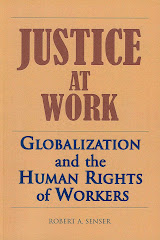
I was happily surprised today to learn that my book, Justice at Work: Globalization and the Human Rights of Workers, can be ordered through amazon.com. Later, it will also be available for on-line purchase at Barnes and Noble and Borders.
Whether bookstores will stock it depends on demand, which is still unknown, as is its easy availability outside the United States.
To my further surprise, amazon com is also selling used copies of my earlier book, Primer on Interracial Justice, published in 1982 by Helicon Press, which I have not bragged about of late because it is out of print, as well as out of date. And amazon.com is also marketing copies of a (copyrighted) review article of mine on how Solidarity won freedom of association, published by the Monthly Labor Review of the U.S. Labor Department.
As before, Justice at Work can be ordered through Xlibris, but the delivery time is not as rapid as through amazon.com.
My only disappointment is that amazon.com does not yet carry the image of my book cover. The cover is a co-production of my wife, our son Thuy, and myself. I am proud of it, and hope you will find that the book’s content matches its quality.
UPDATE: Amazon now carries the image of the book's cover. Take a look.
Print Page
Read more!
Wednesday, March 11, 2009
Pioneering worker rights as human rights
Yes, the Universal Declaration of Human Rights treats the basic rights of workers as human rights, but who takes that seriously? Roy J. Adams, a prominent Canadian teacher and author, does. And he did so long before even human rights organizations did.
In August Adams will pull up stakes from his home base at McMaster University in Hamilton, Ontario, and move 1,400 miles west to the University of Saskatchewan in Saskatoon. There, at the College of Law, he will hold the Ariel F. Sallows chair of human rights -- a milestone in academic history, since he is apparently the first teacher of labor law to be appointed to teach human rights law.
“One more indication that labor rights are being acknowledged as human rights,” as Adams puts it.
Another sign of that trend is his book, “Labour Left Out: Canada’s failure to protect and promote collective bargaining as a human right,” published by the Canadian Center for Policy Alternatives two years ago. A past president of the Canadian Industrial Relations Association, Adams has been a visiting professor or lecturer at universities and schools in 12 countries across the globe.
For more on Adams’ career as industrial relations teacher and human rights advocate, check his home page at http://www.business.mcmaster.ca/hrlr/profs/adamsr/.
Print Page
Read more!
Tuesday, October 14, 2008
Giving People Some Voice in Policy
John Ruggie, the UN general secretary’s special representative for business and human rights, has appointed Gus Ryder, general secretary of the International Confederation of Trade Unions (ITUC) to a global leadership group to advise him how to ensure that businesses worldwide respect human rights.
The group’s 15 members also include Kofi Annan, former UN general secretary and Mary Robinson, the former president of Ireland who also served as UN High Commissioner for Human Rights and is now executive director of the Ethical Globalization Initiative. The 13 other members are leaders from business, diplomacy, and civil society around the world.
Ruggie, a professor at Harvard’s Kennedy School of Government, has a UN Human Rights Council mandate to provide concrete guidance for governments, businesses, and other “stakeholders” on how they can make the UN Universal Declaration of Human Rights more universal in the global economy.
Ryder, 52, born in Liverpool, heads the world’s largest trade union body with a membership of 168,000,000 working men and women in 155 countries. The biographical list distributed with the September 22 announcement says that Ryder’s work “is based around the ITUC’s belief that our globalized world requires effective global governance.”
The UN has long debated how active it should be in promoting human rights in business. Ruggie succeeded in ending the stalemate in June this year, when he won the unanimous endorsement of the Human Rights Council for a three-year project seeking to embed human rights in the policies and practices of multinational corporations.
He succeeded because he made special efforts to consult business leaders across the globe. His new leadership group, which includes a former secretary general of the International Chamber of Commerce, Maria Livanos Cattaui of Swtzerland, continues that outreach.
(For background on this UN initiative, click here for one of my blog articles. For others, see “categories” in the right-hand column of this page, and click on John Ruggie.)
Is there a lesson here for Secretary Paulson?
U.S. Secretary Treasurer Paulson would be wise to follow Ruggie’s example. Paulson, a former top dog on Wall Street, is leading the bailout of Wall Street. In any other situation, that would be considered a conflict of interest. And it is indeed a conflict of interest, but it is unfortunately made necessary by the longtime practice of letting groups of wealthy insiders monopolize the nation’s financial policy.
The current crisis is evidence of how badly they have blundered. Appointing an advisory group of independent outside experts might be a start at making sure that the Paulson team dedicates itself exclusively to the national interest.
Print Page
Read more!
Monday, August 04, 2008
Solzhenitsyn: We beg you to interfere
I heard him speak 33 years ago, but I still remember his riveting voice and presence. My memory of the great Alexandr Solzhenitsyn, who died Sunday in Moscow, is aided by something I wrote about the powerful address I heard him deliver.
The article in which I quote him appeared in the December 1993 issue of Blueprint for Social Justice published by Loyola University-New Orleans under the title Human Rights: Ten Objections Answered. The first of those ten objections was this one: “To raise human rights issues internationally is to meddle in the internal affairs of other sovereign countries.”
I began my answer with Solzhenitsyn and his answer:
I have never heard a more devastating rebuttal to this objection than the one given before 2,000 guests in the Washington-Hilton ballroom in Washington, D.C., the evening of June 30, 1975. The speaker was Aleksandr Solzhenitsyn, author of The Gulag Archipelago and himself a former stonecutter in the Soviet Union’s Gulag.
The AFL-CIO sponsored Solzhenitsyn’s address at a time when the Carter Administration deemed it highly impolitic for the nation’s capitol to host a large public forum for such a vigorous critic of the Soviet Union. Senior government officials were conspicuously absent, but a few lesser lights from the State Department like myself, in response to a printed invitation from the AFL-CIO, attended without asking for permission.
Although Solzhenitsyn spoke in Russian, he did so with such feeling that his charisma carried over into the English translation. No part of his message evoked warmer applause than this one: “On our crowded planet there are no longer any internal affairs. The Communist leaders say, ‘Don’t interfere in our internal affairs. Let us strangle our citizens in peace and quiet.” But I tell you: Interfere as much as you can. We beg you to come and interfere.”
I went on to develop my own answer, applying it to similar objections then made by the People’s Republic of China. Among other things, I wrote: “China is sovereign, but so is the United States. There is nothing in divine or human law saying that the United States must permit the products of forced labor – which can range from socks to Diesel engines – to enter the U.S. from China. The United States can exercise its sovereign right to prevent such imports.”
To this day, the U.S. government has not been effective in preventing such imports from Communist China.
Print Page Read more!
Thursday, April 24, 2008
Multinationals, Human Rights, and UN – III
(Reporting on the Ruggie Report – III)
Can anything concrete come out of the report that Professor John Ruggie prepared for the June session of the UN Human Rights Council? After all, the report offers just a “framework” for business and human rights, not a program of action.
Yet the report is far from a compilation of abstractions. I find that it contains a bundle of specific policy ideas that, if taken seriously by the Council and even only a few major UN members, will improve the protection of individuals, organizations, and weak governments against what Ruggie calls “corporate-related human rights harm.”
Take Ruggie’s incisive criticism of the present foreign investment system. He describes how trade and investment laws have expanded the legal rights of foreign investors without matching responsibilities, and thereby undermined the State’s duty to protect human rights, “skewing the balance between the two.”
This imbalance creates human rights predicaments for both “host States” and “home States.” A major example cited by Ruggie: “host States can find it difficult to strengthen domestic social and environmental standards, including those related to human rights, without fear of foreign investor challenges, which can take place under binding international arbitration” – that is, under a procedure that often favors the investor, a flaw not mentioned by Ruggie.
His report provides enough information on this imbalance to strengthen already existing campaigns to correct it. And the various issues that Ruggie highlights should be instructive to Congress next year when it formulates U.S. trade and investment policy to replace “trade promotion”legislation and other policies conducive to moving jobs offshore. Ruggie’s insights will also be useful in the almost certain renegotiation next year of the 15-year-old North American Free Trade Agreement (NAFTA), which set the pattern for the imbalances written into subsequent U.S. bilateral trade agreements.
Another concrete matter covered in Ruggie’s “framework” concerns the Paris-based Organization for Economic Cooperation and Development (OECD), of which the United States and 39 other industrialized states are members. The OECD Guidelines for Multinational Enterprises are “currently the most widely applicable set of government-endorsed standards related to corporate responsibility and human rights,” as Ruggie points out.
In analyzing the Guidelines, he explains why and how they should be revised to make their human rights provisions more specific, and how their administration needs improvement. The case he makes is sure to assist trade union leaders and others who have long pressed for similar reforms.
So the report does indeed have much potential value on the practical level. Moving from the potential to the actual, of course, will depend on a variety of “actors,” or “stakeholders,” including the institution that commissioned the report, the Human Rights Council.
Ruggie concludes his report with this sentence: “The Human Rights Council can make a singular contribution to closing the governance gaps in business and human rights by supporting the framework, inviting its further elaboration, and fostering its uptake by all relevant social actors.”
Note the term that appears in that sentence and elsewhere in the report – governance gaps. The gaps exist “between the scope and impact of economic forces and actors, and the capacity of societies to manage their adverse consequences….How to narrow and ultimately bridge the gaps in relation to human rights is our fundamental challenge.”
He restates, and reemphasizes, that challenge in his concluding paragraphs: “As has happened throughout history, rapid market expansion has also created governance gaps in numerous policy domains: gaps between the scope of economic activities and actors, and the capacity of political institutions to manage their adverse consequences. The area of business and human rights is one such domain.”
The greatest value of Ruggie’s 28-page report, in my view, is that he contributes much toward an evolving paradigm of business and human rights under globalization. Policymakers need such a conceptual framework to make sustainable progress toward integrating business and human rights in principle and in practice.
Print Page
Read more!
Tuesday, April 15, 2008
The Latest on Business and Human Rights
What are the steps that governments could take to bring multinational corporations fully under the rule of law? That paraphrases one of the controversial questions that Professor John Ruggie of Harvard will answer in a report that he has prepared as the Special Representative of the UN Secretary General on Human Rights and Business.
The report, which will be considered by the June meeting of the UN Human Rights Council in Geneva, is expected to be released in the next week or two. Though it won’t make a splash in the media, it is eagerly awaited by many business people and human rights types.
I have been following, and writing about, the controversy ever since it exploded in the former Human Rights Council (then called a commission) when an advisory group of experts published a document entitled “Norms on the Responsibilities of Transnational Corporations with regard to Human Rights,” or Norms for short, in 2003.
The proposed Norms, distilled from UN treaties and agreements, met sharply divided reactions. At one extreme, leaders of organized business strongly opposed them, mainly because they seemed to be obligatory. At the other end, many human rights people (including me) generally favored them as a way to balance the global rights of business with some matching responsibilities.
Professor Ruggie was appointed in July 2005 to resolve the controversy. A political scientist wise in the ways of humans, societies, and the UN, Ruggie has succeeded in calming tempers. For nearly three years now, he has been vigorously proactive, talking with all groups having a stake in the controversy, persuading many of them to comment in writing, arranging for authoritative reports on specific points, and publicly communicating his approach in a series of speeches and articles. One of his first acts was to bury the term “Norms,” which had become overburdened with emotions.
A by-product of Ruggie’s openness and transparency is that the complex issues involved are now on the public record, thanks to an archive maintained by Business and Human Rights Resource Center, headquartered in London with offices in Hong Kong, South Africa, and the United States, and world accessible through a voluminous Website.
So we can already know where Ruggie stands on most points at which business and human rights intersect. Most refreshingly, his stance is one that recognizes the complexities of his project, and does not oversimplify them with easy slogans appealing to one side while infuriating the other.
At an international business forum held at the World Bank last October, Ruggie discussed his perspective on business’s twin roles as rule makers and what he calls “rule takers.” Here is an excerpt from his remarks, lengthy because his insights are not easy to summarize and because they tip off what will almost certainly be a major aspect of his upcoming report:Business already is deeply involved in global governance—quite apart from its influence on individual governments. Employers associations, along with labor, have been constitutionally represented in the ILO since 1919. Today, business participates as a rule maker in such diverse areas as setting global telecommunications standards and protecting intellectual property rights.
Through bilateral investment treaties and host government agreements, companies can seek to insulate their direct foreign investments from future legislative or regulatory changes in host countries, including policies that promote human rights. And they are able to proceed directly to binding international arbitration, bypassing the host country’s courts, if they believe that their investments are adversely affected by such regulatory changes.
But while business has become a direct participant in the system of global governance, it has proven a far greater challenge to render it subject to international rules for harms committed abroad—to make business a global rule taker, in other words. For example, a parent company generally is not legally liable for wrongs committed by an overseas subsidiary, even where it is the sole shareholder, unless the subsidiary is under such close operational control by the parent that it can be seen as its mere agent. And sourcing goods and services from contracted suppliers generally is considered an arms-length market exchange, even for sole suppliers, not a related-party transaction.
To be sure, each legally distinct entity within a corporate group or network is subject to the laws of the countries in which it operates. But host country governments and courts often are unable or unwilling to confront major global corporate players. And the group or network as a whole is not governed directly by international law.
In short, we see an emerging trend whereby business as rule maker increasingly operates in a single global economic space; but business as rule taker largely continues to operate in the world of separate national jurisdictions, with only a thin overlay of relatively weak international institutions and legal instruments.
In the area of human rights, the main bridges between these two worlds are lawsuits where they are permitted, thus far primarily under the US Alien Tort Claims Act; “naming and shaming” campaigns by NGOs; and self-governance or multi-stakeholder initiatives that corporations adopt voluntarily.
To put it simply: we need stronger bridges. History suggests that such a pronounced divergence between rule maker and rule taker may not be politically sustainable—that pushback against globalization driven by increased populism, protectionism and various forms of fundamentalism is likely to occur unless ways can be found to establish more effective transnational means of governance, covering all key international players, including business.
Many who speak for victims of corporate related human rights abuses have advocated drafting a binding international legal instrument as their preferred answer. But let us recall that the recently adopted United Nations Declaration on the Rights of Indigenous Peoples was twenty-two years in the making—and it is not now, nor will it soon become, a legally binding treaty. So whatever long-term aspirations one has, and however meritorious they may be, victims cannot wait a quarter century—they need help now.
My own approach to this challenge is to build up from what we’ve got—and aim to close “law free” zones where they exist.
Call that a carefully charted path between opposing arguments. It is more accurate, I believe, to say that Ruggie is trying to establish a common ground -- a new paradigm -- for business and human rights that the corporate world would be wise to recognize. His upcoming report promises to outline a major step in that evolving process.
Many people see no need for such a new paradigm for business. They accept the prevailing paradigm as a good one, subject perhaps to some tinkering, but essentially the best achievable, at least for this generation. Naturally, they oppose Ruggie’s enterprise and any cooperation with it.
But many others, although agreeing that the prevailing paradigm does not promote an inclusive globalization, contend that Ruggie’s paradigm is unsatisfactory for one reason or another. They, too, can make a contribution by presenting a paradigm that might be better.
For me this is not a one-time story, but a developing one with dramatic consequences for the future, whichever way it goes. I’ll be following it closely. So keep tuned to Human Rights for Workers Too by bookmarking http://humanrightsforworkers.blogspot.com/. See you there again soon.
Print Page
Read more!
Saturday, April 12, 2008
Imbedded in WTO: Human Rights for Some
Does the WTO promote human rights? No, it does not. At least that would be the unqualified answer of the WTO and trade experts generally. But that answer should be qualified, and one trade expert, Susan Ariel Aaronson, nails down a partial qualification in a new study.
“Human rights are seeping into WTO deliberations and activities,” says Aaronson, associate professor in the business and international affairs schools at George Washington University and co-author of "Trade Imbalance: the Struggle to Weigh Human Rights in Trade Policymaking" (Cambridge 2008).
Aaronson makes clear that the WTO has no mandate on human rights and that the various trade and investment agreements under its umbrella make no explicit mention of human rights as such. Yet “a wide range of human rights concerns” arise in day-to-day WTO operations, and she documents examples in the following categories:
-- “Members use trade waivers and exceptions to promote human rights at home or abroad.”
-- “They occasionally bring up human rights during accessions and trade policy reviews.”
-- “They have amended the TRIPS agreement to make it clear that nations can use the public health exception to TRIPS in times of public health emergencies.”
-- “Human rights concerns have even entered into trade negotiations (e.g., food security).”
John Ruggie, the UN secretary general’s special representative on business and human rights, who is preparing a report on business and human rights for the UN Human Rights Council, commissioned Aaronson’s study. Her overall conclusion is that although nation-states are limited by WTO agreements in their ability to advance human rights, they still have a good deal of leeway to do so at home and abroad.
Outside the paramaters of this study is another fascinating dimension to the global network of trade and investment agreements. Here, too, there is no explicit mention of human rights, but that doesn’t mean they are non-existent.
Actually, human rights linkages are evident in a surprising number of WTO trade agreements. That’s especially so for two major WTO concerns: the protection of intellectual property rights and the protection of the rights of foreign investors. Check the Universal Declaration of Human Rights. Its article 27 proclaims the right to the protection of various types of intellectual property; and article 17, “the right to own property alone as well as in association with others” and the right not to be arbitrarily deprived of property.
These particular human rights are implemented at the WTO (or multilateral) level by two key global agreements: more than amply by the “Trade-Related Aspects of Intellectual Property Rights” (TRIPS) agreement and, less satisfactorily (from the typical investor’s perspective) by the “Trade-Related Investment Measures (TRIMs)” agreement.”
Country-to-country (bilateral) agreements carry this implementation even further, with TRIPs and TRIMs protections strengthened beyond WTO requirements. Take, for example, the administration’s trade agreement with Colombia, which Congress has just shelved. The Colombia FTA devotes
-- 33 pages to protecting intellectual property rights, 11 of them on enforcement alone
-- 35 pages to protecting foreign investment, very broadly defined, 13 of them on enforcement through dispute settlement procedures in which only the investor can bring a claim.
Again, there is no mention that the rights involved are human rights. That omission holds true for a bundle of other WTO-protected rights in this FTA, as well as across-the-board in all multilateral and bilateral trade agreements.
This is not a semantic quibble. It is an issue that leads to a fundamental question: is the present global trade regime serving the common good or not?
In response to demands that the WTO start protecting the human rights of workers, the usual answer is that the WTO does not do human rights. The truth is otherwise. The WTO does indeed do some human rights, and that limited mission is imbedded in the policies and rules of the whole trade and investment regime.
Open acknowledgment of this fact – by putting an end to mislabeling – would turn the spotlight on who now benefits from the human rights provisions that the WTO promulgates globally, but under other names. Such transparency would reveal the way that selected human rights are woven into the very fabric of the WTO. It would expose the inequity, the lack of inclusiveness, of a WTO system that ignores the human rights of stakeholders indispensable to the global economy – the world’s working men and women.
My congratulations to Professor Aaronson for her provocative study. It should be complemented by an analysis on how extensively the WTO and its agreements support the human rights of global business without acknowledging the human rights principles of the enterprise.
Print Page
Read more!
Saturday, March 29, 2008
HOORAY! A Little Step Forward
At long last, cross-border investing is in the spotlight for something other than money-making. It is starting to get attention for its effect on people other than the investors themselves.
Here’s what’s happening. Over the years international agreements – numbering at least 2,500 - to protect the rights of international investors have proliferated to the point that they cover most of the globe. Now, there is growing challenge to the ubiquity of those agreements and increasing pressure to have the protected investment rights balanced with corresponding responsibilities. Or (from another perspective) to balance investor rights with corresponding rights of host governments and their citizens.
Last November, the 19 governments that are member states of the Common Market for Eastern and Southern Africa, Comesa for short, took a pioneering step by adopting an area agreement that will, when put in effect, cover private investment flows into and within Comesa. Its terms will include minimum requirements on labor standards and respect for human rights.
Another sign of the way the breeze is blowing: a two-day meeting in Singapore last October brought together more than 30 government officials who negotiate international investment agreements for over 25 countries. Briefings by experts served to strengthen the negotiating capacity of developing countries in light of three circumstances:-- The increasing complexity of the model agreements proposed by the United States, Canada, and other major countries.
-- The stark disadvantage faced by developing countries when dealing with wealthier nations, which throw greater resources into the negotiating process.
-- The uncertainties of investor-state arbitration in settling disputes.
The meeting enabled the developing country negotiators to network and to share ideas on how to achieve an appropriate balance between the need to attract more foreign direct investment and the need to serve the country’s own public policy directives.
Developing countries don’t have the help that rich countries get from their Paris-based Organization for Economic Cooperation and Development (OECD). But the Singapore meeting was only the beginning, as indicated by its formal name: the First Annual Forum of Developing Country Negotiators.
The forum’s co-sponsor, the International Institute for Sustainable Development, has just made another contribution toward highlighting the significance of “International Investment Agreements, Business and Human Rights: Key Issues and Opportunities.” That’s the title of a 43-page report that the Institute’s Howard Mann prepared at the request of John Ruggie, the UN Special Representative on Business and Human Rights.
The report addresses this basic question: Does the present international investment agreement (IIA) regime play a positive role in embedding human rights principles into the values and institutional practices of global capital markets?
Answer: No, it does not, and it often plays a negative role by preventing a government from requiring a foreign investor to respect the country’s own labor and environment regulations. ”IIAs limit the right of states to regulate, and these limits may extend to the state duty to protect and promote human rights,” the report states.
Investment agreements go into great detail on the rights of foreign investors and how those rights can be enforced. But “there is no enforcement mechanism against [foreign] corporations, as there are no obligations falling upon them.”
The Institute’s report received no attention from the media. Hopefully, its message will live on, however, since Ruggie will draw on it for a report to the Human Rights Council later this year.
Why do I keep harping on this subject? Because:1. International investments are a major force in shaping globalization.
2. Investment policy, as written and enforced, now takes priority over the labor policies of governments in the developing world.
3. This absence of pro-worker policies facilitates the job outflow from the United States and other industrial countries.
4. Reform of investment agreements is absolutely necessary, and future trade negotiations must insure that investment agreements balance the rights of foreign investment with corresponding responsibilities, including the responsibility to respect the human rights of workers.
5. Current demands to reform trade and investment policy fall short in that they neglect to cover the practices discussed in the IISD report.
Print Page
Read more!
Thursday, March 13, 2008
How Not to Win Bipartisan Support
President Bush objects strenuously to Senator Hillary Clinton’s support for a Congressional “time out” on deciding any more trade agreements this year. He certainly has a right to speak up in support of his trade program. But he has no right to distort Senator Clinton’s position.
He did so on March 12 in a long speech to the U.S. Hispanic Chamber of Commerce. Without mentioning her name, he claimed that she supports “a timeout from trade,…a timeout from growth, a timeout from jobs, and a timeout from good results.”
Mrs. Clinton’s position is a bit less sweeping. For one thing, she knows that, even without new trade deals, trade will continue to flow. Last October she included her call for a time-out in a speech in Iowa, and she later explained her reasons in a USA Today interview. She said, in part:
“I think that on balance, trade was a net positive for America and American workers during the 20th century….We have to consider carefully, What’s the role of trade going forward? How do we best position the United States to take advantage of the global economy?’ And I don’t think we’ve had serious conversation about that.”
Bush no doubt thinks all that is already settled. But that’s not enough reason for his fear-mongering about “isolationist policies and protectionist policies” that would “stop trade, erect barriers, try to wall ourselves off from the world” – positions that nobody in Congress holds. It also wasn’t the best way to win friends and influence people on the Hill.
Yet Bush used that high-visibility event, attended by six Cabinet members, to threaten to force a vote on a trade agreement with Colombia after it returns from its Easter recess. He was technically able to do that under the power he still holds under the President’s Trade Promotion Act, which expired last July when Congress refused to extend it. Wielding that club of executive power now, however, no longer strikes cringing obeisance.
The most forceful response that I’ve seen came from Change to Win, the partnership of seven unions that broke off from the AFL-CIO in 2005. Recalling that Colombia remains the most dangerous country in the world for unionists, a Change to Win press release urged Congress to reject the deal with Colombia because (as its new ad says)“Americans don’t trade with death squads.”
James P. Hoffa, head of the Teamsters and a Change to Win leader, added: “Workers need trade policies that create jobs. They don’t need more deals that destroy jobs. Voters across the country are making the point increasingly clear every time they go to the polls. America is hemorrhaging jobs because of the so-called free trade agreements. That must be stopped.”
Back to President Bush and his support for choice in the supermarket.
I couldn’t help getting a kick about one additional reason he gave for wanting Congress to hurry up and approve more free trade agreements. “We want our consumers to have choices when they walk into markets,” he said. “The more choices available, the better it is for a consumer.” But this traditional argument is somewhat outmoded.
Have you walked into a store recently to buy a product made in the United States? If so, you know how restricted your choices are. Globalization, whatever its wonders, has in too many cases narrowed our choices to goods made in China. This is especially troubling to anyone (like me) anxious to avoid buying anything from a country that is the sweatshop for the world, the home of forced labor camps, the jailer of dissidents, and the persecutors of religion.
In their 1980 book, “Free to Choose,” Milton and Rose Friedman portrayed the act of making a purchase in a store to casting a ballot in a voting booth – an essential part of economic freedom. President Bush did not use that comparison in his speech, but the Friedman point does make some sense as one way to measure the impact of trade.
Last year the United States imported a record volume of goods from China: $321,507,800,000 worth in all, according to the Commerce Department. Personally, I see it as 321,507,800,000 votes for China’s human rights policy. Yes, all too often, I voted the same way. I really tried not to, even by doing without, but usually I had no choice.
Print Page Read more!
Tuesday, February 19, 2008
Personal Reflections on the Holocaust
I try to read something on the Holocaust each year during Lent. Two books I read in past years were “Hitler’s Willing Executioners: Ordinary Germans and the Holocaust” by Daniel Jonah Goldenhagen and “Nazi Terror: The Gestapo, Jews, and Ordinary Germans.” This year I re-read a long magazine article by Dr. Sherwin B. Nuland about his two-day visit in 2004 to the U.S. Holocaust Memorial Museum in Washington, D.C.
Nuland, professor of clinical surgery at Yale School of Medicine, found the Museum “a place to learn, to look within oneself, and to ponder the nature of our shared humanity.” In addition, because he was there during an extraordinary exhibition on ”Deadly Medicine: Creating the Master Race,” he reflected much about his personal responsibilities as a doctor, and especially about how he might have acted had he been practicing in Germany during the Nazi years:
“It had always seemed obvious to me, and to the several colleagues with whom I discussed it over the years, that none of us would ever have fallen prey to such delusions as the justification of euthanasia and genocide.”
After “Deadly Medicine’ he was no longer so sure. He now feared he may have been swept along by each of the eugenics movement’s “small steps” that, at least in the early stages, did not appear dangerous, and were supported by “highly regarded scientists.”
Nuland’s self-examination shook him deeply. In The New Republic of September 13/20, 2004, he wrote: “To my startled dismay, I found myself understanding why much of the German medical establishment acted as it did. I realized that, given the circumstances, I might have done the same.”
The “Deadly Medicine” exhibit, and Nuland’s eight-page review, traced how the international eugenics movement – its dedication to improving the “purity of the human race by better breeding” – led to Hitler’s program of “ridding Germany and eventually Europe of the pestilential disease of Judaism.” Under medical science’s stamp of approval, “who but a few visionaries would see any danger in the promotion of purity?”
Nuland’s own profession cooperated widely and willingly with the Holocaust: “No association or guild was more complicit in the rise of Nazism and the desecrations committed by its leaders and followers than the profession of medicine, in the form both of its organizations and its members.”
How could this happen to members of such a noble profession? Among other reasons: “their failure to recognize a basic fact about the scientific enterprise...Neither medicine nor science itself derives its ‘truths’ in the thoroughly detached atmosphere in which its practitioners would like to believe they work…There is no such thing as a thoroughly detached scientific undertaking.”
Reflecting on the Holocaust is for me, too, a moving experience. If my father, an ethnic German, had not migrated to the United States, I might have lived through the days of Nazi rule.
That thought disturbs me. It stems from an honest self-appraisal of the kind that Lent calls for. And it leads to a prayerful reaffirmation to dedicating myself to the cause of human rights for all.
Read more!

 Posts
Posts