Showing posts with label Worker Rights. Show all posts

Thursday, February 18, 2010

Tooting my own horn: 14 years of Human Rights for Workers

I have no idea how many people read this Weblog, Human Rights for Workers, but I get enough positive reactions to energize me to go on. In the past few weeks, I received heartening emails from three people:

“Thank you for your tireless crusade to promote human rights for workers.” – G. Rajasekaran, secretary general, Malaysian Trades Union Congress, Subang Jaya, Malaysia, January 31.

“Always a pleasure to read you.” -- Marie-Claude Hessler, human rights activist, retired lawyer, Paris, February 11.

“Happy New Year and thanks for your admirable persistence in reminding us of some inconvenient truths.” – John Langan, S.J., professor of Catholic Social Thought at Georgetown University, January 2.
Each letter commented on a specific article. Father Langan, for example, had this to say about my posting titled ‘Economic suicide is not an option’: “This one-pager is, I think, exceptionally clear and helpful.”

Why am I basking in such shameless self-promotion today?

Blame it on my mood, which became exuberant when the sun broke through after days of blizzards. Or maybe I just couldn’t think of another way to introduce some news: Human Rights for Workers is now 14 years old, 14 years under the same one-person staff.

I launched HRFW on February 14, 1996, a cyberspace pioneer devoted to the question: “What’s happening to working men and women in this era of globalization?” After mutating into a Weblog with the same name two years ago, it still focuses on that basic question. So do many other sites and blogs now, each in its own way. There’s so much company that it’s impossible to keep up with it all.

Why don’t I, at long last, go into full retirement, and leave the field to all those newer and better staffed endeavors? There's one problem, if I did that. What on earth would I do for enjoyment?

We’ll have a party when HRFW turns l5. I’ll send you plenty advance notice.

Print Page Read more!

Sunday, February 07, 2010

AFL-CIO offers a “just” trade policy for the 21st century

“We cannot afford another trade agreement that privileges substandard new opportunity for investors over good jobs for workers,” the AFL-CIO says in testimony for the U.S. Trade Representative (USTR).

In the 34-page document the AFL-CIO presents its views on crucial elements of the proposed Trans-Pacific Partnership Trade Agreement (TPPTA), and says it is looking forward “to working with the Obama Administration to create a just trade policy for the 21st century.”

U.S. negotiations are set to begin in mid-March with TPPTA, involving at least seven Asia-Pacific governments. The United States already has bilateral free trade agreements (FTAs) with four of them: Australia, Chile, Peru, and Singapore.

A remarkable feature of the AFL-CIO position is that it deals with far more than strictly trade union issues, narrowly defined. For example, among “new issues for consideration,” it lists “valuation of currency” as an important trade union issue now ignored by existing agreements. “The U.S. cannot effectively export to countries that intervene systematically to keep their currency artificially low in relation to the dollar, as China, in particular, is doing.”

Only seven pages of the submission to USTR are devoted to improving the labor chapters of existing agreements. By contrast, the paper has 17 pages of non-labor chapters on issues that need to be improved. Among the most important are those that would fall in chapters on:

Investment.
This seven-page section emphasizes that foreign investors in the U.S. can now “claim rights above and beyond those that our domestic investors enjoy,” and that this broad definition of investment should be narrowed to cover “only the kinds of property now protected by the U.S. constitution,” thereby excluding claims for losses from expected profits not met, for example.

Another examples of a recommended change in the investment template: a hostgovernment will be permitted to ensure that investment activity is conducted in a way sensitive to environmental and labor rights.

Procurement.
A government will have the right “to require a supplier to comply with generally applicable laws regarding fundamental principles and rights at work.”

Intellectual property.
“Our FTAs have provided excessive protection for the producers of brand-name pharmaceuticals,” thereby jeopardizing access to affordable medicines, particularly to developing countries.

Consumer protection.
Both our domestic and trade policies must be crafted to prevent dangerous consumer and industrial goods from reaching our shores. Safety inspectors should get enhanced rights to inspect the facilities of a country exporting toxic products.

(The full text of the AFL-CIO submission is available at
http://www.regulations.gov/search/Regs/home.html#docketDetail?R=USTR-2009-0041
Scroll down to USTR2009-0041-0100.)

Print Page Read more!

Sunday, January 31, 2010

Searching for ways to enlighten worker rights illiterates

How do you talk about worker rights to people who are illiterate about worker rights issues?

The question occurred to me because of a new survey that reveals what the New York Times calls “widespread political illiteracy” among Americans. The “News IQ Test,” conducted in early January by the Pew Research Center, found that only
-- 26% of the respondents knew that it takes 60 votes to break a filibuster in the Senate.
-- 36% knew that no Republican voted for the Senate health care bill on December 24.
-- 39% knew that the Majority Leader of the Senate is Harry Reid.

There may be a lesson here for those of us trying to convince the public that globalization, especially its trade system, needs a reform that incorporates the human rights of workers. How can we frame the issues so that the public understands what we’re talking about?

The old expression “social clause” – as in adding a “social clause” to trade agreements -- is inadequate and fortunately out of fashion. Yet we don’t have a phrase that captures the popular imagination. The goal of “decent work for everyone” comes closest.

It is a term embraced by the UN International Labor Organization in its strategy for a global coalition to support decent work. But what do you mean by “decent work”?

Here is a definition developed by Pope Benedict XVI in his encyclical, Caritas in Veritate:

“What is meant by the word ‘decent’ in regard to work? It means
• work that expresses the essential dignity of every man and woman in the context of their particular society:
• work that is freely chosen, effectively associating workers, both men and women, with the development of their community;
• work that enables the worker to be respected and free from any form of discrimination;
• work that makes it possible for families to meet their needs and provide schooling for their children, without the children themselves being forced into labor;
• work that permits the workers to organize themselves freely, and to make their voices heard;
• work that leaves enough room for rediscovering one's roots at a personal, familial and spiritual level;
• work that guarantees those who have retired a decent standard of living.”

With that comprehensive definition in mind, “decent work” is a great goal, but I’m afraid that, alone, it wouldn’t score very high in a Pew News IQ test.

Print Page Read more!

Sunday, December 06, 2009

Linking Trade and Labor via the WTO, or much sooner

Why do China’s people spend so little compared to Americans? A major reason is that China’s workers are paid so little for their work.

That pretty much sums up an article on “The Frugal Republic” by James Surowiecki in the December 7 New Yorker.

“While [China’s] boom has been extraordinary, ordinary workers have not reaped the gains one might expect,” Surowiecki writes. “In the past decade, in fact, the share of GDP that goes to wages has actually fallen, while the share that goes to profits has risen.” Further, only a small fraction of the workforce receives unemployment benefits, and pensions are underfunded and haphazardly administered.

No wonder, then, that household consumption in China accounts for 35% of GDP, only half the rate of the United States, as the New Yorker financial writer points out, adding:

“Ultimately, all China’s barriers to higher consumption are a product of the fact that for the past three decades the entire economy has been focused on one thing: making stuff. The Chinese and American and American economies are mirror images of each other.”
In short, China makes things; the United States (and other countries) consumes them. An unsustainable imbalance, meaning that it can’t last.

A drawing accompanying the New Yorker article shows a Chinese woman packing fancy high-heeled shoes coming off an assembly line. The worker is in her bare feet, shoeless.

As early as a half century ago, many unions foresaw that kind of umbalanced result from free trade – workers deprived of their share of the benefits from working in the international economy. The unions argued for adding a “social dimension” to trade agreements.

What if their idea had been accepted then? Wisely implemented, it could have served as a guideline for a half century of trade agreements more balanced than the worker-unfriendly policies that now prevail.

The idea is not dead, but it needs updating for the 21st century. Since the global economy has exploded, especially in the past 15 years, the original concept would have to be buttressed with a set of other provisions ensuring that the complexities of globalization and its various institutions serve the common good.

Toward that end, the International Trade Union Confederation and its Global Union partners last month prepared a statement of priorities for the WTO Ministerial Conference held in Geneva November 30 to December 2. The conference was not a negotiation session, so it is impossible to know for sure what effect the statement, and the 60-member union delegation promoting it, had on the ministers.

One positive sign: in summing up the conference, its chairman cited “trade and social issues” as among the “new” topics that the WTO needed to address to conclude the stalled Doha Development Round next year. A high-level preparatory group is to meet in mid-December to consider those issues.

But it could be too late. New WTO policies take years to adopt, more years to enforce.

At the Geneva conference Ron Kirk, the U.S. Trade Representative (USTR), emphasized that trade can, and should, help the economic recovery “right at home – particularly in terms of creating the well-paid jobs that Americans want and need.” (See “In Geneva and in Washington the call is for Jobs, Jobs, Jobs.”)

In an interview with the Associated Press, Ambassador Kirk voiced his impatience with WTO procedures. “The whole notion of everything taking 10 years, 15 years, and 20 years is just antithetical to me,” he said. “The world changes too quick. Competition is too fierce. The consumers, businesses, workers can’t often wait 20 or 30 years just to get a result.”

Will the Obama administration, having become more job-conscious, set its own job-creation link to trade? It’s a safe bet that experts are pouring over all the options, before checking where WTO boundaries may or may not exist.

Print Page Read more!

Thursday, December 03, 2009

In Geneva and in Washington the call is for Jobs, Jobs, Jobs

In his speech on the morning of the last day of the WTO Ministerial Conference in Geneva, U.S. Ambassador Ron Kirk only hinted at all that he had in mind. At a working session on the WTO’s contribution to development, Kirk, the United States Trade Representative (USTR), spoke of what “remains the linchpin to our efforts” to bring the stalled Doha negotiation round to a successful conclusion.

That, he said, “will require market-opening initiatives from all key players – not only developed but also advanced developing countries, commensurate with their role in the global economy.”

In a statement that afternoon, December 2, he reaffirmed the Obama administration’s commitment to a Doha agreement favorable to the poorest countries, but also emphasized another economic necessity:

“In the United States, we recognize that trade can be an important pillar of global economic recovery and of recovery right at home – particularly in terms of creating the well-paid jobs that Americans want and need.”
Then in subsequent talks with reporters Ambassador Kirk was more specific.

“We are turning out attention almost full time to how we can create jobs and continue to grow the economy,” he told the Associated Press. “Too many Americans believed…that our previous trade policies had been overly generous to our partners.”

So far what is offered on the negotiating table, he told the Wall Street Journal, doesn’t give the United States “meaningful market access in the part of the world that will be growing and driving GDP growth over the next few years,” referring to countries like China, India, and Brazil.

The Business Standard of India quoted Kirk along the same lines: “The United States has been clear that we will need to achieve meaningful opening of markets that results in significant new trade flows – China, India, and Brazil, and South Africa.”

Meanwhile, Washington was preparing for a White House “Jobs Summit” on December 3 with the participation of business, labor, academia, and non-profit groups on how to put Americans back to work.

The Alliance for American Manufacturing called for “aggressive action to spur manufacturing job creation.” On the AFL-CIO blog, the call was for Jobs, Jobs, Jobs.

Lori Wallach, director of Public Citizen’s Global Trade Watch division, issued a statement on December 2 calling for replacing the Doha Round agenda with a WTO “turnaround plan.” “Ten years after the world’s most powerful governments and corporations failed to launch a massive WTO expansion at the 1999 WTO Ministerial,” she said, “there is still no WTO expansion. BUT, there also is still no WTO turnaround, and the current rules are causing major damage on many fronts.”

Print Page Read more!

Tuesday, November 17, 2009

Justice at Work: too optimistic?

Professor David Cingranelli, professor of political science at Binghamton University, got an “error’ report when he tried to leave a comment on my November 14 blog. He did finally get through by regular email with the following critique.
I’ve been thinking more generally about your arguments in your excellent new book, “Justice at Work: Globalization and the Human Rights of Workers.” I love the book, but I think you are way too optimistic about the potential of Corporate Social Responsibility, anti-sweatshop movements, personal boycotts, and fair traded goods movements as ways to deal with the most negative effects of globalization on workers.

I also think national policies like the [proposed] prohibition on spending taxpayer dollars for goods made by forced child labor make Americans feel good, but are similarly ineffective. There are few incentives for US politicians to enforce the provisions of laws such as these, and, more importantly, if the unethical producers of such goods don’t sell them here, they will sell them somewhere else.

Only international norms promulgated by the United Nations through the ILO and enforced by the World Bank and IMF can effectively solve these problems. IMF and World Bank leaders resist this idea. But, unlike the WTO, both of these institutions are Specialized Agencies of the United Nations, and the United Nations’ twin missions, according to its own charter, are to promote peace and human rights. No UN entity can say that the promotion of human rights is not part of its own mission. In your blog you have reported on some small steps taken by the World Bank towards this end, but much more remains to be done.

Current policies of the IMF and World Bank are actually leading to reduced government respect for a wide range of human rights around the world. This fact is well documented in my recent book with Rodwan Abouharb, Human Rights and Structural Adjustment (Cambridge University Press, 2007).

Chapter 9 presents the results of a global, comparative study showing that, other things being equal, the longer a developing country has been under structural adjustment programs, the worse its respect for workers’ rights including freedom of association and collective bargaining.

Thank you for providing so much good information about the effects of globalization on the most vulnerable of the world’s workers. While I disagree with some of your opinions, your voice has helped me refine my own thoughts about this important subject.

-- David Cingranelli, professor of political science, Binghamton University.

(An undergraduate class of his had a two-week, six-hour discussion of Justice of Work.)

Print Page Read more!

Wednesday, November 11, 2009

Moving to stop spending taxpayer money on sweatshop goods

The Federal government, according to official policy, can and does buy supplies made in sweatshops, foreign and domestic. A grassroots movement to change that is gaining strength.

Short of the federal level, 39 cities, 15 counties, eight states, and over 100 public school districts have already adopted procurement rules to ensure that the uniforms, shoes, and other products they buy for police, fire, and other public employees are not made in sweatshops.

Laying the ground work for extending such a ban to the Federal level was a major focus of the sixth annual “Sweatfree Communities summit” held in Washington, D.C., November 6-8.

“There’s a big gap in federal procurement policies,” says Bjorn Claeson, executive director of Sweatfree Communities, the non-profit organization that unites the movement.

A potentially ground-breaking document, “Principles for International Sweatfree Federal Government Procurement,” was released at a forum held on Capitol Hill on January 6. It is a five-page working draft compiled by Claeson with contributions from the AFL-CIO, the Change to Win union alliance, the International Labor Rights Forum, and other like-minded organizations.

To help member governments meet their sweatshop-free purchasing goals, Sweatfree Communities has recently formed the Sweatfree Purchasing Consortium. Still in the developing stages, it has two core functions:

-- Connect government buyers with suppliers pre-screened as sweatfree.
-- Serve as the contact and coordinating points for monitoring suppliers, investigating complaints, and achieving effective remedies.

Might any of these efforts conflict with the rules of the World Trade Organizations? Briefly, no; they are “WTO compliant,” says Claeson, whom I interviewed by phone.

Unfortunately, because of heath problems, I was unable to attend the summit. But I am impressed by what I read on two Websites and what I heard from Claeson. This is a movement whose time has come.

The two Websites, http://www.sweatfree.org, and a separate one for the consortium, http://buysweatfree.org, contain a surprising wealth of information. A particularly useful one for ordinary shoppers is the 2009 Shop with a Conscience Consumer Guide, with listings for women’s wear, men’s wear, baby clothes, footwear, outerwear, T-shirts, and sports equipment.

Among the 2009 Sweatfree Summit co-sponsors not mentioned here before are these: the Catholic Relief Services, the United Methodist Church Global Ministries, and Georgetown University Law School, which hosted all the sessions except for the one on Capitol hill.

Print Page Read more!

Thursday, October 22, 2009

U.S. Reviewing Urgent Question: Link investor rights with duties?

“We feel this is a critical moment to take a fresh approach to bilateral investment treaties and the investment chapters of trade agreements….We look forward to working with the administration to [establish] a whole new framework for the governance of international investment that protects the public interest in the United States and abroad.”
So says a “collective statement” by representatives of labor, environmental, and economic development groups in a report prepared at the administration’s request for its review of U.S. policy on cross-border investment.

Among the concerns raised in the statement was that current investment rules “provide sweeping protections for U.S. investment abroad, without commensurate investor obligations,” thereby facilitating and accelerating the movement of U.S. jobs, production capacity, and technology.

“Strong labor provisions and a record of effective enforcement of those provisions should be a precondition for any negotiations, [but] they are not enough,” the statement adds. “A whole new framework is needed to reverse the devastating impacts of offshoring on U.S. workers and communities.”

Any such reversal will require detailed revisions of a 2004 document called the “Model BIT,” which serves as the official guide for negotiating bilateral investment treaties and the investment chapters of regular free trade agreements.

The present model is tilted too far in favor of investor rights. Among the recommended changes to restore balance, all opposed by business groups, are these:
-- Favoring cress-border investors with no rights more extensive than those granted investors under the U.S. constitution.
-- Clarifying the meaning of “indirect expropriation” (against which the investor is protected) so as to ensure, for example, that a government will not be restrained from, and penalized for, improving health, safety, environmental, and other legitimate public welfare objectives.
-- Changing the present arbitration system of dispute settlement to one involving only governments (state-to-state), among other reasons because outside arbitrators are not qualified to determine the public interest at stake.
China's Mercantilism a Major Threat

Another important change would try to create “a level playing field” globally between private enterprises and those “state-owned” – meaning particularly those owned by the People’s Republic of China.

That change is urgent for several reasons cited in the statement. For example:

-- “China engages in trade based on mercantilist principles, and has a strategic industrial policy meant to create and expand industrial sectors with the intent of becoming dominant within China and globally. In fact, China has targeted ten sectors or ‘pillars,’ including steel, telecommunications, and aerospace. To achieve dominance, the Chinese government subsidizes home-grown industries (commonly SOEs, or state-owned enterprises), manipulates its currency for export advantage, and insulates its domestic enterprises from foreign competitors in a host of ways.”

-- “As investment flows into the United States continue to grow [by over 70 percent since 2004], it can be anticipated that the U.S. market [for foreign investment in the U.S.] will expand substantially. Consequently, BITs can no longer be viewed solely as a package of rights and obligations to protect outward investment by U.S. investors in less developed nations. BIT obligations apply with equal force to investments within the United States by foreign companies and governments, including SOEs.”

The collective statement quoted above is signed by nine persons, including Linda Andros of the United Steelworkers, Matthew Porterfield of Georgetown University’s Institute of Public Law. and Martin Wagner of Earthjustice.

Their statement is part of a long document that also reflects the views of business interests as formulated by other eight persons. That document in turn is part of a much longer report submitted to the Secretary of State on September 30.

I have highlighted, mostly be direct quotation, those parts of the analysis that most clearly state the major issues impacting workers and their organizations. However important, it is a daunting chore, except to those who want to know what’s at stake behind many thousands of sentences in legalese.

Print Page Read more!

Saturday, October 17, 2009

The next crucial human rights test for Obama: APEC summit meeting in Singapore

On his first Presidential trip to Asia, President Obama will stop in Singapore next month to address the 20th anniversary meeting of the Asia-Pacific Economic Cooperation (APEC) forum, which groups 21 countries on the Pacific rim.

APEC is a glaring example of an intergovernmental institution that by long tradition includes representatives of business but not of labor. (See "Only Businessmen Allowed Here: APEC.”) APEC thus symbolizes the Bush era paradigm that excludes workers, their rights, and their organizations from public policymaking.

Consistent with that paradigm, more than 800 of the world’s top business leaders will represent the “private sector” at the Nov. 13-15 APEC summit, and worker issues will not be on the agenda. Among the government leaders who will address the delegates, besides President Obama, will be the presidents of Russia, Indonesia, Australia, and Communist China.

“Engagement between the public and private sector is the highlight,” an APEC press release says. “Intreractive open dialogue and panel discussions will pave the way for the alignment of APEC policies and goals with global business.”

In other words, according to APEC, labor is not a part of the private sectior, and public sector policies should be aligned with global business.

Will Mr. Obama express any disagreement, or at least discomfort, with the monopoly that APEC, as an intergovernmental body, gives to one part of the private sector and to the views of that single part? Will he take the opportunity to distiniguish the Obama administration’s economic polices from those that the Bush administraion supported in APEC?

So far, there is no sign that he will.

“APEC is strategically important to the United States,” a State Department official told Congress on October 14, “because it is a primary venue for multilateral engagement with the Asia-Pacific on economic key interests.”

In that testimony, Kurt Tong, the acting senior official for APEC in the State Department’s Bureau of East Asian Affairs, made no significant distinction between current U.S. policies toward APEC and those the past. In his words on the “rubric of inclusive growth,” for example, Tong praises “flexible labor markets,” which is generally code for anti-worker policies such as opposing unions and minimum wages.

Business plays a direct, formal role in APEC through the APEC Business Advisory Council (ABAC), established in 1995. One of its foremost purposes, as its mission statement puts it, is to champion free and open trade and investment. “Our initiatives turn policy goals into concrete results,” ABAC adds.

Asian-Pacific unions and their parent labor international body, then named the International Confederation of Free Trade Unions, founded the Asia Pacific Labor Network in l995, hoping to match the power of business and to raise the profile of labor issues in APEC. Despite repeated efforts, they have failed.

They seemed to come close last year, when, a month before the November 2008 APEC summit in Peru, Peruvian President Alan Garcia, told a union delegation that he would support a role for labor and labor issues in APEC. Nothing happened.

The struggle is not over, however. The cause is just, and will not die.

Print Page Read more!

Monday, April 20, 2009

President Obama’s basic choice on trade

As the Obama administration wrestles with shaping its policy on the World Trade Organization (WTO), the old questions about fairness and equal treatment pop up once again.

Fairness?
(I can hear the loud objections.) Why sidetrack the WTO into controversies about fairness and equal treatment?

It may come as a surprise to some that the WTO is already committed to equal treatment. That commitment is so basic that it is expressed in two principles that the WTO calls “the foundation of the multilateral trading system.”

These two principles, both formulating “trade without discrimination,” are:

“1. Most-favored-nation (MFN): treating other people equally….Grant someone a special favor (such as a lower customs duty rate for one of their products), and you have to do the same for all other WTO members.”

“2. National treatment: treating foreigners and locals equally. Imported and locally produced goods should be treated equally….The same should apply to foreign and domestic services, and to foreign and domestic trademarks, copyrights, and patents.”
Those two principles, here quoted from an official document, “Understanding the WTO,"are written into all three key WTO agreements, the General Agreement on Tariffs and Trade (GATT), the General Agreement Trade in Services (GATS), and the Agreement on Trade-Related Aspects of Intellectual Property Rights (TRIPS).

Why does equality of treatment have such a fundamental role in the WTO as in the trading system as a whole?

Because it is fair to those whose rights and interests it is designed to protect – the business people and firms engaged in international commerce. The laws of individual countries were not – and are not -- adequate to offer that protection. After World War II, policymakers of leading nations agreed to correct that particular gap, and created the first versions of GATT the agreement and GATT the organization, both focused on business.

Even at the beginning, some leaders recognized that the focus on business was one-sided and needed to be corrected to include the rights and interests of workers and their organizations. Those efforts failed then, and have failed ever since.

The challenging trade issues now facing the Obama administration can be reduced to three statements:

1. The world trade and investment system does not protect the rights and interests of workers and worker organizations as it does the rights and interests of business and business firms.

2. That imbalance is unfair, and is increasingly recognized as unacceptable -- a trend that partly accounts for the widespread disenchantment with globalization.

3. The challenge is to decide what actions, short range to long range, are necessary to correct that imbalance.

Adopting a WTO agreement on Trade-Related Aspects of International Labor Standards (TRAILS) would be a historic achievement, but not a cure-all. Biased ideas toward work, workers, and worker organizations are imbeded in our culture. Curing them requires a multi-faceted approach.
* * *

This crisis should not go to waste


“Anonymous” makes the following comment about my previous post (below), titled “Oust U.S. financial oligarchy: economist”
“I'm so not listening to economists these days, Bob. Let's hear from people who are breaking out new mobilization ideas - the grass-roots cannot be rallied with what this-or-that economist says. Get the agit-prop, resistance-inspiring and activists' victories stories out there, before this moment passes!”

My view: Let a thousand flowers bloom. Including those among economists.


Print Page Read more!

Sunday, March 22, 2009

A new book appearing on Amazon.Com

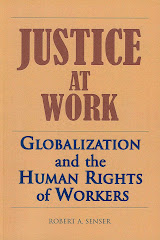
I was happily surprised today to learn that my book, Justice at Work: Globalization and the Human Rights of Workers, can be ordered through amazon.com. Later, it will also be available for on-line purchase at Barnes and Noble and Borders.

Whether bookstores will stock it depends on demand, which is still unknown, as is its easy availability outside the United States.

To my further surprise, amazon com is also selling used copies of my earlier book, Primer on Interracial Justice, published in 1982 by Helicon Press, which I have not bragged about of late because it is out of print, as well as out of date. And amazon.com is also marketing copies of a (copyrighted) review article of mine on how Solidarity won freedom of association, published by the Monthly Labor Review of the U.S. Labor Department.

As before, Justice at Work can be ordered through Xlibris, but the delivery time is not as rapid as through amazon.com.

My only disappointment is that amazon.com does not yet carry the image of my book cover. The cover is a co-production of my wife, our son Thuy, and myself. I am proud of it, and hope you will find that the book’s content matches its quality.

UPDATE: Amazon now carries the image of the book's cover. Take a look.

Print Page Read more!

Wednesday, January 28, 2009

Why union membership remains low

The number of workers belonging to unions in the United States grew by 428,000 last year to 16,100,000, mostly thanks to increased membership in the ranks of teachers, police officers, firefighters, and other local government employees.

The 2008 union membership rate in the public sector generally – 36.8 percent –stood in stark contrast to the rate in the private sector – 7.6 percent. In other words, government workers were nearly five times more likely to belong to a union than employees in the private sector.

Collective bargaining contracts covered about 1,700,000 workers who themselves refrained from joining a union. These holdouts were distributed about half and half between the public and private sectors.

Exhaustive data on union membership is contained in the latest annual report, “Union Members in 2008,” issued by the U.S. Labor Department’s Bureau of Labor Statistics (BLS), based on monthly household surveys conducted by the Census Bureau.

The BLS report, which covers 12 pages, does not explain why unions are stronger in the public than in the private sector. Numerous surveys, however, show not only that private business is much more unreceptive to unions than government agencies, but also that U.S. law permits companies to put that attitude into action.

A new Human Rights Watch briefing paper focuses on labor law and practice in the U.S. private sector, without drawing a contrast with the public sector. After reading the 12-page report, however, I cannot help marveling that even 8,255,000 of private sector workers still belong to unions.

U.S. labor law “is weak and riddled with loopholes,” and employers take advantage of that weakness in the law and in its enforcement to vitiate the right of workers to organize. The HRW briefing paper supports those two findings with detailed evidence. For example:

-- Penalties for firing pro-union workers and for otherwise breaching the law are so small that employers dismiss them as a worthwhile cost of doing business.
-- The government run election procedures by which workers vote for or against a union are heavily slanted against the union.
-- Even if workers succeed in winning an election, an employer can stall reaching a collective bargaining agreement to the point of making the victory meaningless.

HRW is among a growing number of organizations supporting Congressional approval of the Employee Free Choice Act. For Human Rights Watch, that passage is “a human rights imperative.”

Print Page Read more!

Wednesday, December 24, 2008

Competition gone bezerk

“Companies [today] are competing with everyone from everywhere for everything.” So say the authors of Globality, a new book about the latest phase of globalization. The Economist quotes those words approvingly in its most recent report on globalization, “A Bigger World.”

Both the book and the Economist favor the global economy as it is, not as it should be. They reflect the perspective of a leading economist, N. Gregory Mankow, former chairman of the Council of Economic Advisors. He holds that when you invoke ethics or morality, you leave the economics department and go over to the philosophy department.

Over at LaSalle University in Philadelphia, a professor of economics, David George, has published a fascinating study, "On being ‘competitive’: the evolution of a word." Diligently, he tracks the six-decade-long evolution of “competitive” as the label for a limited characteristic, or idea, into a universal ideal with frequent perverse results. For example:

“Amazingly, the firm that is least able to be described as ‘competitive’ by the old definition (a single firm in a sea of many firms) now is most able to be described as ‘competitive’ under the new definition (a victorious or most [competitive] firm).”

Most significantly, George shows that "competitiveness" has acquired an excessively high positive value in the business and the public mind. This poses a serious temptation to the Obama administration as a priority goal of its global economic policy. If Obama succumbs, he would be continuing the disastrous policies of the Bush administration.

Let’s leave the world of Real-World Economics Review, where George’s study appears, for the real world where the consequences of the new meaning of competitive are often very perverse. What does it mean to be competitive with everyone from everywhere for everything? When unfettered competition drives economic policy?

It means, as some Southern senators have proposed, cutting the wages of Detroit auto workers to the level of those who work for Japanese-owned non-union plants in the South. It means, too, something that pro-competitive advocates won’t discuss: gradually bringing the wages of all American workers, white- and blue-collar employees, in line with the wages of workers in China and other competitive countries in our bigger world.

But it also means far more than that. American workers cannot be truly competitive until they meet many more conditions of the bigger world, such as:

—cutting or eliminating company health care benefits, a process that has already begun.
—reducing government inspection of labor conditions, another process that is far along.
—trimming private pension plans, also well under way
—eliminating on-job discrimination programs against women and minorities

Those are just a few examples of the consequences of modern competitiveness, of how the “competitive” bandwagon imperils the whole range of human achievements gained (despite stiff resistance) in the United States.

No wonder globalization is in crisis. Competition has gone bezerk.

The sage of Singapore, Lee Kuan Yew, saw it coming. In a special section of the Economist 15 years ago, he predicted what globalization held in store for the United States. “America’s top 10% will enjoy the highest incomes in the world. But the wages of its less-educated citizens will drop to those of workers in the developing countries.”

That trend did not disturb Lee, a self-confessed social Darwinist. He and his government vigorously opposed any global regulation that would, for example, put limits on employing under-age boys and girls full time in factories.

Pope John Paul II extolled a different approach. In an address to more than 200,000 people on May Day eight years ago, he declared: “Globalization is a reality present today in every area of human life, but it is a reality which must be managed wisely. Solidarity too must become globalized.”

Which brand of globalization will the Obama administration follow? I wish I knew.


Print Page Read more!

Wednesday, October 15, 2008

Why the fixation on the Dow?

One out of nine workers in the United States is either employed or underemployed. Together, they number 17,136,000 men and women.

Did you see that number flash on your TV screen? And how often, if ever, have you seen a TV chart on how the real median income of American families dwindled in the past eight years while CEO compensation soared?

But you can hardly turn on a TV without learning the latest movement of the stock market. You see repeated shots of the Dow’s fluctuations in real time, as though the board on Wall Street were monitoring the nation’s health.

Even as an indicator of the economy’s health, the Dow index is very imperfect. The media obsession with it is a distraction that obscures how the economy is hurting ordinary American workers.

Remember, most people (51.4 percent of American households) don’t own stock in any form, and two-thirds of those with stock own less than $5,000 worth. The media track their interests superbly well. But what about the 66 percent of the country’s civilian population 16 and over who are in the labor force? That adds up to 154,000,000 men and women. Yes, many own some stock, but all of them, including the workers who own stock, depend on their jobs for their earnings, not on Wall Street.

The Economic Policy Institute regularly issues analytical reports based on labor data collected by the U.S. Bureau of Labor Statistics and other sources. The information in the first paragraph is drawn from an October 15 EPI “snapshot” report.

Print Page Read more!

Friday, September 19, 2008

Worker rights as an economic asset

Protecting worker rights as part of trade policy can be good for the economy. So says report just released by a Washington think tank, the Center for American Progress.

“The promotion of labor standards, alongside environmental protections, should be an integral part of the future U.S. trade agenda,” says the report titled “Labor Rights Can Be Good Trade Policy.”

The authors, Christian E. Weller and Stephen Zucconi, warn that, to be effective, the worker rights provisions of trade agreements must be enforced with “positive incentives for moving toward better labor standards, and negative incentives, including sanctions, when benchmarks are not met.”

Nearly a third of the 34-page report consists of data buttressing their points, including the fact that “stronger labor rights are correlated with smaller trade balances,” for instance, and that U.S. trade is more balanced with countries that have better worker rights.

Yet improving standards won’t, by itself, produce impressive results. That’s a crucial point emphasized in the Center report. Adopting global labor standards, Weller and Zuicconi insist, is a “key”(but not the only) element in a “broader” progressive international policy agenda to grow the global middle class.

In other words, improving labor standards in the North American Free Trade Agreement, as Senator Obama advocates, is a necessary but not sufficient reform. The Center study does not draw that specific conclusion, but I think it follows logically from a realistic assessment of the negative impact that NAFTA.as a whole has on the situation of workers in Canada, Mexico, and the United States

Print Page Read more!