Modeled after the Soviet gulag, China’s system of forced labor camps is now more than a half-century old, but it remains as essential as ever to the modern Communist regime. That’s because the system – the laogai – is not just a large group of places where millions of men and women are confined to do forced labor and to endure other cruel punishment. More important, the laogai is a collective tool to maintain the Party/state partnership’s monopoly of power.
You would think that as China has modernized economically, the Beijing regime would have less need for such a cruel system. Indeed, the Party/state monopoly is eroding, gradually, but the rulers’ determination to retain it is not. Beijing is as dependent as ever on arbitrarily detaining and abusing those seen as a threat to that monopoly.
Changing the Term of the Debate
A powerful new book, “Laogai: The Machinery of Repression,” explains those political reasons for the durability of the laogai in the People’s Republic of China. It also illustrates the plight of the 3,000,000 or more slave laborers with never-before-published photographs smuggled out of the country, as well as with other disturbing photos.
The 160-page volume, of coffee-table size but not content, features a forward by Harry Wu, a survivor of 16 years in the laogai. He has dedicated – and risked – his life to oppose oppression in his native land. Thanks to his single-minded effort, he has succeeded in popularizing the term laogai as a gulag with Chinese characteristics.
“Laogai: The Machinery of Repression” deals candidly with the role that the laogai has played in China’s economic development. The book has pictures, some taken by Harry Wu, of a few laogai-made exports -- plastic flowers, tea, tea cups, dolls, rubber boots, chains, clasps – and of several prisons that double as factories.
Wu tells his own moving story as a prisoner and as a campaigner relentlessly exposing laogai-made products. During one of his secret trips to gather evidence, he landed in jail for 66 days. He was released only after intensive efforts spearheaded by Jeff Fiedler, an AFL-CIO leader and longtime friend.
Wu’s campaign against laogai imports, embraced by Congress, produced two U.S-China agreements designed to enforce a U.S. (and China) law against trade in prison-labor products. The results are zero or thereabouts. Whom to blame? Deception by Chinese officials. The difficulties of gathering evidence in China. An unenthusiastic U.S. bureaucracy. And above all, in my view, a high-level unwillingness to disturb a bilateral relationship that enriches the elite on both sides.
To be fair, there was one success. A prison-made Diesel engine was blocked from U.S. entry in 1992. But that apparently did nothing to make life more bearable for prisoners in the Golden Horse Diesel factory, also serving as Yunnan No. 1 prison, where the blocked engine originated. As late as February this year, women imprisoned in that factory were reportedly required to work 14 hours a day.
* * *
The People’s Republic of China is the second largest trading partner of the United States. Last year, we imported goods worth $337,772,628,000 from China, not counting $6,483,400,000 from Hong Kong.
How much of those “made-in-Chinas” goods were made in the laogai? Nobody knows. Who cares?
“Laogai: The Machinery of Repression” is published by Umbrage Books in Brooklyn, N.Y.
Print Page
Read more!
Thursday, August 27, 2009
How 3,000,000-plus slave laborers underpin modern China


Tuesday, August 25, 2009
Rx: a new economic model that would value work and workers
Stripped down to its basics, the economic model to which we are addicted undervalues work and workers, a failing that is largely responsible for our sick economy. Thank God, some bright minds are working to free us from that addiction. They are shaping the outlines of a model – a paradigm -- that seriously values work and workers.
One of the few economists addressing that enormous challenge is Thomas Palley, with a Yale PhD and varied experience that now includes an assignment at the New America Foundation, a Washington-based think tank. In that role, he has written a policy paper released July 22 under the title “America’s Exhausted Paradigm: Macroeconomic Causes of the Financial Crisis and Great Recession.”
“Macroeconomics” is jargon for the big economic picture, and as Palley emphasizes in an email: “It’s critical that we get the big picture right. Without that, we will be pushed toward small picture reforms that do not solve the fundamental problems.”
Tracing Origins of Today's Flawed System
The big picture is very big indeed, and Palley’s report is itself only an overview. Here I present my highlights of only one part of that overview. I focus on his critique of the neo-liberal economic policies adopted after 1980 under Ronald Reagan as a “flawed growth model” that has continued to infect policies of subsequent administrations, Republican and Democratic alike, including the present one.
Palley, with well documented backup, contrasts the new model to the one that the United States followed in the four decades after World War II. Prior to 1980, the United States benefited from policies that led to what Palley calls a “virtuous circle of growth,” in which wages grew with productivity. “Rising wages meant robust aggregate demand, which contributed to full employment, [which] in turn provided an incentive to invest, which raised productivity, thereby supporting higher wages.”
The rejection of that model after 1980 – and to this very day -- put workers figuratively and literally in a box, a box with anti-worker policy pressures coming from four sides, which Palley designates as small government, labor market flexibility, retreat from full employment, and globalization.
Small government policies, advocated under the cover of liberating people from government interference, fundamentally undermine the legitimacy of government. The policies include deregulation, light-touch regulation, privatization, and outsourcing public services, all to the advantage of corporations and the disadvantage of workers.
Labor market flexibility is the name of a program enabling employers to fight unions, minimum wages, unemployment benefits, and other worker rights. In neo-liberal economic theory, flexibility generates more employment, but in the real world has led to wage stagnation and widening inequality.
Abandonment of full employment means the Federal Reserve’s actions that put a higher priority on low inflation than on the goal of full employment. The switch was facilitated by the economic profession’s embracing the theory of a “natural” rate of unemployment, thus providing political cover for higher actual unemployment, a condition that undermines the bargaining power of workers on wages.
Globalization, with a combination of free trade and the unfettered cross-border movement of capital, puts American workers into competition with a huge foreign labor force, in which workers have markedly lower wages and working conditions. At the same time, intergovernmental agencies, especially the World Bank and the International Monetary Fund, promote global policies that put foreign workers into the same neo-liberal box as American workers. Thereby, the neo-liberal policies not only undermine demand in advanced countries. They also fail to compensate for this by creating adequate demand in developing countries. A prime example is China, with its rising income inequality.
Palley’s critique covers not only the flawed economic growth model but also the United States’ “flawed engagement with the global economy.” That and the concluding sections of his paper deal with critical issues such as the following:
-- Why concentrating on micro tales of villainy (Madoff’s massive Ponzi project, huge banker bonuses paid by taxpayers) can distract from addressing the fundamental economic problems.
-- How NAFTA established the global template that U.S. corporations wanted, to the detriment of the U.S. economy, most visibly to its manufacturing sector and its workers.
-- How the U.S. policy of encouraging and facilitating new investment abroad decreases U.S. jobs while withholding from foreign workers their rightful share of gains in increased productivity.
-- Why the significance of granting Permanent Normal Trade Relations (PNTR) to the People’s Republic of China in 2000 is not about trade.
-- Why economic stagnation is the logical next stage of the prevailing paradigm.
For reasons of space and time, this posting does not deal with those and other issues that Palley analyzes. I intend to do so in coming weeks. There is no way I can avoid them, since they are so intricately woven into current events affecting work and workers.
For a fuller understanding of Palley’s position, read the text of his paper on the New America Foundation Website. Click here.
And watch a You Tube video of Palley’s oral presentation of his critique, also available on New America Foundation Website.
Print Page
Read more!
Sunday, August 23, 2009
3 MDs, 3 different diagnoses
You’re sick with a bad sore throat. You go to three different doctors. You get three different diagnoses of your illness.
That personalized analogy, as fleshed out in a Salon article, is a good way to understand the different basic approaches that today’s economists take in diagnosing the current economic sickness.
Michael Lind, director of the New America Foundation’s economic growth program, analyzes the parallel diagnoses in his April 7 Salon article titled “Rx for the Economy: Which Doctor Should We Believe?" Here’s my somewhat oversimplified summary of his enlightening MD/PhDecon analysis.
-- The first doctor says you have a sore throat and prescribes an aspirin.Those three different diagnoses have their parallels in three different ways that economists see what went wrong to cause the greatest global economic collapse since the Depression of the 1930s.
-- The second says your sore throat is a symptom of pneumonia and prescribes antibiotics.
--The third doctor sees your condition as more complex. He prescribes aspirin for the sore throat and antibiotics for your pneumonia, but also a 12-step program for overcoming alcoholism, an addiction that has weakened your immune system and renders it vulnerable to infections like pneumonia.
-- Economic doctor No. 1 blames lax financial regulation for turning the U.S. housing bubble into the current crisis. So the cure is some new financial regulation and tougher enforcement, national and international.
-- That cure is fine, says Economic doctor No.2, but it does not go far enough. It fails to deal with a larger cause – global trade imbalances, created by American (household, corporate, and governmental) overspending and oversaving by China and several other Asian governments to steer more investment into export manufacturing. The cure is not only tougher regulation but also a global economic rebalancing that includes a curb on currency manipulation.
-- Enter Doctor No. 3, whose diagnosis includes but is not limited to the diagnoses of the other two physicians. The bubble-blowing system of unbalanced trade never would have arisen in the first place, had employers on both sides of the Pacific shared more of the gains from productivity growth with their workers.
So the present crisis is caused indirectly by poor regulation, proximately by global trade imbalances, and ultimately by the maldistribution of the gains from economic growth among employers and workers in major industrial countries. The basic idea, as explained in Lind’s own words:
“Rich people have a lower propensity to consume (the term was coined by Keynes) than middle-class and low-income people. It follows that if the gains from productivity growth go to workers, they are more likely to spend the money, stimulating further investment and further growth. But if the gains from productivity growth disproportionately go to the rich, they are less likely to spend the money on mass-produced goods and services than they are to save the money or use it to speculate in assets. The result? Either the economy chokes (too much savings) or explodes (asset bubbles).“
The cure? Lind ends his article without specifying one. No wonder. Even the economists who agree on the overall diagnosis – Robert Reich, James K. Galbraith, and Thomas Palley, among others -- have not reached a consensus on anything like a 12-point recovery program.
Lind’s closing sentences: “We had better hope that the first physician is right: the world economy’s sore throat is nothing more than a sore throat, and an aspirin in the form of more financial regulation will be sufficient as a cure. Otherwise, the patient is a serious trouble.”
(For my analysis of Thomas Palley’s ideas, keep tuned.)
Print Page Read more!
Friday, August 21, 2009
The plight of the super-super-rich
To be among the ultra-rich Americans – those in the top 1/10,000th (0.0001%) of income earners – your household had to have an inflation-adjusted income of at least $2,000,000 in the late 1970s. By 2007 your household income had to be at least $11,500,000 to qualify for membership in that select group.
“The trend has come to seem almost permanent,” the New York Times reported August 21.
But the page one headline on that story was: “After 30-Year Run, Rise of the Super-Rich Hits a Sobering Wall.” Those in the top one-ten-thousandth are still extraordinarily rich, but not quite as rich as before. Or so it seems.
The existence of the 30-year up-up-up trend is based on the most reliable data available -- Federal income tax returns, which were analyzed by two economists for the years up to 2007. The Census Bureau has not yet released IRS data for the 2008 or 2009 tax returns.
So how did the Times come to the conclusion that, as the title on a graphic put it, “For Decades, the Richest Pulled Away, But Since 2007, They Have Become Poorer”?
In the absence of IRS data, the Times relied on various indicators. An important one was the multi-billion dollar stock market losses suffered last year by the likes of John McAfee, founder of the anti-virus software company that bears his name.
Details on McAfee’s new circumstances served to personify the plight of the whole group at the pinnacle of the money pyramid. Poorer by $96,000,000, McAfee is now getting by on his remaining $4,000,000 by selling some of his valued possessions, including his 10-passenger jet and scenic real estate in Hawaii and New Mexico.
The chief executive of one of the country’s biggest bond traders, Mohammed Ar El-Erian, offered this analysis:
“We are coming from an abnormal period where a tremendous amount of wealth was created largely by selling assets back and forth….You had wealth creation that could not be tied to the underlying economy, and the benefits were very skewed; they went to the assets of the rich. It was financial engineering.”
Key question that the article did not answer: will the United States again stake its economic health on financial engineering?
Print Page
Read more!
Who killed this American industry?
“Did the U.S. government kill the American circuit board industry?”In an interview, Douglas Bartlett, chairman and owner of Illinois-based Bartlett Manufacturing Company, was explaining why his firm, the oldest printed circuit board manufacturer in the United States, had recently closed its doors after 56 years in business here.
“Yes. U.S. government policies have killed many American industries. There is a march to free trade, which is okay so long as the rest of the world is playing by the same rules. But our government, our professors, and our geniuses like Robert Zoellick [former U.S. Trade Representative] … have been on a march to a free-trade utopia. They just killed us.”
“People are not making the connection between the collapse of manufacturing and the collapse of the financial system,” Bartlett told Richard McCormack, editor of Manufacturing & Technology News. “It is not a sound bite, and therefore it doesn’t get the press he needs.”
Bartlett tried to organize a printed circuit board (PCB) trade association to promote the interests of American producers, as the larger trade association did for foreign producers. With the U.S PCB industry “on its last legs,” however, he could not find support for an American group.
Faced with dwindling PCB orders even as the global PCB industry was booming, he decided to hang on after the Obama victory last November, Bartlett said, in hopes that the new administration would bring a change in policy. By mid-March he felt there would be “more of the same.” In mid-July he auctioned off the company’s last piece of equipment.
Here are other points Bartlett made in the interview, published in the July 28 issue of Manufacturing & Technology News:
“When you have a situation of a weakening high-tech industry, you would think that the government would look at it [the PCB part] and say, This is a poster child of what’s going wrong. It needs to be saved. But in the last six months, the industry has been crippled beyond repair.
“Everyone says the future is high tech. But you can’t hold together high-tech pieces of equipment unless you have nuts and bolts, wires, circuit boards, and flat screens. If all you have are a few tech components, you’re screwed because you don’t have the mass of jobs and wealth to bring it all together. We had engineers working in our factories, but those factories are now in China. The knowledge dies off, and so we are going to die off.
“Our kids are going to be fluffing dogs and doing toenails while the Chinese are making leading-edge devices.”
At the end of the interview he sounded an up-beat note. “Does it mean that I’ve given up on Washington? No, because I’m talking to you. There are shining stars who are trying to get the story out, but the momentum is horrendously against them.”
Print Page Read more!
Tuesday, August 18, 2009
Why United States needs factories to assure its greatness as a nation
About 40,000 U.S. factories closed shop in the past seven years. At long last, a campaign is underway to reverse that huge decline in industrial power.
Promulgating the case for reindustrializing the U.S. economy is the purpose of a book, “Manufacturing a Better Future for America,” published by a new group, the Alliance for American Manufacturing. The book makes this prediction in its final paragraph:
“If we continue to outsource all aspects of manufacturing – manufacturing processes, jobs, and expertise – then we will wake up one morning to discover that our corresponding economic and military power has been exported as well.”To prevent that from happening is the goal of the Alliance, a partnership that brings together a large union, the United Steelworkers of America, and a selected group of America’s leading manufacturing corporations, including U.S. Steel.
The United States “is broke because it has stopped producing what it consumes,” writes Richard McCormack, the editor of the 332-page volume, who is also editor and publisher of Manufacturing & Technology News. “The country must restart its industrial engine and produce products that America needs to buy and the world demands.”
A conventional view holds that government is not, and should not be involved in choosing winners and losers in the marketplace. That’s one of the myths punctured in nine chapters written by McCormack and ten other writers. But in fact the U.S. government has been – and is – mightily involved.
Most obvious is the current multi-billion dollar bailout of the investment and banking system to rescue losers from a collapse of their own making. Less recognized and understood is the U.S. government role
-- in establishing and enforcing the rules of global trade and investment for business, and
-- in permitting those rules to turn U.S. industries and their workers into losers.
McCormack identifies the “once dominant and important U.S. industries” – semiconductors, machine tools, printed circuit boards, consumer electronics, autos parts, appliances, furniture, clothing, telecommunications equipment, and home furnishings – as suffering from economic collapse as victims of a global economic system “stacked against U.S. based producers.”
U.S. labor is so productive that competing with low-wage labor is generally “the least of American companies’ worries,” McCormack writes. Instead, governments in Asian lure foreign firms with a wide range of other attractive advantages, such as the following.
“Foreign producers receive subsidies, tax abatements, free buildings, free energy. They don’t havc to pay Social Security, workers’ comp, disability, or health care. They don’t have to match a 401(k) contribution. They are able to avoid more than 100 years of government regulations put on American businesses. OSHA does not exist in most developing nations. They use electricity that would never be allowed to be generated in the United States because of pollution controls.”
I shudder when I hear politicians proclaim that the United States must become more competitive. How? By eliminating (say) Social Security?
Stay tuned for more on a “developing story" ignored by the mass media.
Print Page Read more!
Monday, August 17, 2009
Watch for toxic school supplies
A toxic plastic softener – polyvinyl chloride, or PVC -- is banned in children’s toys but is still legal in school supplies. So stick to plain metal paperclips, for example: the colored ones are coated with PVC.
That alert comes from the Center for Health, Environment, and Justice in a new report, Guide to PVC-Free School Supplies, which is being publicized by an NGO, MomsRising.
Among the school products that may be tainted with PVC are lunchboxes, binders, modeling clay, backpacks with shiny plastic designs, and notebooks with metal spirals encased in colored plastic, according to MomsRising.
That organization is circulating a petition to be sent to manufacturers and retailers of those products. Click here to sign a copy.
Print Page
Read more!
Friday, August 14, 2009
GDP ‘Growth’: a tool to fool
Statistics on economic growth are misleading measures of a nation’s economic health, but they are widely used anyway.
The front page of today’s Washington Post hailed a “modest growth” in France and Germany as the “latest sign of a global comeback, and reported that “improving indicators” are pointing to an end of the recession in the United States, China, and even Japan.
Yet another story in today’s Post, this one on page 11, headlined: “Optimism Bypasses Consumers,” with this subhead “Retail Sales, Foreclosure Data Show Outlook Remains Bleak for Households.”
The difference between the two stories is that the optimistic one builds on a small climb in the Gross Domestic Product, the commonly used measure of how the economy is faring. But GDP is an unreliable indicator. It is one measure of the economy, but by itself “a deeply foolish one,” according to a long analysis in the August 10 New York Times.
The title, “GDP RIP,” overstates the article’s content and reality. GDP is not dead. In fact, the author, Professor Eric Zencey of Empire State College, bemoans “our habit of taking it as a measure of economic welfare,” and recommends that it be renamed “gross domestic transactions.”
Criticism of GDP is not new. The Organization for Economic Cooperation and Development (OECD) has analyzed its weaknesses, without dampening its use. (See “GDP = Grossly Distorted Picture” in the March 1, 2006, issue of my Website, Human Rights for Workers.)
In his analysis, Zencey has numerous examples of GDP’s basic flaw: it adds up all economic activities (for example, rebuilding New Orleans after Hurricane Katrina is a plus in GDP, but the $82,000,000,000 in damages is not an activity and thus not subtracted). Zencey offers this enlightening parallel:“If you kept your checkbook the way GDP measures the national accounts, you’d record all the money deposited into your account, make entries for every check you write, and then add all the numbers together. The resulting bottom line might tell you something useful about the total cash flow of your household, but it’s not going to tell you whether you’re better off this month than last or, indeed, whether you’re solvent or going broke.”
A much better measure of the economy, to my mind, is the level of employment and unemployment. Using this measure is enlightening, and sobering. Take this U.S. “job picture” painted by the Economic Policy Institute on August 7:“The 6,700,000 jobs lost since the start of the recession understates the magnitude of the hole in the labor market. To keep up with population growth, the economy needs to add approximately 127,000 jobs every month, or, across the full 19 months of recession, 2,400,000 jobs. This means the labor market is currently 9,100,000 jobs below pre-recession employment levels.”
Yet, as the EPI points out, without the boost added by the American Recovery and Reinvestment Act, the job picture would be even worse. Thanks to the stimulus, the economy created or saved an estimated 720,000 jobs in the second quarter of this year alone.
Bottom line: effective recovery policies require restoring employment, not saving bankers’ bonusus.
Print Page
Read more!
Monday, August 10, 2009
Deviating from free-trade model
“See, I just don’t want to just reduce our dependence on foreign oil and then end up being dependent on foreign technologies. I don’t want to have to import a hybrid car – I want to build a hybrid car here. I don’t want to have to import a hybrid truck…Thus, on August 5, did President Obama announce $2,400,000,000 in grants to develop “the next generation of fuel-efficient cars and trucks powered by the next generation of battery technologies – all made right here in the U.S. of A.”
“I don’t want to have to import a windmill from someplace else – l want to build a windmill right here in Indiana…And that’s just the beginning.”
About two-thirds of the $2,400,000,000 in grants are to be used to develop and produce advanced vehicle batteries. At present even U.S.-made hybrids, such as the Ford Fusion, depend on imported batteries, primarily from Asia.
While the President was in Indiana, Vice President Biden was in Michigan and Commerce Secretary Locke in Missouri to deliver the good news to two other hard hit areas that will share the stimulus money. “After too many years of economic growth fueled by speculation and short-term thinking,” Locke said, “these types of investment will help recapture the spirit of innovation that has always moved us forward.”
This stimulus money, while much needed and welcomed, will fall far short in regaining the manufacturing jobs lost in recent years. Michigan is estimated to gain up to 30,000 jobs in manufacturing batteries by 2020 if all goes well. But the state has lost some 250,000 industrial jobs since 2005.
Nationally, we Americans continue to consume way more than we produce here. The U.S. trade deficit ballooned by $37,300,000,000 in May. Canada alone added $600,000,000 to that deficit.
Canada is complaining that the “made-in-the-USA” special electric car grants to cities and states violate free trade principles and free trade pacts. But, according to the Financial Post, Canadian provinces have long-standing “buy provincial” policies that apply to their spending for infrastructure and procurement.
As a result, the Obama administration is apparently free to deviate from its free trade model under those circumstances. But it will still have to cope, sooner rather than later, with modernizing a global trade and investment system designed for the past century.
In pursuing that reform, a focus only on the narrow interests of the United States would not just be a world-class blunder; it would be a loser in a World Trade Organization that has 153 members, most from the developing world.
The current system poses problems for people everywhere. Two glaring examples are the protections it gives to the rights of cross-border investors and owners of intellectual property rights without balancing those global rights with corresponding global responsibilities.
Unions here and abroad have long demanded that trade agreements protect labor rights as it does the rights of capital. Had these demands been met (say) three decades ago, it would have made a difference in how globalization evolved. Now those demands, still valid, will have to be part of a package that takes into account the rights of people in the developing world in regard to issues such as foreign investment and intellectual property.
Print Page Read more!
Saturday, August 01, 2009
Corporate social responsibility movement: Is it just a scam?
“What do we do when the entire economy becomes a Nigerian email scam?” That's the provocative question posed in an article on the Website of America magazine on August 3.
Well, one thing we should do is to recognize that the corporate social responsibility (CSR) movement is itself largely a scam. The Economist has a different word for it.
“For most companies. . . CSR is little more than a cosmetic treatment,” the Economist wrote in 2005. “The human face that CSR applies to capitalism goes on each morning, gets increasingly smeared by day, and washed off at night.”
Nothing substantive has happened since 2005 to change that searing indictment. Yes, CSR has great potential. Yes, some of its corporate supporters may indeed be serious reformers, not scam artists. Yes, religious and other groups use CSR principles to pressure companies like Nike to conduct themselves accordingly. It’s a lever against firms concerned about their brand-name reputation.
But the CSR lever is weak. Overrating it is a serious error. Why? Because it lends credence to the illusion that CSR is solving the global problems of the nature described by Pope Benedict in his new encyclical and by Maryann Cusimano Love in her summary of the encyclical published in the August 3 issue.
The world economy is in crisis today because it suffers from “governance gaps” where sweatshops and other grave social and moral evils thrive. Thanks to current international law, investors and business people are privileged to operate globally under rights without matching responsibilities.
So it should be no surprise that Pope Bendict praises “the strongly felt need, even in the midst of a global recession, for a reform” of the world’s inter-governmental institutions. He mentions only the United Nations by name but adds “economic institutions and finance,” a generic way of including other key inter-governmental organizations, especially those dealing with international trade and investment, with the World Trade Organization at the top of that pyramid.
The Pope repeatedly emphasizes, as a general principle, the need to balance rights and responsibilities. He gets very specific when it comes to two highly controversial subjects:
-- Responsibility of investors: The positive side of the reform movement already underway in the global financial system, he wrote, should be further developed, “highlighting the responsibility of the investor.”
-- Intellectual property protection: “On the part of rich countries, there is an excessive zeal for…an unduly rigid assertion of the right to protect intellectual property, especially in the field of health care.”
Just those two reforms, if adopted and implemented in international trade and investment pacts, would be major breakthroughs in globalization and in what the Pope calls “integral human development.” But both reforms are outside the stated CSR goals. Both are vigorously opposed by the business and financial community in the United States and beyond.
In fact, it so happens that rigid protection of intellectual property and investor rights are two key features of the three pending U.S. trade agreements signed by President Bush – and are also two major reasons for rejecting them. The media, Wall Street, and the Wall Streeters in the Obama administration all want the President to pressure Congress to ratify them.
Hopefully, he will have the backbone and good sense to say No we won't.
Print Page
Read more!
Monday, July 27, 2009
Global Electronics Industry: The 'New Nike'
Like the garment and toy industries, the global electronics industry is outsourcing almost all its production, but has added its own special wrinkle to sweatshop manufacturing – by turning most of its work force in Mexico into “temporary help.” Thereby the electronics industry has become the “new Nike,” according to Garrett Brown, coordinator of the Maquiladora Health and Safety Support Network.
In Mexico about 240,000 men and women – or 55 or 60% of all the industry’s workers -- are employed not by the industry itself but by 60 different temporary employment agencies. This “perma-temp” status is the most precarious form of employment, with low pay and virtually no benefits, Brown writes in the July issue of the Border/Line Health & Safety bulletin.
Globally, 75% of computer products are now made by “contract manufacturers” (CMs), rather than by their “original equipment manufacturers” (OEMs). Although CMs are totally unknown to consumers, several, such as Hon Hai/Foxcom, produce billions in sales with hundreds of thousands of workers in China and other Asian countries, Brown points out.
He applies the “New Nike” label to makers of cell phones, game consoles, printers, and computers because the industry that sells them is plagued with the same sweatshop conditions that prevail in the athletic and garment companies, including:
-- excessive hours, sometimes week after week of work without a day off.
-- low pay, with the legal minimum becoming the actual pay ceiling, not the floor.
-- long delays in getting paid.
-- hefty recruitment fees that put migrant workers deeply in debt.
-- exposure to dangerous chemicals without adequate safety gear.
That’s not all:
“There is the ever-growing tsunami of electronic waste that has flooded countries like China, Ghana, and India, where it is ‘processed’ in rudimentary workshops, often by children, in ways that poison the workers and pollute the environment.”
Corporate codes of conduct? “They are always trumped on the factory floor by the ‘iron triangle’ of ever-lower prices [demanded by] suppliers, high quality benchmarks, and shortening delivery times.”
UPDATE. On July l6, Sun Danyong, 25, an employee in a Foxcom factory making Apple iPhones in Shenzhen, China, committed suicide by leaping from the 12th story of the building where he lived. A few days earlier, in a text message to his girlfriend, he said he had been beaten and humiliated by a factory security team who suspected him of stealing a prototype of a new iPhone.
In a short statement expressing regret over Sun’s death, Apple said: “We require all our suppliers treat all workers with dignity and respect.”
Print Page
Read more!
Thursday, July 23, 2009
USTR's initiative on worker rights
The U.S. government’s top official on trade, Ambassador Ron Kirk, has committed his White House agency to a rather ambitious goal: “a proactive enforcement strategy to save American jobs, by helping to ensure that American workers compete on a level playing field.”
Henceforth, Kirk said in a policy announced July 23, the Office of the U.S. Trade Representative (USTR) will be proactive in monitoring and enforcing the labor obligations contained in the country’s free trade agreements.
Previously, USTR’s involvement in labor violations has been largely “complaint driven.” That is, USTR usually would not get involved unless a person or a group filed a formal complaint backed with evidence persuasive enough to trigger an investigation by USTR and an inter-agency committee.
Under the new procedure, USTR, together with other agencies, principally State and Labor, will “regularly” monitor violations of worker rights and will try informally to obtain compliance. When these efforts fail, Kirk added, “USTR will not hesitate, as in other areas of trade agreement enforcement, to invoke formal dispute settlement.”
USTR and other agencies also are to undertake a positive role in promoting respect for international labor norms. Kirk mentioned China specifically as a country with which the administration “is seeking to enhance engagement” on labor issues.
Other Opportunities for Human Rights Initiatives
The USTR announcement illustrates that government officials, under their existing legal authority, and without any new legislation, have a good deal of leeway to take initiatives to enhance human rights. Opportunities abound.
Take the State Department. Among its little known responsibilities is to house the “national contact point” for the Guidelines on Multinational Corporations of the 30-nation Organization for Economic Cooperation and Development (OECD). That national contact point (NCP) handles grievances that individuals or unions have against a corporation for alleged violations of the Multinational Guidelines.
Says a report of John G. Ruggie, the UN Special Representative for Business and Human Rights: Housing the NCP within a government office that is “tasked with promoting business, trade, and investment raises questions about conflicts of interest.” In State the NCP is housed in the Office of Investment Affairs of the Economic Bureau.
In the same report, approved by the UN Council on Human Rights, Ruggie pointed out that the OECD guidelines were last updated in 2000, and suggested they could stand revision. “We’ve learned a lot about business and human rights since 2000,” he told the 2008 meeting of NCPs in Paris. State: hint, hint.
Print Page
Read more!
$$ Questions that don’t get asked
Where on earth are we going to get the money to go back to the moon? to bail out another big bank? to continue paying for the wars in Iraq and in Afghanistan?Instead of those pressing questions, we hear this one over and over and over again: Where we going to find the money to pay for health reform?
When you constantly repeat that question, to the exclusion of other budgetary questions, you disclose your priorities. When politicians and the media focus on that question, as they do, they are judging health care in a negative way: health reform is less important and needs a greater justification for the expenditure of federal dollars.
July 20, the 40th anniversary of the America’s successful landing on the moon, was a time of prideful celebration. But it should also have been good time to raise questions about the wisdom, financial and otherwise, of continuing our programs of human spaceflight.
At present NASA is on an outer space path that will cost taxpayers an estimated $100,000,000,000. In my view, it is a crazy luxury to spend that kind of money to plant a flag on Mars when we have so many urgent things to do right here on earth.
Print Page Read more!
Tuesday, July 21, 2009
Toxic $$ Fight Health Care Reform
A cool $177,000,000 -- that's how much the health care industry has contributed since 1989 to members of Congressional committees now drafting bills to reform the nation's health system. What kind of reform can you expect especially when the key lawmaker on health issues, Senator Max Baucus of Montana, alone collected nearly $1.500,000 from health-related companies in 2007 and 2008?“What’s on your mind?” That’s the question my Facebook page asked me today, as on every day. And I answered with the above paragraph. The information in it is from an investigative report in this morning’s Washington Post.
The report depressed me. What a way for me to start July 21, my birthday! But thank God, I have a few ways to sound off. I need to enhance my ways of doing so. You should too.
Health care in the United States is sick, in desperate need of a comprehensive cure. But comprehensive reforms usually manage to rally private interests into well-financed coalitions against the public interest.
Where, for God’s sake, are the voices for a health care system that serves the common good? Still far too weak to overcome the power of $177,000,000.
Print Page Read more!
Wednesday, July 15, 2009
The Failure of the Economy -- and of the Economists
So Wall Street’s Goldman Sachs reports the highest profits in the firm’s 140-year history -- $3,440,000,000 for the second quarter of this year – and earmarks an average of about $770,000 in bonuses for each of its 29,400 employees. Meanwhile, 14,700,000 men and women in the United States are jobless, triggering an unemployment rate of 9.5 percent, the highest level in more than a quarter century.
That’s an example of an imbalance in our economic system – an imbalance that favors workers who manipulate money over those who actually produce something. In a May 29 New York Review of Books article, a leading economist, Benjamin M. Friedman, fills in some of the details of this imbalance.
Friedman does so by using a favorite tool of economists: efficiency. His article, “The Failure of the Economy & the Economists,” tracks performance in several ways, starting with profit-making:
“In recent years the financial industry has accounted for an unusually large share of all profits earned in the US economy. The share of the ‘finance’ sector in total corporate profits rose from 10 percent on average from the 1950s through the 1980s, to 22 percent in the 1990s, and an astonishing 34 percent in the first half of this decade.”Moreover: “The finance industry’s share of U.S. wages and salaries has likewise been rising from 3 percent in the early 1950s to 7 percent in the current decade. An important question … is what fraction of the economy’s total returns to productively invested capital is absorbed up front by the financial industry as the costs of allocating that capital.”
Friedman, author of “The Moral Consequences of Economic Growth," insists that the question is important, since the total cost of the industry goes up “if this system also exposes the economy at large to episodic losses in production and incomes and to the need for taxpayer subsidies.” And that’s what’s happening now. “Today those losses are mounting, and so are the subsidies.”
Why, Friedman asks, is there so little discussion of this fundamental reality?
One reason, he says, is intellectual: the systematic failure of thinking on the part of economists. He explains that failure at some length, and presents one solution offered by economists George Akerlof and Robert Shiller: “fire the weather forecaster.”
Just to be clear: I don’t support firing economists guilty of intellectual failures. That would be inefficient. We should first give them the opportunity to participate in intensive retraining programs.
Are you laughing? I am not.
Print Page Read more!
Saturday, July 11, 2009
Speaking out against nuclear weapons

There are currently almost 24,000 nuclear warheads in existence, with a destructive power equivalent to 400,000 times the power of the bomb dropped on Hiroshima in 1945. Nuclear arms account for a significant portion of global arms expenditure, which reached an all-time high of US $1,400,000,000,000 in 2008, an increase of 45% over the preceding decade.So said the International Trade Union Confederation (ITUC), the global voice of workers in 157 countries, in launching a worldwide campaign against nuclear weapons. The campaign, run in cooperation with “Mayors for Peace,” which groups more than 2,000 cities in 130 countries, is a lead-up to the May 2010 UN review of the Nuclear Non-Proliferation Treaty (NPT).
Guy Ryder, ITUC general secretary, expressed labor’s concern “about the prospect of further nuclear proliferation, particularly in North Asia, South Asia, and the Middle East,“ and added: “The only way to deal with this is through multilateral negotiations, and the 2010 NPT review is tremendously important in that regard.”
A petition to UN Secretary General Ban Ki-moon, as well as other information, can be found on the campaign website http://www.ituc-csi.org/.
Print Page Read more!
Thursday, July 09, 2009
This job market is not ‘race neutral’
In contrast to whites and Hispanics of the same age group, the wages of black workers 25 to 54 years old are continuing to sink, according to an “economic snapshot” issued July 8 by the Economic Policy Institute.
Over the last two years the weekly media wage of black workers in their prime working years dropped by 3.7% or about $23, while that of whites, Hispanics, and Asian groups of the same ages actually rose. This continues the pay shrinkage of blacks that marked the 2000-2007 business cycle, when the weekly median wage of blacks dropped 0.6%, while other groups received small increases.
The downward trend in income is a crucial element in an overall decline in the social wellbeing of African-American communities since 2000.
That development was described last year in an EPI briefing paper, “Reversal of Fortune,” by Algernon Austin, who heads the EPI program on race, ethnicity, and the economy.
Austin there emphasized the need for “a national strategy for black full employment,” with the goal of having black unemployment sustained below 5%. In May the black jobless figure was 14.7%, 16.6% for black men over 20.
Meanwhile, a popular slogan demands “race-neutral policies.” Too bad that the job market does not conform to slogans.
Print Page
Read more!
Tuesday, July 07, 2009
Ten Challenges for American Catholics Implicit In Pope's New Encyclical
Pope Benedict XVI’s new encyclical, “Love in Truth,” like all Papal encyclicals, is not country-specific in the issues that it raises. Nor is it addressed only to Catholics. Rather, the Pope’s analysis deals with the “challenges of today’s world.” Nevertheless, many of those challenges ought to be of special concern to American Catholics, both as office-holders and as ordinary citizens of the world’s leading power.
Here is my partial list of such challenges, 10 of them, selected from among those that fall within the province of this Weblog, Human Rights for Workers. The quotes, italics included, are directly from the Vatican text.
Globalization
“The processes of globalization, suitably understood and directed, open up the unprecedented possibility of large-scale redistribution of wealth on a world-wide scale; if badly directed, however, they can lead to an increase in poverty and inequality, and could even lead to a global crisis. It is necessary to correct its malfunctions, some of them serious, that cause new divisions between peoples and within peoples, and also to ensure that the redistribution of wealth does not come about through the redistribution or increase of poverty…”
Inequalities
“The world’s wealth is growing in absolute terms, but inequalities are on the increase. In rich countries, new sectors of society are succumbing to poverty and new forms of poverty are emerging. In poorer areas, some groups enjoy a sort of ‘superdevelopment’ of a wasteful and consumerist kind which forms an unacceptable contrast with the ongoing situations of dehumanizing deprivation.”
Unemployment
“Unemployment today provokes new forms of economic marginalization, and the current crisis can only make that situation worse. Being out of work or dependent on public or private assistance for a prolonged period undermines the freedom and creativity of the person and his family and social relationships, causing great psychological and spiritual suffering. I would like to remind everyone, especially governments engaged in boosting the world’s economic and social assets, that the primary capital to be safeguarded is man, the human person in his or her integrity.”
Role of government
“The integrated economy of the present day does not make the role of States redundant, but rather it commits governments to greater collaboration with one another. Both wisdom and prudence suggest not being too precipitous in declaring the demise of the State. In terms of the resolution of the present crisis, the State’s role seems destined to grow, as it regains many of its competences.”
Unions
“Through the combination of social and economic change, trade union organizations experience greater difficulty in carrying out their task in representing the interests of workers, partly because Governments, for reasons of economic utility, often limit the freedom or the negotiating capacity of labor unions. Hence traditional networks of solidarity have more and more obstacles to overcome. The repeated calls issued within the Chuch’s social doctrine…for the promotion of workers’ associations that can defend their rights must therefore be honored today even more than in the past.”
The Market and Ethics
“Efforts are needed – and it is essential to say this – not only to create ‘ethical’ sectors or segments of the economy or the world of finance, but to ensure that the whole economy – the whole of finance – is ethical, not merely by virtue of an external label, but by its respect for requirements intrinsic to its very nature.
Rights and Duties
“Many people today would claim that they owe nothing to anyone, except themselves. They are concerned only with their rights, and they often have great difficulty in taking responsibility for their own and other people’s integral development. Hence, it is important to call for a renewed reflection on how rights presuppose duties, if they are not lo become mere license.”
Intellectual property protection
“On the part of rich countries there is an excessive zeal for protecting knowledge through an unduly rigid assertion of the right to protect intellectual property, especially in the field of health care.”
Investor responsibility
“Both the regulation of the financial sector, so as to safeguard weaker parties and discourage scandalous speculation, and the experimentation with new forms of finance, designed to support development projects, are positive experiences that should be further explored and encouraged, highlighting the responsibility of the investor.”
The Environment
“The environment is God’s gift to everyone, and in our use of it we have a responsibility towards the poor, toward future generations, and toward humanity as a whole.”
* * *
To repeat: that’s my list of 10. There certainly are other challenges that demand attention, but 10 is a nice round number, and for a blog this posting is already overly long.
Print Page
Read more!
Monday, July 06, 2009
Happy Birthday, My Dear!

The birthday I’m celebrating here is that of my wife, Dzung, the 37th of her birthdays that we’ve celebrated since we married. The image on this e-card is the cover of the Vietnamese literary quarterly that she edits and publishes with a team that includes Vu Tha Hoa, an artist in Paris who contributed the cover’s painting.
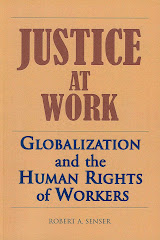
Dzung and I are both writers, but she is also a poet, and much more prolific than I am. To my one book (see cover at right), she has published six. Two of her books are so moving that some people read them straight through, without even stopping for sleep. Who would ever read a book on globalization in one sitting.
Dzung felt that Co Thom’s cover doesn’t quite blend in with this blog. Yet, more technologically advanced than I am, she created a JPG file of the cover for me.
A full-page ad for Justice at Work appears in the current issue of Co Thom. As an old friend of mine has said, nepotism is okay if it stays within the family.
Print Page
Read more!
Saturday, July 04, 2009
Reviving the anti-sweatshop movement

“Nearly 20 years of anti-sweatshop activism has come to naught,” says a veteran campaigner against sweatshops, Jeff Ballinger. He contends, therefore, that it is urgent to try a new, more effective, strategy.
In the lead article of Dissent magazine’s summer issue, Ballinger lays out his thoughts on such a strategy. The article's title: “Finding an Anti-Sweatshop Strategy That Works.”
As an illustration of the anti-sweatshop movement’s failure, he cites a who-got-how-much breakdown of the $38 price of hoodie sold in the University of Connecticut bookstore a couple of years ago. Out of that $38, the workers in Mexico who produced it received a meager l8 cents. “The workers’ share could hardly have been lower when the movement began,” writes Ballinger, who himself helped create the movement.
From his own experience working with workers in the United States and Asia, he is convinced that to get rid of sweatshops, you have to start by helping workers “empower” themselves – get them involved in learning the facts of their vulnerable situation and the way to do something about it.
How to help under current circumstances? In Ballinger’s view, “fighting sweatshop abuses here and abroad will not be key policy undertakings of Barack Obama and his team.” He presumably means that strong anti-sweatshop legislation may get sidetracked by other priorities, such as battling for health care and financial reforms.
But even so, Ballinger insists, the executive branch has available a wide set of initiatives that it could take on its own – initiatives that “would at least begin an assault on global sweatshop practices.” That beginning should be launched by President Obama himself: “Addressing the rule of law as applied to the workplace ought to be a slam-dunk for the President and the recently re-energized State Department.”
Among the specific initiatives that Ballinger proposes for a “no-nonsense strategy” are these:
-- Expand the Bush administration’s “Trafficking in Persons” program to include workers lured to leave their Asian home countries for sweatshop jobs elsewhere in Asia.
-- Be sure to connect with real labor activists, in Asia and Central America especially.
-- Have AID missions adopt “worker empowerment” projects, such as those that involve workers themselves in using survey-research tools to gather information useful to local legal aid groups as well as to unions.
-- Have U.S. Embassies gather labor and environmental information in a more focused and systematic way, for example, by reporting meaningful details on enforcement by labor inspections.
-- In addition to raw data, gather wiki-style narratives on recent strikes, the human effect of sub-par wages, outright wage-cheating, and other pressing issues, as well as local academic papers on these issues.
-- Share information on these subjects with U.S. corporations that contract out work to local factories and offices.Ballinger is currently finishing up work on a PhD degree, aided by a grant from the Laborers International Union. For the full text of Ballinger’s article, click here.
Print Page
Read more!

 Posts
Posts