After a worker rights activist, Jeff Ballinger, started targeting Nike in 1992 for its anti-labor policies, a prominent union leader advised him to forget it: Nike was just too big to expect to make a dent in it. That negative view long seemed accurate, but student leaders by the hundreds, some encouraged by Jeff himself and his publication, “Press for Change,” refused to believe it.
On April 9 the University of Wisconsin-Madison announced that it is severing its ties with Nike – the first to do so in a national campaign coordinated by the United Students Against Sweatshops (USAS). That followed a significant breakthrough in which two Dominican Republic factories have started making sweat-free products for U.S. university bookstores (see the April 8 issue of Human Rights for Workers).
Could this be the tipping in a campaign long deemed hopeless?
The Wisconsin university’s decision came after its monitoring agent, the Worker Rights Consortium (WRC), found and publicized grievous violations of the university’s code of conduct by two of Nike supplier factories in Honduras, including a refusal to pay $2,200,000 in benefits and severance pay.
“It’s a major victory national,” Jonah Zinn, 19, a sophomore at Wisconsin, who was part of a student campaign urging the contract cancellation, as the university’s own Labor Licensing Policy Committee had recommended.
Not stopping there, USAS and its affiliates nation-wide are in the midst of a multi-campus “NIKE: Pay for It” tour. It includes a demonstration Sunday, April 12, at Niketown, off Central Park in New York City. Speakers include Rod Palmquist, USAS national organizer, and two former workers at the Honduras factories.
What can you do?
For one thing, check the USAS Website at
In my view, the Nike Swoosh is a symbol of shame. I’d suggest, at the minimum, removing it from anything you might own.
Print Page
Read more!
Saturday, April 10, 2010
A tipping point in long struggle against Nike and its policies?


Thursday, April 08, 2010
Different anti-sweatshop strategy wins breakthrough
A factory in the Dominican Republic has begun production on sweatfree goods for delivery to university bookstores starting this fall or earlier. It is a breakthrough for a new strategy pioneered by the United Students against Sweatshops (USAS) and its partner, the Worker Rights Consortium (WRC).
Under an arrangement that took two years of dialogue, Knights Apparel, one of the largest vendors of apparel bearing university logos, and the DR factory management have committed to pay workers a living wage, as defined by a study conducted by the WRC. Knights will pay its supplier factory a price designed to make this possible.
Both Knights and the factory management have also made a commitment to respect the right of workers to organize and to recognize any union chosen by the workers. The WRC will be responsible for verifying these and other standards.
A noted health and safety expert, Garret Brown, and a colleague have already made an inspection of the factory, and will work on health and safety issues in cooperation with worker representatives in the factory.
To meet expected demand for no-sweat goods, Knights has launched a new brand, Alta Garcia, which for now will be sold only to campus stores, beginning with those that have already declared their intention to carry the product.
Says Scott Nova, WRC director: “It is a pilot project, not a comprehensive solution, to the challenges we face, but it is an exciting step forward.”
The project puts into practice key elements of the WRC’s innovative Designated Suppliers Program (DSP). Its aim is to enhance the enforcement of university codes of conduct, which as stand-alone documents have proveen pretty much useless without the institutional and incentive framework to make them effective.
The WRC is a Washington- based research and investigative non-governmental group funded by more than 170 U.S. colleges and universities. Its 15-member governing board comprises five persons from each of the three WRC constituencies – the universities, the United Students Against Sweatshops (USAS), and independent labor rights experts comprising the WRC advisory council.
Illustrating the universities’ basic interest in the endeavor is the desire not to have their names smirched by complicity with sweatshops. Duke University’s “trademark licensing policy” affirms “a policy of protecting the symbols that are associated with its name and reputation as one of the finest universities in the country.”
Once resistant to any such policy, Duke in the spring of 1998 adopted one of the first comprehensive codes of conduct against sweatshops. Months later its officials joined Duke Students Against Sweatshops in signing an agreement committing the school to seek disclosure of all licensing factory locations, and it later had contracts with 409 licensees renegotiated to require such disclosure.
In the fiercely competitive global marketplace, however, this approach made little impact.
Duke’s director of trademark licensing, Jim Wilkerson, supported the founding of WRC in 2001, and went on to become a key officer of its board and of its 36-member DSP working group. It took an arduous decade of discussion, planning, negotiating, getting legal advice, writing and rewriting DSP – plus the pressure of USAS chapters on hesitant universities – for the WRC to come this far.
It still has a long way to go, as a phone conversation with Wilkerson, a fan of this blog, made me realize.
For a report by the Maquiladora Health & Safety Network, see “Network Assists Start-up of Real ‘no sweat’ garment factory.”
Note: The WRC is a joint initiative aimed at the procurement policies of universities. A parallel movement, the SweatFree Consortiium, is a joint initiative aimed at the procurement policies of governments, local, state, and national. See my December 14, 2009, posting on SweatFree Communities and the Sweatfree Purchasing Consortium.
Print Page
Read more!
Saturday, April 03, 2010
U.S. cities establish plague-like record in population loss
A pandemic of destruction has struck a “nation within a nation -- the entire Great Lakes Nation,” says Hunter Morrison, director of Youngstown State University’s Office of Planning and Partnership.
Dozens of American cities in that area – places like Cleveland, Youngstown, Detroit, Warren, and Buffalo -- have lost half of their populations over the course of one generation. This is the first time that so many cities have lost so many people in such a short time since the Plague struck Europe in 1348, according to Morrison’s study of the health of global cities over the century.
America is more interested in building Baghdad and Kabul than it is in assuring the vitality of its own cities, writes Richard A. McCormick in a Manufacturing & Technology News article on Morrison’s study.
Morrison, former director of the Cleveland City planning department for 20 years, looked for trends worldwide in which a large number of cities have fallen into disrepair, including:
-- Great Britain, when deindustrialization struck places like Newcastle, Glasgow, Birmingham, Sheffield, and Belfast.None of these areas experienced the U.S passivity toward devastation in the U.S. Midwest, McCormack writes. “Other countries understood how vital it was for their cities to remain healthy. They committed themselves and the resources required to keep their old cities vibrant. No such attitude prevailed in the United States.”
-- Eastern Europe after the Berlin Wall came down in 1989, leading to expectations that millions of people would abandon dilapidated Eastern European cities.
What needs to be done to turn the situation around?
“A way to address a problem is to recognize that you have one," says Morrison. "It's not Cleveland's problem or Elyria's problem. It's not saving Cleveland. It's the way we operate as a nation -- a nation of places. What has been brought to the table is that deindustrialization is something that is good because it is cleaner. But it is nothing of the sort. It is a diminution of wealth creation.
“If deindustrialization was such a good thing, then why is China industrializing? The reason you do manufacturing is to create wealth by adding value. It's real simple. We've gone away from that."
In another article in the same issue, a California industrialist worries that it may not be long before Silicon Valley resembles the once-thriving area of the Shenango River Valley in deindustrialized western Pennsylvania.
American failure to deal with the obsolescence of its major inner cities creates many cruelties. One is to blame the unhappy results on the blacks and other minorities left behind.
Print Page Read more!
Thursday, April 01, 2010
Battling Floating Sweatshops
 Left stranded in the Philippines since their ship ran aground on New Year’s Day, 22 North Koreans finally started their way home on March 19, thanks to the intervention of the International Transportworkers Federation (ITF). The rescue was part of a day’s work for the ITF, a global union which represents 4,500,000 transport workers in 148 countries, with its own inspectors in the ports of 48 countries.
It was the ITF port inspector in Manila, Rodrigo Aguinaldo, who took the key role in solving the complicated case of the 22 North Koreans. North Korea has no Embassy or consulate in the Philippines. Among other things, he found food and lodging for the crew, and most of all handled negotiations with the Chinese Embassy to release their passports and allow them to fly home via China.
The ITF came to the crew’s aid even though North Korea’s maritime flag is a “flag of convenience” that allows ships’ owners to evade the national laws, taxes, and unionization of their home countries. The ITF and its seafarers and dock workers sections have long fought this dodge as a floating form of sweatshops.
Even so, at latest count, 40 percent of the world’s big merchant vessels flew flags different from their home countries. In fact, the custom is so deep-seated in maritime culture that the world’s top five shipowning countries (Japan, Germany, the United States, Greece, and China) have “flagged out” their maritime fleets to countries like Vamuatu. Belize, and Cyprus.
Instead of just battling improper flags, the ITF adopted a strategy of also battling the sweatshops that millions of seafarers must endure. As a result, of the remaining FOC vessels in the world, 48 percent have signed an ITF-approved agreement that guarantees seafarers minimal standards of pay and working conditions. ITF inspectors inspect ships visiting their port city, and in cooperation with local authorities, “arrest” a vessel until its sweatshop conditions are corrected.
Last year seafarers collected nearly $40,000,000 in back wages and underpayments, thanks to the ITF, whose inspectors visited 9,562 vessels, most of them flying flags of convenience.
The ITF scored a new breakthrough in 2006, when the UN International Labor Conference adopted the Maritime Labor Convention, which among other things requires large ships operating in international waters to have a maritime labor certificate reinforcing the rights of seafarers. Uniquely among ILO conventions, this one, when ratified, will apply to all states, even those that do not ratify it.
So far, eight states, not yet including the United States, have ratified the convention, with 22 more needed for the convention to go into force.
For more information, see the current issue of The ITF Seafarers Bulletin at http://www.itfseafarers.org/.
Print Page
Read more!
Wednesday, March 24, 2010
Emergency care needed for U.S.’ sick trade deficit with China
How much more time will pass before the Obama administration takes action on our toxic trade with the People’s Republic of China?
As a result of our burgeoning trade deficit with China since 2001, when China joined the World Trade Organization:
-- About 2,400,000 jobs have been lost or displaced in the United States.Those are among the facts documented in a new report by the Economic Policy Institute (EPI) issued March 23 in conjunction with the Alliance for American Manufacturing (AAM).
-- The computer, electronic equipment, and parts industries led, with 627,000 jobs displaced, more than in any other sector of the economy.
-- Every Congressional district, including the District of Columbia and Puerto Rico, has been affected, with California and Texas as the biggest losers among states.
The impact of the China trade deficit – which reached a record high of $270,000,000 in 2008 – is not limited to the hemorrhaging of jobs. Workers still employed are affected too, by decreased wages. A typical full-time, median wage earner lost an estimated $1,400 in 2006.
Currency manipulation is a major cause of the huge trade surplus enjoyed by China, according to the report’s author, Robert E. Scott of EPI. This intervention “makes the yuan artificially cheap and provides an effective subsidy on Chinese exports.”
As a result, China’s goods cost up to 40 percent less, according to the AAM, which brings together a select group of America’s leading manufacturers and the United Steelworkers.
The AAM supports the newly introduced Senate legislation designed to halt the misalignment of currencies by China and other countries. The group also urges the U.S. Treasury Department to list China as a currency manipulator in its semi-annual report on currency exchange, due by April 15.
Extensive background information can be found on the AAM Website at http://manufacturethis.org/
Print Page Read more!
Thursday, March 11, 2010
Joining forces against sweatshops
After more than a decade of campaigns, why haven’t anti-sweatshop organizations made much more progress? When I put that a question to a friend who is a veteran of those campaigns, he replied: “Because the movement is Balkanized.”
In that light, a March 10 public letter of two anti-sweatshop organizations, the International Labor Rights Forum (ILRF) and the Sweatfree Communities (SFC) is especially good news. Barma Arthrea, ILRF executive director, and Bjorn Claeson, SFC director, wrote that they are “pleased to announce that SFC and ILR will be joining forces in a new collaboration that we hope will stengthen our advocacy efforts to create a sweatfree world.”
Among the benefits expected from working together:
• Expansion of “our work to encourage federal, local, and state government entities to use their purchasing power to promote and enforce strong labor rights standards.”The two groups have already been working together informally, especially in the past year. Now they are doings so more actively “during a one-year transition period followed by an evaluation at which time a final decision will be made on whether to fully merge into one organization.”
• “Strengthen our efforts to build a grassroots international labor solidarity movement in the U.S.”
Sweatfree Communities, headquarterd in Bangor, Maine, was founded in 2003 by anti-sweatshop activists, including local labor leaders, in Maine, Minnesota, New York, Wisconsin, and elsewhere. Their working together since then has led 39 cities, 15 counties, and eight states to adopt “sweat-free” procurement policies, starting with uniforms for police officers, firefighters, and others, including prisoners.
The International Labor Rights Forum, headquartered in Washington, was founded in1986 by leaders in human rights, labor, academic, and faith-based organizations, to promote global labor standards, especially through trade and aid policies. (Personal disclosure: I’ve been a member of ILRF since the ealy 1990s.)
Both organizations have excellent Websites that inform members and the public on developments affecting the human rights of working men and women.
IRLR: http://www.laborrights.org
SFC: http://www.sweatfree.org
For a copy of 2010 Shopping with a Conscience Guide, see http://www.sweatfree.org/shoppingguide
Print Page Read more!
Thursday, March 04, 2010
Businness, human rights, and due diligence
You’re an employer, and want to avoid any unnecessary risks in your global production business. You certainly don’t want to become liable for failing to exercise due diligence in your human rights practices.
But what is due diligence?
An authoritative answer to that question has come from John Ruggie, the UN Secretary General’s special representative on human rights and business. Ruggie gave the keynote address to a conference sponsored on February 25 in Atlanta by the U.S. Council for International Business, the U.S. Chamber of Commerce, and the International Organization of Employers.
Ruggie identifies four components of human rights due diligence for companies:
1. A statement of policy articulating the company’s commitment to respect human rights;
2. Periodic assessments of actual and potential human rights impacts of company activities and relationships;
3. Integrating those commitments and assessments into internal control and oversight systems; and
4. Tracking as well as reporting performance.
The process “has to go beyond simply identifying and managing material risks to the company itself, to include the risks a company’s activities and associated relationships may pose to the rights of affected individuals and companies,” Ruggie points out, adding:
“In a world of 80,000 multinationals, ten times as many subsidiaries, and countless national firms,…[the process] necessarily will vary with circumstances.”
Ruggie offers several reasons why following a meaningful process of due diligence is well worth the effort it requires. One advantage is that it offers a corporate board “strong protection against mismanagement claims by shareholders, [which in the context of lawsuits]…can only count in its favor.”
In carrying out his mandate from the UN Human Rights Council, Ruggie will in the coming months be working with a number of organizations, including:
• The OECD as it updates its "Guidelines for Multinational Enterprises."
• The International Finance Corporation as it revises its Performance Standards.
• The European Commission, as it explores new approaches to ensuring responsible behavior overseas by European firms.
For the full text of Ruggie’s address, click
http://www.business-humanrights.org/Links/Repository/153835/
Print Page
Read more!
Tuesday, March 02, 2010
Public procurement with a conscience

Although efforts to adopt decent labor standards through free trade agreements are stymied on the international level, activists in the United States are quietly making progress on the local level. At last count, 39 cities, 15 counties, and eight states have adopted policies expressed under a common banner: No taxpayer dollars for sweatshop goods!Those are the first two paragraphs of an article of mine just published in Policy Innovations, the Carnegie Council’s on-line magazine for a fairer globalization.
These policies are promoted by a nongovernmental network, Sweatfree Communities, founded in 2003 by anti-sweatshop activists who had been working separately in Maine, Minnesota, New York, Wisconsin, and elsewhere. They now work together with a three-prong strategy:
For more than a decade now, I’ve studied the various levers available to advance the human rights of workers in the 21st century’s global economy. The Policy Innovations article is one result of those studies. As I say in the closing paragraph;
“New trade legislation – necessary as it is to safeguard worker rights globally – will not do the job alone. A combination of governmental and nongovernmental levers is needed. One of those key levers is public procurement with a conscience.”
For the full article, click
http://www.policyinnovations.org/ideas/innovations/data/000159
Print Page Read more!
How many more will have to die…?
…before the world’s business and political leaders start to rid the globe of sweatshops?
At least 21 workers died and dozens of other workers were injured on February 26 when a fire swept through a sweater factory near the capital city of Dhaka in Bangladesh. Most of the victims, at least 14 of the dead, were women.
Since the year 2000 alone, 143 garment workers, almost all women, were killed in Bangladesh’s factory fires.
How many more women will die in sweatshops, in Bangladesh and elsewhere, before a pundit like Nicholas Kristof stops writing that sweatshops are good for women?
Moreover, “why does the garment sector in Bangladesh continue to grow despite the fires and despite the abusive working conditions that nobody denies – not even the brands themselves?”
Bjorn Claeson, director of Sweatfree Communities, adds that and other pointed questions, in an article published in “Labor is Not a Commodity,” a blog jointly operated with the International Labor Rights Forum and other groups dedicated to global labor solidarity.
Print Page
Read more!
Thursday, February 18, 2010
Tooting my own horn: 14 years of Human Rights for Workers
I have no idea how many people read this Weblog, Human Rights for Workers, but I get enough positive reactions to energize me to go on. In the past few weeks, I received heartening emails from three people:
“Thank you for your tireless crusade to promote human rights for workers.” – G. Rajasekaran, secretary general, Malaysian Trades Union Congress, Subang Jaya, Malaysia, January 31.Each letter commented on a specific article. Father Langan, for example, had this to say about my posting titled ‘Economic suicide is not an option’: “This one-pager is, I think, exceptionally clear and helpful.”
“Always a pleasure to read you.” -- Marie-Claude Hessler, human rights activist, retired lawyer, Paris, February 11.
“Happy New Year and thanks for your admirable persistence in reminding us of some inconvenient truths.” – John Langan, S.J., professor of Catholic Social Thought at Georgetown University, January 2.
Why am I basking in such shameless self-promotion today?
Blame it on my mood, which became exuberant when the sun broke through after days of blizzards. Or maybe I just couldn’t think of another way to introduce some news: Human Rights for Workers is now 14 years old, 14 years under the same one-person staff.
I launched HRFW on February 14, 1996, a cyberspace pioneer devoted to the question: “What’s happening to working men and women in this era of globalization?” After mutating into a Weblog with the same name two years ago, it still focuses on that basic question. So do many other sites and blogs now, each in its own way. There’s so much company that it’s impossible to keep up with it all.
Why don’t I, at long last, go into full retirement, and leave the field to all those newer and better staffed endeavors? There's one problem, if I did that. What on earth would I do for enjoyment?
We’ll have a party when HRFW turns l5. I’ll send you plenty advance notice.
Print Page Read more!
Tuesday, February 16, 2010
“Race-neutral” policies are not necessarily neutral
For the first time since he took office, President Obama met at the White House with a group of black civil rights leaders February 10. The meeting followed by a day a New York Times story headlined “Frustration at Obama’s Nuancd Style on Race.”
After the hour-long meeting, one participant, Benjamin Jealous, president of the NAACP, told New York Times reporter Helene Cooper: “In these times, it didn’t make sense to talk about race-based initiatives.”
Ms. Cooper reported that “as he did today, Mr. Obama has said that broader efforts to help the disadvantaged will also benefit blacks.” (She did not quote the President directly.)
In other words, the administration’s policy is “race neutral.” It’s a policy with some appeal. For the first black U.S. president, it deflects the charge that his very origins will cause him to favor persons of his own race.
But how neutral is neutrality on race?
Mr. Obama would be wise to read a book, “More Than Just Race,” by William Julius Wilson, a professor at the University of Chicago. Mr. Wilson, who is black, used to believe that public policy should always be color blind. His book explains why he no longer thinks so.
Take the implact of globalization, or “complex global economic transformation,” as Mr. Wilson calls it. Economic and political leaders did not make a decision to shape globalization so that, by the massive shift of manufacturing jobs abroad and other means, it would discriminate against many black Americans. But that indeed was and is one of its effects. Mr. Wilson documents the unintended racial consequences in detail. My summary does not do justice to the reality.
At the bottom end of the pay and skill scales, globalization’s increased demand for workers should have been a boon for inner-city blacks, who generally rank low in job skills. However, the urban manufacturing industries that once provided equal job opportunities by the millions have largely moved abroad, thanks to the combination of U.S. free trade and investment policies and the foreign attractions of low wages and weak labor protection laws weakly enforced.
Meanwhile, at the top end of the last century’s expanded U.S. labor market, many better-educated blacks landed good paying suburban jobs, as managers and professionals, for example, thanks to a decline in employment discrimination, They and their kin joined the general exodus of American urbanites into the suburbs.
The blacks who were left behind thereby became more concentrated than ever before in poor communities, more isolated from the rest of America, more embittered by their plight. Black women, who have traditionally held jobs in service industries, were more fortunate. Most service industries can’t escape to other countries.
“The economic predicament of low-skilled black men in the inner city has reached catastrophic proportions,” Mr. Wilson wrote a year ago. Their plight has not diminished since then. It needs to become a priority in the Obama administration.
Print Page
Read more!
Wednesday, February 10, 2010
In fashion or not, students still campaign against sweatshops
The signs are everywhere, says Newsweek, that “the age of global human-rights advocacy” is over. Everywhere? Certainly not in the ranks of the United Students Against Sweatshops (USAS) and its chapters in some 250 colleges and universities in the United States and Canada.
USAS, whose worker-rights advocacy reaches all across the world, is bringing together hundreds of student activists at a national conference at the University of Tennessee campus in Knoxville over the February 19-21 weekend. Among other things, they will celebrate a major victory for garment workers in Honduras.
“We are impressed by the social consciences of students in the United States,” a Honduran union president said after a 10-month nation-wide campaign in the United States ended in victory last month. Workers from Honduras will be at the University of Knoxville campus to describe how, against overwhelming odds, the student campaign caused Russell Athletic, a leading sportswear company, to reverse its anti-union position.
The final key to victory was the action of nearly 100 colleges and universities canceling or suspending licensing deals under which Russell Athletic makes clothing and sports equipment with colleges’ names and logos. The company’s decision came after a wide-ranging of USAS campaign that included picketing NBA finals at Orlando and Los Angeles, distributing flyers in retail outlets, and sending Twitter messages urging customers to boycott Russell products.
In the settlement, Russell agreed not only to reinstate 1,200 discharged workers but also to work with unions at its Honduran factories, eight in all. Russell’s reversal is a “giant breakthrough for labor rights in the region,” says Scott Nova, executive director of Worker Rights Consortium, USAS partner, which monitors compliance with standards adopted by dozens of colleges and universities.
As a writer and supporter of USAS since its very beginning, I am especially impressed by two things about this movement:
1. Despite the built-in annual turnover of members and leaders, USAS is pursuing the cause of worker rights with unremitting dedication.
2. It is struggling for the rights not of its own student members but of others -- workers, mostly women, whom they do not know personally and will never get to know. With a few exceptions.
Among the foreign guests at Knoxville, weather permitting, will be a delegation of unionists from Honduras. They will report on the succces of a coordinated effort and the work of repeating it throughout Central America.(For an article of mine,"Freshmen Are Teaching Elders Lessons in Global Ethics," click on http://www.senser.com/biv-4.htm.)
≈
Print Page
Read more!
Sunday, February 07, 2010
AFL-CIO offers a “just” trade policy for the 21st century
“We cannot afford another trade agreement that privileges substandard new opportunity for investors over good jobs for workers,” the AFL-CIO says in testimony for the U.S. Trade Representative (USTR).
In the 34-page document the AFL-CIO presents its views on crucial elements of the proposed Trans-Pacific Partnership Trade Agreement (TPPTA), and says it is looking forward “to working with the Obama Administration to create a just trade policy for the 21st century.”
U.S. negotiations are set to begin in mid-March with TPPTA, involving at least seven Asia-Pacific governments. The United States already has bilateral free trade agreements (FTAs) with four of them: Australia, Chile, Peru, and Singapore.
A remarkable feature of the AFL-CIO position is that it deals with far more than strictly trade union issues, narrowly defined. For example, among “new issues for consideration,” it lists “valuation of currency” as an important trade union issue now ignored by existing agreements. “The U.S. cannot effectively export to countries that intervene systematically to keep their currency artificially low in relation to the dollar, as China, in particular, is doing.”
Only seven pages of the submission to USTR are devoted to improving the labor chapters of existing agreements. By contrast, the paper has 17 pages of non-labor chapters on issues that need to be improved. Among the most important are those that would fall in chapters on:
Investment. This seven-page section emphasizes that foreign investors in the U.S. can now “claim rights above and beyond those that our domestic investors enjoy,” and that this broad definition of investment should be narrowed to cover “only the kinds of property now protected by the U.S. constitution,” thereby excluding claims for losses from expected profits not met, for example.
Another examples of a recommended change in the investment template: a hostgovernment will be permitted to ensure that investment activity is conducted in a way sensitive to environmental and labor rights.
Procurement. A government will have the right “to require a supplier to comply with generally applicable laws regarding fundamental principles and rights at work.”
Intellectual property. “Our FTAs have provided excessive protection for the producers of brand-name pharmaceuticals,” thereby jeopardizing access to affordable medicines, particularly to developing countries.
Consumer protection. Both our domestic and trade policies must be crafted to prevent dangerous consumer and industrial goods from reaching our shores. Safety inspectors should get enhanced rights to inspect the facilities of a country exporting toxic products.
(The full text of the AFL-CIO submission is available at
http://www.regulations.gov/search/Regs/home.html#docketDetail?R=USTR-2009-0041
Scroll down to USTR2009-0041-0100.)
Print Page
Read more!
Sunday, January 31, 2010
Searching for ways to enlighten worker rights illiterates
How do you talk about worker rights to people who are illiterate about worker rights issues?
The question occurred to me because of a new survey that reveals what the New York Times calls “widespread political illiteracy” among Americans. The “News IQ Test,” conducted in early January by the Pew Research Center, found that only
-- 26% of the respondents knew that it takes 60 votes to break a filibuster in the Senate.
-- 36% knew that no Republican voted for the Senate health care bill on December 24.
-- 39% knew that the Majority Leader of the Senate is Harry Reid.
There may be a lesson here for those of us trying to convince the public that globalization, especially its trade system, needs a reform that incorporates the human rights of workers. How can we frame the issues so that the public understands what we’re talking about?
The old expression “social clause” – as in adding a “social clause” to trade agreements -- is inadequate and fortunately out of fashion. Yet we don’t have a phrase that captures the popular imagination. The goal of “decent work for everyone” comes closest.
It is a term embraced by the UN International Labor Organization in its strategy for a global coalition to support decent work. But what do you mean by “decent work”?
Here is a definition developed by Pope Benedict XVI in his encyclical, Caritas in Veritate:
“What is meant by the word ‘decent’ in regard to work? It means
• work that expresses the essential dignity of every man and woman in the context of their particular society:
• work that is freely chosen, effectively associating workers, both men and women, with the development of their community;
• work that enables the worker to be respected and free from any form of discrimination;
• work that makes it possible for families to meet their needs and provide schooling for their children, without the children themselves being forced into labor;
• work that permits the workers to organize themselves freely, and to make their voices heard;
• work that leaves enough room for rediscovering one's roots at a personal, familial and spiritual level;
• work that guarantees those who have retired a decent standard of living.”
With that comprehensive definition in mind, “decent work” is a great goal, but I’m afraid that, alone, it wouldn’t score very high in a Pew News IQ test.
Print Page
Read more!
Thursday, January 28, 2010
President's agenda for jobs: is it populist enough?
I didn’t watch or listen to President Obama’ State of the Union address. I read it the morning after. And I re-read large chunks of it, focusing on what he said about jobs.
“Jobs must be our number-one focus in 2010,” he declared. Here are his plans.
One way is to “put Americans to work today building the infrastructure of tomorrow” and “building clean energy facilities.” These steps, however, “won’t make up for the seven million jobs that we’ve lost over the past two years.”Some pundits attributed Obama’s new emphasis on jobs to a need to become more “populist” after a Republican won the U.S. Senate seat held by the late Senator Kennedy. But how populist is President Obama’s position?
So “it’s time to get serious about the problems that are hampering our growth.” One of a series of initiatives proposed by the President: “Double our exports over the next five years, an increase that will support two million jobs in America.”
In aggressively seeking new markets, the U.S. must make sure that other countries are playing by the rules. “And that’s why we’ll continue to shape a Doha trade agreement that opens global markets, and why we will strengthen our trade relations in Asia and with key partners like South Korea and Panama and Colombia.”
A few weeks ago Gallup asked 1,017 Americans this open-ended question: “In your opinion, what would be the best way to create more jobs in the United States?”
The top prescription was “Keep manufacturing jobs here/Stop sending overseas,” favored by 18% of respondents. Another 4% chose “higher taxes on imports/Buy American.” So in effect 20% deemed globalization to be the chief obstacle to ending U.S. unemployment.
The Gallup poll findings were consistent with those in a recent survey by the Pew Research Center. Its respondents were asked to prioritize a prepared list of 11 long-range foreign policy goals. Surprisingly, “protecting the jobs of American workers” shared the top place with “taking measures to protect the U.S. from terrorist attacks.” Both were given 85% “top priority," and 13% “some priority."
If these findings do reflect public opinion, Obama’s jobs agenda may not turn out to be a winner on voting day. It could depend on the unemployment rate at that time.
Print Page Read more!
Monday, January 25, 2010
Is WTO softening its posture toward human rights or is it looking for a mission?
An unwritten policy of the World Trade Organization (WTO) – that trade and human rights don’t mix – may become outdated before too long. At least, that’s a tentative conclusion that you might draw from a January 13 speech by WTO Director-General Pascal Lamy.
The headline of the WT0 press release summarized Lamy’s remarks this way: “Lamy calls for mindset change to align trade and human rights.”
Lamy expressed the point in two sentences toward the end of his text:
“It is our responsibility to coordinate our actions in a meaningful and efficient manner to ensure that trade does not impair human rights, but rather strengthens them. I am aware of the challenge that this represents, of the change in mindset this requires.”Lamy was not specific about the policy changes a new mindset would involve. Rather, he spoke in general about the ways trade can be “a positive vector for reinforcement of human rights.” For example:
“To be successful, the opening of markets require solid social policies to redistribute wealth or provide safeguards to the men and women whose living conditions have been disrupted by evolving trade rules and trade patterns.”Lamy’s topic was “Toward Shared Responsibility and Greater Coherence: Human Rights, Trade, and Macroeconomic Policy” at a three-day colloquium sponsored by two Geneva-based organizations, the International Council on Human Rights Policy and Realizing Rights.
* * *
Actually, the WTO is already much more involved in human rights than Mr. Lamy acknowledges. For the details, read my blog article, “Imbedded in WTO: Human Rights for Some,” at
http://humanrightsforworkers.blogspot.com/2008/04/imbedded-in-wto-human-rights-for-some.html
Print Page Read more!
Wednesday, January 13, 2010
How globalization has turned against a best friend
“Manufacturing matters mightily to the wealth and power of the United States and to our ability to sustain the kind of open society we have come to take for granted.”
That was the opening sentence of “Manufacturing Matters” by two University of California/Berkley professors, Stephen Cohen and John Zysman, published in 1987. The co-authors, early critics of globalization, called “subcontracting production” to foreign countries “the fast track to disaster.”
Like other opinion-leaders, however, newspapers became cheerleaders for globalization and its major components, free trade and free investment. They argued that the growing decline in manufacturing in the United States didn’t matter much anymore.
In the past eight years that decline has meant the loss of 42,400 factories and more than 5,000,000 manufacturing jobs. Besides, 90,000 more factories are in peril, reports Richard McCormack, editor of Manufacturing and Technology News.
“When a factory closes, it creates a vortex that has far-reaching consequences,” McCormack points out.
Newspapers, too, have been caught in that vortex. Two months ago, the Washington Post headlined “The accelerating decline of newspapers.” How could it be otherwise?
Newspapers do not exist isolated from the communities they serve. When people in those communities hurt economically, so do newspapers. In December 15,300,000 Americans were officially counted as unemployed and 11,700,00 others were working part-time against their wishes or wanting a job but not seeking one during the past four weeks.
So in this depressing climate, newspapers, too, have joined the “sunset” industries, for a variety of reasons. A major one is that they have been so successful at preaching and practicing global free trade that the ideology has added them to its victims. When will newspapers, from the New York Times and Washington Post on down, start learning from their own experience? Lesson number one: manufacturing matters.
Print Page
Read more!
Thursday, January 07, 2010
Poll: for Americans protecting jobs is highest foreign policy priority
From a list of 11 long-range foreign policy goals for the United States, which one do Americans rank as having the highest priority? A Pew Research Center poll just released has this significant pair of findings:
-- “Taking measures to protect the U.S. from terrorist attacks” has the highest rating: 98% of persons responding (85% “top priority,” 13% “some priority”).Of the nine other listed goals, only “preventing the spread of weapons of mass destruction” (with 94%) came close.
-- Another goal, “protecting the jobs of American workers,” has exactly the same amount of support (85% top priority, 13% some).
Oddly, pursuing free trade agreements was not on the prepared list of goals. Responses to other questions, however, showed continuing negative views of free trade agreements, because they
-- lower the wages of American workers (in the view of 49%).
-- lead to job losses in the U.S. (53%).
-- slow down the economy (42%)
The poll, on “America’s Place in the World 2009,” was conducted in cooperation with the Council on Foreign Relations. Public Citizen's “Eyes on Trade” points out:
“The survey also reveals quite a disconnect between the views of the foreign policy elite and the views of the public at large: 88 percent of the members of the Council on Foreign Relations believe that these trade agreements are a good thing for the United States, which is more than double the proportion of ordinary Americans who believe the same.”
Print Page Read more!
Saturday, January 02, 2010
Economic suicide is not an option
 Almost everybody who is anybody seems to be scrambling to figure out how a Nigerian terrorist came so close to blasting a hole in a transatlantic airliner approaching Detroit. The concern is legitimate. But while concentrating on one peril, we are ignoring another – that the United States is blindly on the path to a major economic disaster.
The alarming signs are there aplenty, but policymakers are either not connecting the dots or not telling the public what the signs mean. Either way, it’s way past time to spread an alarm about the danger of national econicide.
Buried in his January 1 New York Times column, Paul Krugman makes this prediction: that China’s policies probably will reduce U.S. employment by 1,400,000 jobs over the next two years. That should be startling, except that it’s nothing new. China has been stealing jobs from American workers for years without causing corrective action by American leaders, Democrat or Republican.
The supposed cure, mindlessly repeated, is to make Americans more “competitive.” But American companies are among the most efficient in the world, Richard McCormack, editor of Manufacturing and Technology News, points out, and in an article published in the January-February issue of The American Prospect adds:
“The nation’s steel industry, for instance, produces one ton of steel using two man-hours. A comparable ton of steel in China is produced with 12 man-hours, and Chinese companies produce three times the amount of carbon emissions per ton of steel. The same kinds of comparisons are true for other industries.”“China is blatantly protectionist,” Carolyn Bartholomew, chair of the U.S.-China Economic and Security Review, writes in the same magazine. “The Beijing government manipulates its currency, showers subsidies on favored industries, provides low-interest loans from a state-owned banking system, tolerates and even encourages the theft of intellectual property, and ignores WTO rules.”
In his column, Krugman explains that China, now a major financial and trade power, “doesn’t act like other big economies. Instead, it follows a mercantilist policy, keeping its trade surplus artificially high. And in today’s depressed world, that policy is, to put it bluntly, predatory.”
Among the excuses given for why we can’t retaliate against China’s predatory actions is that protectionism is always a Bad Thing, always, even in response to the persistent protectionism of others. “If that’s what you believe, you learned Econ 101 from the wrong people,” Krugman writes, and goes on to explain that the usual rules don’t apply in times of high employment that are not solved by domestic measures.
For support, Krugman turns to the master, the late Paul Samuelson, to show how mercantilism (such as practiced by China) changes the situation. Here is his quote from a classic Samuelson paper, interspersed with Krugman’s defintion:
“With employment less than full… all the debunked mercantilistic arguments”—that is, claims that nations who subsidize their exports effectively steal jobs from other countries – “turn out to be valid.”Krugman calls Chinese mercantilism such a serious problem that “the victims have little to lose from a trade confrontation.”
For detailed insights into what the U.S. government should do (“before it’s too late”), don’t miss the special report in The American Prospect at
http://www.prospect.org/cs/special_report.
Will Congress and the administration stand up to predatory China, or are our leaders paralyzed by what they mislearned in Econ 101?
Print Page Read more!
Saturday, December 19, 2009
Regulate corporate conduct abroad: UK parliamentary report
In a gentle but persuasive manner, a report by a British Parliamentary committee is telling the government how it must do more to embed human rights into the overseas operations of British multinationals.
Using forced labor, polluting neighborhoods, collaborating with repressive regimes, and helping in projects that force people out of their homes – these were among the serious corporate human rights violations that demonstrated the need for government action, according to the committee chair, Andrew Dismore.
The 129-page committee report, issued December 16, criticizes the Labor government for relying on voluntary codes of conduct and other non-enforceable measures instead of using tougher tools it has available to improve the global conduct of British corporations.
Leading a list of specific recommendations is that the government use its own “immense power as a purchaser [to] take responsibility for human rights impacts on its supply chain.” This would require “clear and detailed measures to ensure that the UK takes a lead as an ethical consumer.”
Among the other items on the report’s “to do” list:
-- Public investment: as in public procurement, “there is clear merit in encouraging public authorities to adopt an ethical or social responsible approach.”
-- Export credit guarantees: if the Export Credit Guarantee Department continues to resist requiring applicants to perform “due diligence of human rights impacts,” then the requirement should be written into law.
-- Company law: although the Company Act of 2006 was an improvement, it should be amended to require an annual human rights impact assessment.
Above all, the report urges the government to be “more proactive” in providing clearer guidance and support in the above and other areas.
The Parliamentary inquiry followed the framework established by John Ruggie, UN special representative on business and human rights, and quotes his 2009 UN report throughout. In fact, Ruggie testified at committee hearings, as did experts from a wide range of other organizations, including the Trades Union Congress.
For links to the report and related material, check the Business & Human Rights Resources Center website at:
http://www.business-humanrights.org/Links/Repository/886314
Print Page
Read more!
Thursday, December 17, 2009
A new model for trade agreements is U.S. aim, starting in trans-Pacific
The Obama administration is starting to move U.S. trade policy in a new direction – very new, or so it appears from the words of the top U.S. trade official, Ron Kirk.
President Obama will start the ball rolling soon. He intends to enter into negotiations for an Asia-Pacific trade agreement known as the Trans-Pacific Partnership, as U.S. Trade Representative (USTR) Kirk announced in a press statement and in letters to Congressional leaders December 14.
The goal is “a new kind of trade agreement for the 21st century, bringing home the jobs and economic opportunity we want all our trade deals to deliver,” Ambassador Kirk said in his press announcement.
He emphasized that USTR would intensify the already-begun consultation with congress to develop negotiating objectives seeking “the highest economic benefit for America’s workers, farmers, ranchers, manufacturers, and service providers” and reflecting “our shared values on labor, the environment, and other key issues.”
In separate letters to House Speaker Nancy Pelosi and Senate Majority Leader Harry Reid, Kirk reiterated the theme that successful conclusion of the Trans-Pacific Partnership negotiations requires “a high-standard, 21st century agreement,” one that “updates the U.S. approach to traditional trade issues. “
Among the issues he cited that need updating were:
-- “environmental protection and conservation, transparency, workers rights and protection, and development.”
-- “new opportunities for small and medium-sized businesses to increase exports to the region.”
-- U.S. firms’ participation in “production and supply chains in order to encourage investment and production in the United States.”
In concluding his two-page letter to the Congressional leaders, Kirk wrote:“The TPP Agreement provides an opportunity to develop a new model for U.S. trade negotiations and a new regional approach that focuses more on jobs, enhances U.S. competitiveness, and ensures that the benefits of our trade agreements are shared by all Americans.”
U.S. negotiating partners under TPP so far include only seven countries: Australia, Brunei Darussalam, Chile, New Zealand, Peru, Singapore, and Vietnam. Others countries are expected to join soon. China is the wild card.
Initial negotiations are already scheduled to begin in March. Negotiations – oops, consultations -- with Congress and within Congress on priorities are already underway.
USTR is seeking public input on the “direction, focus, and content” of the TPP negotiations. A new webpage, http://www.ustr.gov/tpp is already operational with information for the public.
Print Page
Read more!
Monday, December 14, 2009
Portland (OR) celebrates its progress toward ‘sweat-free’ procurement
 “When we put on our uniforms and wear city-supplied hats and T-shirts, we need to be assured these products are not produced under sweatshop conditions.” That’s what Richard Beetle, business manager of the Laborers local union, said when the city council of Portland, Oregon, last year decided that the city would purchase only uniforms and other apparel that are “sweat-free.”
This Friday afternoon, November 18, Portland marks that breakthrough by holding an after-work party in City Hall. Mayor Sam Adams will be there to help celebrate the success of the “SweatFree Procurement Policy” he sponsored while he was a city commissioner. A former garment worker, Gloria Gonzalez, will describe her years in sweatshops and the plight of millions of women and girls still working in them.
City Hall will be adorned with profiles of garment workers around the world painted by Janet Essley. The Essley painting above, of a garment worker in Haiti, is one of the 23 in a traveling exhibit that gives “a human face to the workers behind the uniforms of our police, firefighters, and other public employees.”
The city now spends about $20,000,000 a year on uniforms, almost all made in “sweatfree” workplaces. Under the policy adopted on October 15 last year, the city plans to expand sweat-free procurement to other products, such as computers.
Portland isn’t pursuing this policy alone. It belongs to “SweatFree Communities,” a network of 39 cities, 15 counties, eight states, and more than 100 public school districts, all dedicated to ending the use of taxpayer dollars in global sweatshops and in domestic work places with substandard work places.
Portland has also joined a SweatFree Communities program, the national SweatFree Purchasing Consortium, a pioneering effort seeking to fill a vacuum on the production side.
At present there is a huge shortage of factories in the world that can be counted on to deliver sweat-free goods. With the purchasing power inherent in a much-enlarged group, the Consortium would represent enough demand to build a large set of reliable sweat-free suppliers.
The goal, therefore, is not only negative – to end public procurement from sweatshops -- but also positive: to establish incentives toward the creation of alternative sources.
Taking the “sweat” out of the world’s sweatshops will require a combination of governmental and nongovernmental levers. Public procurement with a conscience is one of them.
(Interested in displaying the Essley garment worker paintings in your community? Check the art section at http://www.sweatfree.org/presenteinfo.)
Print Page
Read more!
Thursday, December 10, 2009
Topmost business and human rights challenge for 2010
What is the No. 1 priority among the human rights challenges that business and governments must address next year?
The London-based Institute for Human Rights and Business says that governments face this challenge as the topmost among 10: “clarifying responsibilities ‘beyond borders.’” The Institute explains why:
“Pressure is mounting to lift the ‘corporate veil’which shields parent companies from liability for activities of their subsidiaries through stronger national and extraterritorial legal mechanisms. How should governments exercise jurisdiction beyond their borders when companies based in their countries or their subsidiaries transgress internationally recognized human rights standards abroad? How should companies operate in countries with weaker protection of human rights?”I agree with the Institute’s position and said so in the following comment I posted on the Institute’s Website today:
“This is indeed the topmost challenge. Specifically, for example, the U.S. government, as part of its duty to protect human rights, needs to determine what that duty means in the case of U.S. corporations operating abroad. Those global corporations have the right to the protection of the United States in their extraterritorial operations. At present that right has no matching legal responsibilities. It is time to correct that anomaly. Doing so would end the risks that the present vacuum now poses to the corporation itself.”On Human Rights Day, December 10, the Institute launched a “top 10 for 2010” campaign “as a reminder of the ongoing and emerging governance gaps and operational challenges requiring action by governments, business leaders, and civil society,” says Mary Robinson, former UN High Commissioner for Human Rights and chair of the Institute’s advisory board. (For the full list of 10 challenges, see the Institute’s Website at http://www.instittehrb.org.)
“Extraterritorial jurisdiction” stands out in the No. 1 challenge. John G. Ruggie, UN Senior Representative for Business and Human Rights, calls extraterritorial jurisdiction “the elephant in the room that polite people prefer not to talk about.” Talk about it he did last month in Stockholm, where he gave the keynote presentation at the European Union Presidency conference.
In his lengthy analysis, Professor Ruggie made an important distinction between
-- “true extraterritorial jurisdiction,” such as criminal legislation on child sex tourism, which has a clear nationality link to the perpetrator as the basis of jurisdiction, and
-- “domestic measures that have extraterritorial implications,” such as a human rights reporting requirement for the corporate parent and its foreign subsidiaries as well, the jurisdictional basis for which is territorial.
In the expanding global economy, governments have increasingly relied on both types, but have been delinquent in applying either to the area of business and human rights -- even when governments are supporting a business enterprise, such as providers of export credit or investment insurance.
“And so we have the oddity of home states promoting investments abroad – extraterritorially, if you will – often in conflict affected zones where bad things are known to happen,” Ruggie pointed out, “but not requiring due diligence from companies because doing so may be perceived as exercising extraterritorial jurisdiction.”
The European Commission has launched its study of the issue. So has the Netherlands. Ruggie, as part of his UN mandate, hopes “to promote an honest and non-doctrinal discussion.”
Print Page Read more!
Tuesday, December 08, 2009
Why are sweatshops so durable?….
….Why? Yes, I know, I know. Labor laws are weak or non-existent. Bureaucracies are understaffed or corrupt. Employers are greedy or opportunistic. Consumers are indifferent or disorganized. And so on.
Yet, do these explanations answer my question? Are they symptoms rather than causes?
Questions like these can be depressing, especially when you’re fighting a cold on a rainy day.
I don’t read the New York Review of Books to cheer me up, but the other day its holiday issue lifted my spirits. I flipped rapidly past essay-packed pages in favor of the many colorful full-page ads picturing fascinating new books.
Then, about two thirds through, an article headed “The Universal Attraction of Slavery” caught my eye – a review of a new book, “Abolition: A History of Slavery and Antislavery,” by a noted historian, Seymour Dresher. I started reading the review by another noted historian, David Brion Davis.
“Since I have been attempting for over 40 years to put slavery in a more global perspective,” Davis wrote, “I could not be more delighted by Seymour Drescher’s magisterial new history of both slavery and anti-slavery from the late middle ages to the end of World War II.”Three paragraphs later, I picked up my pen and marked a passage that impressed me. By the time I finished reading the article’s two-and-a-half pages, I had marked one or more passages in 11 of its paragraphs.
Particularly impressive was the last paragraph of Davis’ review:
“By carrying the story of ‘the perennial institution’ from the late Middle Ages to the millions of slave laborers in the Russian Gulag and Nazi concentration and labor camps, Drescher’s monumental work has shown that while opposition to slavery in its various forms can serve as a model for abolishing evil, slavery also seems to be irrevocable, with an amazing capacity to endure or suddenly become resurrected, even in an apparently progressive and civilized nation like 20th century Germany. If Drescher’s profound history of human nature gives some cause for hope with regard to moral progress, it should also end complacency and put us on continual alert.”
Here are some facts, as relayed by Davis, that may be the basis for insights into the evil of today's sweatshops and the movement to abolish them:
-- The slave trade was very profitable, returning about 10 percent on investment. Its abolition was comparable to committing suicide for a major part of Britain’s economy. Drescher’s earlier book, “Econocide,” “destroyed the belief that the British slave system had declined in value before Parliament outlawed the salve trade.”
-- “In one New World system after another, slavery demonstrated its flexibility and durability until abolished by superior military, civil, or political pressure from within or from without.”
-- “No theme in Drescher’s book is more striking than the extraordinary success of abolitionism in mobilizing public opinion in Britain and then in the northern United States…as well as the failure of such efforts in continental Europe.” Important to this success was the institution of “representative government and the tradition of public petitioning, as well as the fact that newspapers, pamphlets, sermons, voluntary societies and associations, and a common-law tradition created in Anglo-American societies a degree of public participation unmatched in the rest of the world.’
-- “Slave labor could still be efficient, productive, and adaptable to a variety of trades and occupations ranging from mining and factory labor to the technologically modernized, steam-powered Cuban sugar mills.”
-- Women had a prominent role in the movement as writers, public speakers, leaders of campaign to boycott slave-grown sugar, and by the 1820s, in Britain, as signers of petitions and influential advocates of immediate, as opposed to gradual, slave emancipation. “By 1833, when public demands succeeded in achieving the emancipation of 800,000 slaves, the number of petition signers had risen to 1.3 million, about 30 percent of whom were women.”
Highly impressed, I was eager to learn more, so ordered Drescher’s book. Now to read its 462 pages.
Print Page Read more!
Sunday, December 06, 2009
Linking Trade and Labor via the WTO, or much sooner
Why do China’s people spend so little compared to Americans? A major reason is that China’s workers are paid so little for their work.
That pretty much sums up an article on “The Frugal Republic” by James Surowiecki in the December 7 New Yorker.
“While [China’s] boom has been extraordinary, ordinary workers have not reaped the gains one might expect,” Surowiecki writes. “In the past decade, in fact, the share of GDP that goes to wages has actually fallen, while the share that goes to profits has risen.” Further, only a small fraction of the workforce receives unemployment benefits, and pensions are underfunded and haphazardly administered.
No wonder, then, that household consumption in China accounts for 35% of GDP, only half the rate of the United States, as the New Yorker financial writer points out, adding:
“Ultimately, all China’s barriers to higher consumption are a product of the fact that for the past three decades the entire economy has been focused on one thing: making stuff. The Chinese and American and American economies are mirror images of each other.”In short, China makes things; the United States (and other countries) consumes them. An unsustainable imbalance, meaning that it can’t last.
A drawing accompanying the New Yorker article shows a Chinese woman packing fancy high-heeled shoes coming off an assembly line. The worker is in her bare feet, shoeless.
As early as a half century ago, many unions foresaw that kind of umbalanced result from free trade – workers deprived of their share of the benefits from working in the international economy. The unions argued for adding a “social dimension” to trade agreements.
What if their idea had been accepted then? Wisely implemented, it could have served as a guideline for a half century of trade agreements more balanced than the worker-unfriendly policies that now prevail.
The idea is not dead, but it needs updating for the 21st century. Since the global economy has exploded, especially in the past 15 years, the original concept would have to be buttressed with a set of other provisions ensuring that the complexities of globalization and its various institutions serve the common good.
Toward that end, the International Trade Union Confederation and its Global Union partners last month prepared a statement of priorities for the WTO Ministerial Conference held in Geneva November 30 to December 2. The conference was not a negotiation session, so it is impossible to know for sure what effect the statement, and the 60-member union delegation promoting it, had on the ministers.
One positive sign: in summing up the conference, its chairman cited “trade and social issues” as among the “new” topics that the WTO needed to address to conclude the stalled Doha Development Round next year. A high-level preparatory group is to meet in mid-December to consider those issues.
But it could be too late. New WTO policies take years to adopt, more years to enforce.
At the Geneva conference Ron Kirk, the U.S. Trade Representative (USTR), emphasized that trade can, and should, help the economic recovery “right at home – particularly in terms of creating the well-paid jobs that Americans want and need.” (See “In Geneva and in Washington the call is for Jobs, Jobs, Jobs.”)
In an interview with the Associated Press, Ambassador Kirk voiced his impatience with WTO procedures. “The whole notion of everything taking 10 years, 15 years, and 20 years is just antithetical to me,” he said. “The world changes too quick. Competition is too fierce. The consumers, businesses, workers can’t often wait 20 or 30 years just to get a result.”
Will the Obama administration, having become more job-conscious, set its own job-creation link to trade? It’s a safe bet that experts are pouring over all the options, before checking where WTO boundaries may or may not exist.
Print Page Read more!
Thursday, December 03, 2009
In Geneva and in Washington the call is for Jobs, Jobs, Jobs
In his speech on the morning of the last day of the WTO Ministerial Conference in Geneva, U.S. Ambassador Ron Kirk only hinted at all that he had in mind. At a working session on the WTO’s contribution to development, Kirk, the United States Trade Representative (USTR), spoke of what “remains the linchpin to our efforts” to bring the stalled Doha negotiation round to a successful conclusion.
That, he said, “will require market-opening initiatives from all key players – not only developed but also advanced developing countries, commensurate with their role in the global economy.”
In a statement that afternoon, December 2, he reaffirmed the Obama administration’s commitment to a Doha agreement favorable to the poorest countries, but also emphasized another economic necessity:
“In the United States, we recognize that trade can be an important pillar of global economic recovery and of recovery right at home – particularly in terms of creating the well-paid jobs that Americans want and need.”Then in subsequent talks with reporters Ambassador Kirk was more specific.
“We are turning out attention almost full time to how we can create jobs and continue to grow the economy,” he told the Associated Press. “Too many Americans believed…that our previous trade policies had been overly generous to our partners.”
So far what is offered on the negotiating table, he told the Wall Street Journal, doesn’t give the United States “meaningful market access in the part of the world that will be growing and driving GDP growth over the next few years,” referring to countries like China, India, and Brazil.
The Business Standard of India quoted Kirk along the same lines: “The United States has been clear that we will need to achieve meaningful opening of markets that results in significant new trade flows – China, India, and Brazil, and South Africa.”
Meanwhile, Washington was preparing for a White House “Jobs Summit” on December 3 with the participation of business, labor, academia, and non-profit groups on how to put Americans back to work.
The Alliance for American Manufacturing called for “aggressive action to spur manufacturing job creation.” On the AFL-CIO blog, the call was for Jobs, Jobs, Jobs.
Lori Wallach, director of Public Citizen’s Global Trade Watch division, issued a statement on December 2 calling for replacing the Doha Round agenda with a WTO “turnaround plan.” “Ten years after the world’s most powerful governments and corporations failed to launch a massive WTO expansion at the 1999 WTO Ministerial,” she said, “there is still no WTO expansion. BUT, there also is still no WTO turnaround, and the current rules are causing major damage on many fronts.”
Print Page Read more!
Saturday, November 21, 2009
A Tribute to Neil Kearney 1950-2009

He was less than two years into a heart-wrenching job – leader of a global union whose workers endure the worst excesses of globalization. He had already visited more than 150 garment factories and textile mills on every continent.
That was in March 1990, when I first met Neil Kearney, general secretary of the International Textile, Garment, and Leather Workers Federation (ITGLWF). By chance, we were then both in Bangladesh, where he had meetings with the fledgling trade unions, some affiliates of his federation, some not.
I was there researching the country’s sweatshops. He was there to eliminate them, much to the anger of the owners and managers of the country’s garment factories, even though he wasn’t trying to eliminate the shops, just the “sweat,” or grueling conditions, in them.
This month Kearney once again visited Bangladesh, for the 50th time in 20 years, some said. But he didn't complete his tight four-day schedule, which included an investigation into reports, publicized in Europe, that a large factory was in gross violation of its worker rights commitments.
Early on the morning of Thursday, November 19, the heart of tireless Neil Kearney stopped beating. He was 59 years old.
The Bangladesh Garment Manufacturers and Owners Association (BGMEA), and several union leaders held a Thursday press conference at the employers’ headquarters to announce Kearney’s death. Together, the BGMEA and the unions started a three-day mourning period on Friday.
“We lost a great friend of Bangladesh who fought for the welfare of the core segment of our country,” Shafiul Islam Mohiuddin, the BGMEA’s acting president, said.
In Brussels, the shocked headquarters staff of the ITGLWF announced that the Federation’s congress will, as scheduled, hold its world congress in Frankfurt, Germany, on December 2-4. The planned theme, “Unionize = Decent Work = Decent Life,” will be supplemented by a celebration of how much Neil Kearney’s life has contributed to decent work and to the decent life of workers throughout the world.
* * *
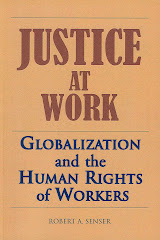
My book, “Justice at Work: Globalization and the Human Rights of Workers,” mentions Neil Kearney at points in four different chapters, but of course that falls far short of telling the full story. His action-packed life has story material for a dramatic movie, even if, or especially if, it focused on Bangladesh alone.
Print Page
Read more!
Wednesday, November 18, 2009
A shameful embrace of sweatshops in a book on oppression of women
 In their new best-selling book, “Half the Sky,” two New York Times writers, Nicholas D. Kristof and Sheryl WuDunn, make an eloquent appeal for ending the worldwide oppression of women. Unfortunately, they mar their case by arguing that sweatshops are actually good for women.
“Sweatshops have given women a boost,” they write. They acknowledge “inequities of garment factories – and they are real – the forced overtime, the sexual harassment, the dangerous conditions.” But, they argue, sweatshop jobs are preferable to hoeing fields all day back in the home village.
In most of their book, Kristof and WuDunn recount shocking examples of how women in many countries suffer as 21st century slaves. Still, some women do not remain passive. They stand up and fight against the prevailing culture of oppression and, against all odds, make progress, often with outside help from non-governmental organizations (and sometimes from Kristof personally).
Yet “Half the Sky” fails to recognize the many courageous initiatives of factory workers in Indonesia and some other countries to improve their lot. In fighting against extreme abuses, these young women, too, welcome all thw support they can get from anti-sweatshop groups in the United States and Europe, whose citizens buy the T-shirts, dolls, and other consumer goods the women make.
In a long endnote, the co-authors point out that “a feminist critique…has emerged to dispute our arguments,” a critique that “contains an element of truth.” For this very limited insight into reality, Kristof and Dubunn rely completely on feminist sources, as the endnote makes clear. Too bad that they didn't interview a few sweatshop workers. If they had done so, their insights might have been substantially less limited.
In the latest of his periodic efforts to discredit the anti-sweatshop cause, Kristof goes so far to recycle a 15-year-old rumor saying:
-- that after Senator Tom Harkin in 1993 introduced a bill (never passed) to ban the import of goods made by girls and boys under 14, Bangladesh garment owners “promptly fired tens of thousands of these young girls,' and
-- that “many of them ended up in brothels and are presumably now dead of AIDS.”
This story pops up regularly in articles opposing the use of trade legislation to improve labor standards (the point about the children dying of AIDS is a new wrinkle). I personally know two researchers, one a Bangladeshi, who have devoted extensive efforts to verify this old story but have discovered no evidence to support it.
“Half of the Sky” offers this recommendation: “Instead of denouncing sweetshops, we in the West should be encouraging manufacturing in poor country.” The implied assumption -- that the anti-sweatshop movement discourages manufacturing in poor countries – is false.
Here’s one example, reported at length by Steven Greenhouse in the November 18 New York Times.Soon after workers in a Honduras factory unionized, Russell Athletic, one of the country’s leading sportswear companies, closed the plants, making 1,200 workers jobless. That was a flagrant violation of the company’s licensing agreements.
Gearing up quickly, the United Students against Sweatshop launched a nationwide campaign in which, among other things, more than 100 colleges and universities agreed to sever or suspend their licensing agreements with Russell. Finally, over the September 14-15 weekend, Worker Rights Consortium, a USAS sister organization, signed a landmark agreement with Russell under which Russell will
-- reopen the Honduras factory with 1,200 rehired workers.
-- open another plant in Honduras to be covered by a union contract.
Moises Alvarado, president of the union at the closed plant, told the New York Times: “For us, it was very important to receive the support of the universities. We are impressed by the social conscience of the students of the United States.”
As its epigraph, “Half the Sky” uses the Chinese proverb, “Women hold up half the sky.” Ignoring the world’s oppressed female garment workers from a large fraction of that half is a blunder and a scandal.
Print Page
Read more!
Tuesday, November 17, 2009
Justice at Work: too optimistic?
Professor David Cingranelli, professor of political science at Binghamton University, got an “error’ report when he tried to leave a comment on my November 14 blog. He did finally get through by regular email with the following critique.I’ve been thinking more generally about your arguments in your excellent new book, “Justice at Work: Globalization and the Human Rights of Workers.” I love the book, but I think you are way too optimistic about the potential of Corporate Social Responsibility, anti-sweatshop movements, personal boycotts, and fair traded goods movements as ways to deal with the most negative effects of globalization on workers.
I also think national policies like the [proposed] prohibition on spending taxpayer dollars for goods made by forced child labor make Americans feel good, but are similarly ineffective. There are few incentives for US politicians to enforce the provisions of laws such as these, and, more importantly, if the unethical producers of such goods don’t sell them here, they will sell them somewhere else.
Only international norms promulgated by the United Nations through the ILO and enforced by the World Bank and IMF can effectively solve these problems. IMF and World Bank leaders resist this idea. But, unlike the WTO, both of these institutions are Specialized Agencies of the United Nations, and the United Nations’ twin missions, according to its own charter, are to promote peace and human rights. No UN entity can say that the promotion of human rights is not part of its own mission. In your blog you have reported on some small steps taken by the World Bank towards this end, but much more remains to be done.
Current policies of the IMF and World Bank are actually leading to reduced government respect for a wide range of human rights around the world. This fact is well documented in my recent book with Rodwan Abouharb, Human Rights and Structural Adjustment (Cambridge University Press, 2007).
Chapter 9 presents the results of a global, comparative study showing that, other things being equal, the longer a developing country has been under structural adjustment programs, the worse its respect for workers’ rights including freedom of association and collective bargaining.
Thank you for providing so much good information about the effects of globalization on the most vulnerable of the world’s workers. While I disagree with some of your opinions, your voice has helped me refine my own thoughts about this important subject.
-- David Cingranelli, professor of political science, Binghamton University.
(An undergraduate class of his had a two-week, six-hour discussion of Justice of Work.)
Print Page Read more!
Monday, November 16, 2009
Glaring contradictions in corporate social responsibility movement
Global corporations based in Europe are almost twice more likely than those based in the United States to have labor and human rights policies covering their global supply chains. But that doesn’t mean that the Europeans do better than their American counterparts in implementing their corporate social responsibilities.
The U.S.-Europe statistical discrepancy is revealed in a study released November 11 by the IRRC Institute: 43 percent of European companies have labor/human rights policies for their worldwide operations, whereas only 23 percent of American multinationals do. Moreover, those European corporate polices are more likely that the Americans’ to describe monitoring procedures, targets for improvement, and enforcement mechanisms.
At a conference on corporate social responsibility held in Stockholm on November 11, an international trade union leader, Jim Baker, gave concrete examples of glaring internal contradictions in the CSR movement. He cited this experience in particular:
“We have spoken with some European companies with interests in the U.S. who say they are committed to human rights, including a couple here in Sweden. We have asked them to disassociate themselves from the anti-union propaganda being used against modest legislation, the Employee Free Choice Act, to correct some of the abuses in U.S. labor law.Baker also described contradictatory behavior in the country of Georgia. There the government and trade unions, working with the most representative employers’ organization, proposed pro-worker reforms in the labor code.
“Although they say they are shocked by what is being said and done, not one has yet distanced itself from that anti-human rights corporate campaign.”
“Who is now blocking the reforms? The U.S. Chamber of Commerce in Georgia,” Baker said, adding that one of that chamber’s large patrons is a firm that, some years ago, made a lot of money doing CSR audits.
Baker, coordinator of the Council of Global Unions, was a speaker at a conference of the Swedish Presidency of the European Union, where John G. Ruggie, the UN Special Representative for Business and Human Rights, made the keynote presentation.
The Swedish Presidency formally renewed its support for Ruggie’s “Protect, Respect, Remedy” framework that the UN Human Right Council unanimously approved in June 2008. (For background, see my June 4, 2008. blog report on “This UN Work Seems Back on Track.)
“The Protect, Respect, Remedy framework gives us a path out of the make-believe world of CSR,” Baker said in his remarks. He went on to explain:
“The Ruggie framework makes it clear that business responsibility includes the respect of laws and international standards related to human rights….[It] is a good way to make sure that rights are respected in supply chains, in small and medium-sized enterprises and by competitors.”
Print Page Read more!
Saturday, November 14, 2009
No to spending taxpayer dollars for goods made by forced child labor
The U.S. government is taking steps to prevent federal agencies from buying goods made by forced or indentured child labor. The policy, if put into effect and enforced, would ban federal procurement of hand-made bricks, cotton, electronics, and toys made by abusive child labor in China, among other countries and other products.
At present, there are “gaping holes in federal procurement policy,” says Bjorn Claeson, executive director of SweatFree Communities. As a result, the U.S. government can now “purchase products made outside the United States in the most egregious sweatshop conditions.”
21 Countries on New List; Only One on Old
An “initial determination” by the Department of Labor on September 10 concluded that 29 products of 21 countries were made by forced or indentured child labor. The products of Burma are the most numerous to make the list – seven in all, ranging from beans (green, soy, and yellow) to teak.
The Labor Department’s action, taken in conjunction with the State and Homeland Security Departments, updates the 2001 list that implemented an executive order issued by President Bill Clinton two years earlier. Burma was the only country on that 2001 list, with 11 products.
According to Labor, the updated list is “based on recent, credible, and appropriately corroborated sources.” In the case of China, the sources of two of its citations, those for forced child labor in toy and electronic manufacturing, were a New York Times investigative article, reporting by the U.S. Embassy in Beijing, and a report by Macro International, a research and consulting firm.
The final decision on the list will come after the 90-day public comment period, that is, after December 10. Comments can be made by email to EO13126@dol.gov.
The 1999 Clinton executive order stands out as one of the very few governmental tools available to deter official purchases of sweatshop products. The executive order’s penalties are meager, however. Contractors are deemed in compliance simply by self-certifying that they are.
As a result, anti-sweatshop groups did not greet the September 20 Labor Department announcement with celebrations. But the human rights organizations themselves have yet to fully recognize the potential that the government procurement process has for promoting the common good.
Who will take the lead in convincing the Obama administration to strengthen the 1999 executive order 13126 on the “Prohibition of Acquisition of Products Produced by Forced or Indentured Child Labor”?
For more on this subject, see the previous (November 11) posting, "Moving to stop spending taxpayer money on sweatshop goods."CORRECTION: The 2001 Labor Department determination listed two countries, Burma and Pakistan, not just Burma.
Print Page Read more!
Wednesday, November 11, 2009
Moving to stop spending taxpayer money on sweatshop goods
The Federal government, according to official policy, can and does buy supplies made in sweatshops, foreign and domestic. A grassroots movement to change that is gaining strength.
Short of the federal level, 39 cities, 15 counties, eight states, and over 100 public school districts have already adopted procurement rules to ensure that the uniforms, shoes, and other products they buy for police, fire, and other public employees are not made in sweatshops.
Laying the ground work for extending such a ban to the Federal level was a major focus of the sixth annual “Sweatfree Communities summit” held in Washington, D.C., November 6-8.
“There’s a big gap in federal procurement policies,” says Bjorn Claeson, executive director of Sweatfree Communities, the non-profit organization that unites the movement.
A potentially ground-breaking document, “Principles for International Sweatfree Federal Government Procurement,” was released at a forum held on Capitol Hill on January 6. It is a five-page working draft compiled by Claeson with contributions from the AFL-CIO, the Change to Win union alliance, the International Labor Rights Forum, and other like-minded organizations.
To help member governments meet their sweatshop-free purchasing goals, Sweatfree Communities has recently formed the Sweatfree Purchasing Consortium. Still in the developing stages, it has two core functions:
-- Connect government buyers with suppliers pre-screened as sweatfree.
-- Serve as the contact and coordinating points for monitoring suppliers, investigating complaints, and achieving effective remedies.
Might any of these efforts conflict with the rules of the World Trade Organizations? Briefly, no; they are “WTO compliant,” says Claeson, whom I interviewed by phone.
Unfortunately, because of heath problems, I was unable to attend the summit. But I am impressed by what I read on two Websites and what I heard from Claeson. This is a movement whose time has come.
The two Websites, http://www.sweatfree.org, and a separate one for the consortium, http://buysweatfree.org, contain a surprising wealth of information. A particularly useful one for ordinary shoppers is the 2009 Shop with a Conscience Consumer Guide, with listings for women’s wear, men’s wear, baby clothes, footwear, outerwear, T-shirts, and sports equipment.
Among the 2009 Sweatfree Summit co-sponsors not mentioned here before are these: the Catholic Relief Services, the United Methodist Church Global Ministries, and Georgetown University Law School, which hosted all the sessions except for the one on Capitol hill.
Print Page Read more!
Wednesday, November 04, 2009
Looking at the economic world as it really is
“Real-world” economists now have a whole Weblog of their own. They have just launched it at http://rwer.wordpress.com with a series of articles that look at the economic world as it really is.
There you’ll find answers to questions mostly ignored by U.S. media. For example:
-- What country in Latin America is expected to have record economic growth this year even though it ignored the advice of the IMF and the U.S. business press?
-- Why are the investment rules in the pending U.S.-Colombia free trade agreement “dangerous, outdated, and out of touch with most of the [non-U.S.] trade agreements in the world”?
The first article is by Mark Weisbrot, co-director of the Center for Economic and Policy Research; the second, by Kevin P. Gallagher, professor of international relations at Boston University..
The new Real-World Economics Review blog replaces the Website of the same name, which is an outgrowth of the “Post-Autistic Economics” movement, the pioneer in re-thinking conventional economics.
Print Page Read more!

 Posts