Wednesday, June 24, 2009

Double standard on labor standards

You are an employer under pressure from corporate stockholders to increase the returns on their investment. You decide the way to do so is to slash your present and future labor costs by firing your current workers en masse and recruiting a set of new ones, people among the unemployed so anxious for a job that they accept anything you impose: sub-minimum pay, no vacations, a seven-day workweek, no sick pay, and other drastically lower labor standards associated with a sweatshop.

As an American employer, you would not be able to implement so radical a decision. It would be illegal. It would be bad public relations. It would also, in the eyes of most people, be immoral. You couldn’t get away with it.

But what if instead of hiring other workers in America, you hire workers overseas – foreign men, women, and children willing to work in the real sweatshops of the kind that dot the Asian industrial landscape.

In both cases you impose harm on Americans, and you undermine the progressive U.S. labor market practices built up over decades. Oddly, however, you would be judged harshly in one case and not the other. That’s because we draw a sharp line between the two radical moves, even though the effect in the United States is exactly the same.

Why does an illegitimate and unacceptable radical change in one case become legitimate and acceptable in the other? Simply because one radical change is consummated across borders under the protection of international trade laws that are deemed superior and not be interfered with.

The above paragraphs reformulate a crucial policy inconsistency conveyed by Dani Rodrik, professor of international political economy, in his June 16 talk at the London School of Economics. In outlining the possible future of capitalism (see my June 21 posting) he briefly discussed labor standards as an important globalization issue that needs to be much better understood.

“And yet,” he added, “we have no good way of even talking about this.”

Why is the labor standards issue so little talked about in Washington power circles these days?

Mostly, I think, because the agenda-setting power circle has made up its collective mind on this issue. The unspoken assumption is that today’s trade rules, despite some flaws, are sufficiently legitimate and really have nothing to do with the grave harm imposed on American workers.

Rodrik’s 90-minute talk, as recorded on video, is a good short overview of why the flaws are threats to globalization itself. His video presentation on “Capitalism.3.0” can be found on the London School’s Website. The quickest way to access it is through Rodrik’s June 18 posting on his Weblog at http://rodrik.typepad.com/

Print Page Read more!

Sunday, June 21, 2009

Envisioning a Reborn Capitalism

The present global economic crisis has shaken capitalism down to its roots. What will, or should, replace it? Dani Rodrik, professor of political economy at Harvard’s school of government, dealt with that question on June 16 in a public lecture at the London School of Economics.

Rodrik warned against making two opposite mistakes in reacting to the crisis: returning to the protectionism of the 1930s (unlikely, unless the U.S. succumbs to even deeper recession) or making “an ambitious effort to take economic globalization to the next level.”

But neither approach would address what Rodrik rightly considers the fundamental problem of the world economy: “the imbalance between the reach of markets (global) and the scope of their governance (mostly national).”

For a Moderate, Moderated Globalization

The scenario that Rodrik advocates is “an intermediate level of globalization.” Its key element: allowing countries to retain much greater domestic “policy space” when domestic requirements conflict with the requirements of international integration. (In other words, a serious need of a country’s own citizenry should trump WTO rules.)

Rodrik’s intermediate level of globalization would not be “a retreat from globalization per se” but a retreat from the gung-ho globalization of the post-1990 years. Unfettered financial globalization and free capital mobility would lose their power as driving forces under his vision of Capitalism 3.0, the assigned title of his London talk.

A major reality that Rodrik recognizes is that “democratic governance and political communities are organized within nation states, and are likely to remain so in the immediate future.” So it is still up to nation-states to act in concert toward Capitalism 3.0 under "guidelines" such as the following:

There is no “one way” of globalization: institutional designs that underpin market economies will differ according to domestic preferences and needs.

Non-democratic countries may be subject to more restrictive global trade/investment rules “since it cannot be presumed that their choices reflect the needs of their citizenry.”

“Like-minded” nations would be able to “deep integrate” (pursue a high degree of free trade and other mutual economic arrangements).

Where deep integration is not feasible or desirable, the countries would rely on “traffic rules” to manage the interface among the various national institutional arrangements.
It is in his “traffic rules” that Rodrik offers some details on putting the “guidelines,” or general principles, into specific rules. What might such traffic rules look like? In the Power Point presentation of his talk, he offers two sets of traffic rules – “illustrations,” not blueprints.

-- Regarding WTO trade rules, for example, he proposes a special “development box” for developing countries to exempt them from some currently prohibited practices that don’t fit their situation.

-- Among the traffic rules for finance, he proposes recognition of the right of governments to interfere in cross-border financial flows that undermine a country’s own regulations.

A video of Rodrik's presentation can be accessed through the June 18 posting on his Weblog at http://rodrik.typepad.com.

Rodrik’s latest book is "One Economics, Many Recipes: Globalization, Institutions, and Economic Growth." His writings appear regularly in the world press through an international press service called Project Syndicate.

The Vatican is expected to release a new document (called an encyclical) by Pope Benedict XVI late in June. Once scheduled to be released in September last year, the encyclical’s publication was delayed to take into account the economic crisis. Judging by previews given orally and in writings by the Pope, its analysis of globalization will be remarkably similar to Rodrik’s.

Print Page Read more!

Thursday, June 18, 2009

‘Globalization and Us’ in Blueprint

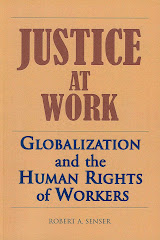
“Globalization and Us,” the concluding chapter of my book, Justice at Work, is featured in the current issue of Blueprint for Social Justice, published by the Twomey Center for Peace Through Justice at Loyola University in New Orleans.

The chapter
includes 15 propositions that form a proposed paradigm for dealing with globalization issues confronting us. Blueprint highlights one of the 15 in large type:

“The heart of the [globalization] reform movement should be to make the Universal Declaration of Human Rights more universal in international business, with close attention to the rights of workers, particularly women workers, who are more vulnerable to exploitation than are men.”
An article of mine, “Human Rights: Ten Objections Answered,” appeared in the December 1993 Blueprint. I wrote it to respond to major criticisms of human rights, especially worker rights. At the time I was working at the AFL-CIO’s Asian-American Free Labor Institute, which is now part of the federation’s Solidarity Center.

Loyola’s Twomey Center is named after the late Rev. Louis J. Twomey, S.J., a battle-scarred Southern champion of human rights for all.

Print Page Read more!

Tuesday, June 16, 2009

Save Capitalism? Well, that depends…

...That depends on the kind of capitalism. Some kinds aren't worth saving.

Not the kind that, as a result of the current financial crises, is inflicting more than $2,000,000,000,000 in total losses on the United States and the world.

Not the kind that values the manipulation of money over the production of goods and services.

Not the kind that treats labor as a commodity, a thing like shipload of coal or garbage.

Not the kind that furiously opposes legislation such as the proposed Employee Free Choice Act, which would help give workers and their organizations a right now enjoyed by business people and their organizations.

Not the kind that uses free trade and investment agreements to grant global rights and privileges to business and business organizations without any commensurate responsibilities.

Not the kind that uses its money and muscle to acquire and exploit vast tracts of land in distant lands no matter the harm done to indigenous peoples.

Not the kind that generates unprecedented luxuries for the few while millions and millions live in misery.

“Greed Is Good (to a point)” is the title of an essay by Fareed Zakaria in the current Newsweek. That’s catchy but grossly misleading. It’s like writing an essay on teen-age pregnancy and titling it “Lust Is Good (to a point).”

But Zakaria wisely recognizes that “the fundamental crisis we face is of globalization itself.” He goes on to explain:

“Technology has created worldwide supply chains, companies, and customers. But our politics [i.e., policymaking] remains resolutely national. The tension is at the heart of the many crashes of this era – a mismatch between interconnected economies that are producing global problems but no matching political process that can effect global solutions.”

For the ful text of Zakaria’s essay, see News Week on line at
http://www.newsweek.com/id/201935.

Print Page Read more!

Friday, June 12, 2009

20,000,000 girls under 12 work fulltime


About 100,000,000 girls in the world go to work instead of to school, according to estimates of the UN International Labor Organization. More than half of these, or 53,000,000, work in hazardous jobs in agriculture, manufacturing, mining, domestic services, and commercial sex, and 20,000,000 of these girls are under 12.

To remind people of this stain on the 21st century, unions and human rights organizations throughout the world observed June 12 as World Day Against Child Labor, with special emphasis on the goal of Give Girls a Chance.

This year marks the 10th anniversary of the ILO convention 182, which is dedicated to eliminate the worst forms of child labor.
What can you do? The International Labor Rights Forum suggests pressuring Hershey, Mars, and Nestle to stop using child labor. For specifics, see the ILRF Website at http://www.ilrf.org/."

Print Page Read more!

Thursday, June 11, 2009

Protesting Very Foreign Investments

Led by an indigenous organization, tens of thousands of Peruvian Indians have for many months been engaging in non-violent protests against gas and oil exploitation of their ancestral lands. Then on June 5, when government forces in helicopters and on foot clashed with protesters blocking a road in an Amazonian province, at least 11 police officers and 30 Indians were killed and many more were wounded.

The specific aim of the protest is to cancel government legislation enacted in implementing the investment provisions of the Peru-U.S. free trade agreement, signed by President Bush in December 2007.

President Alan Garcia says the legislation will spur development. Indian opponents say it opens up communal lands and water resources to exploitation by foreign investors. Last month the nine Roman Catholic bishops in the Amazon issued a declaration calling the Indians’ complaints legitimate.

They condemned the “cruel and inhuman effort to make decisions about the possessions of riverine and Amazonian communities because they lack the legal means to defend their just demands, even in their own country.”

Thirsting for Distant Lands

The conflict in Peru comes amid an international surge in foreign investment not just by multinational corporations but also by governments and various others entities, including hedge funds and commodity traders.

“A Thirst for Distant Lands: Foreign investment in agricultural land and water,” a report released in May by the International Institute for Sustainable Development, notes that the Gulf States, China, Japan, and South Korea are also acquiring vast plots of land abroad to produce food, animal feed, and energy crops for home consumption.

As in Peru, these foreign acquisitions are generally legal, as legal is traditionally understood, that is, in accord with domestic law, even when adopted under foreign government pressure in negotiations for free trade/investment agreements. But that justification overlooks two modern realities: that rich countries promoting those agreements also advertise human rights, freedom, and democracy, and that those advertisements now instruct far-away people whose rights are violated.

More and more, then, there comes into play a factor that John Ruggie, UN special representative on human rights and business, calls a “social license.” Human rights violations can become so egregious, so intolerable that, no matter the legal license, victimized people get themselves organized to protest and to shout loud and clear Stop! No More!

That has happened in Peru.

One more challenge testing the Obama administration’s policy on foreign trade and investment.

Print Page Read more!

Saturday, June 06, 2009

Balance investor rights with responsibilities

It’s time to replace a foreign trade/investment model that has not worked, as Thea Mai Lee, AFL-CIO policy director, has repeatedly emphasized in Congressional testimony and talks at conferences dealing with the current economic crisis.

In Congressional testimony on May 14, she singled out a critical but often ignored element that belongs in a new trade/investment model: a “balanced” treatment of foreign investment.

“While we understand and support the importance of protecting the rights of investors,” she said, “we believe that existing investment provisions in U.S. investment and trade agreements are imbalanced in two crucial aspects:

“First, they significantly enhance the rights of investors vis-à-vis governments, but they fail to establish commensurate responsibilities for investors, particularly with respect to workers’ rights and the environment.

“Second, they give substantive rights and procedural advantages to foreign investors that are not available to domestic investors. This raises the possibility that investment tribunals can be used to circumvent the democratic process and to achieve regulatory outcomes in a secretive and inaccessible forum. Certainly the experience with the investment chapter of the North American Free Trade Agreement (NAFTA) and current BITs [bilateral investment treaties] reinforces these concerns.”
As now written, she said, the pro-investor language “facilitates and accelerates the offshoring of American jobs – precisely because for the most part there has been no commensurate set of investor obligations.”

Lee is co-chairing a subcommittee of the State Department’s advisory committee on international economic policy to review and critique the draft model BIT.

The United States has 40 BITs in force and 10 Free Trade Agreements with provisions protecting investment, plus a separate multilateral agreement under the World Trade Organization for the same purpose.

Print Page Read more!

Friday, June 05, 2009

Black poverty and globalization

Why is it that so many millions of blacks in Detroit, Philadelphia, Los Angeles, and other American cities are mired in poverty? Don’t put blame exclusively on past and present policies designed to discriminate against blacks. There are also other reasons, much neglected and very durable: policies that, on their face, are non-racial but actually do contribute indirectly and yet effectively to the plight of urban blacks in the United States.

That summarizes the main message that William Julius Wilson, Harvard’s distinguished professor of sociology, projects in his new book, More Than Race: Being Black and Poor in the Inner City. He himself calls it the most important point of the book.

Here is one example of the seemingly race-neutral government policies (i.e., not motivated to control or exclude persons by race) that he cites: “Mortgage-interest tax exemptions and mortgages for veterans jointly facilitated the out-migration of working- and middle-class families from inner-city neighborhoods, leaving blacks isolated in central cities.”

In a class all by itself is globalization. Wilson prefers terms like “complex global economic transformations” and tracks the profound negative impacts on urban blacks.

One impact is the creation of greatly increased demand for workers at the two poles of the labor market. Wilson describes the unintended racial consequences in documented detail.

At the bottom end of the pay and skill scales, the increased demand for workers should have been a boon for inner-city blacks, who generally rank low in job skills. However, the urban manufacturing industries that once provided equal job opportunities by the millions have largely moved abroad, thanks to the combination of U.S. free trade and investment policies and the foreign attractions of low wages and weak labor protection laws weakly enforced.

Meanwhile, at the top end of the expanded labor market, thanks to a decline in racial discrimination, many better educated blacks landed well paying suburban jobs, as managers and professionals, for example. They and their kin joined the general exodus of American urbanites into the suburbs.

The black poor who were left behind thereby became more concentrated in poor communities, and more isolated from the rest of America. For the army of unemployed and underemployed black men, this was a double whammy. Black women, who have traditionally had jobs in the service industries, were more fortunate. Most service industries can’t escape to other countries.

Wilson, who is black, used to believe that public policy should be color blind-. He felt that race-neutral agendas would be the most realistic way to win the necessary broad political support for improving the lot of the poor, blacks included.

He has changed his mind. He now sees that the special situation of urban blacks justifies a special approach and that it is urgent to educate the public accordingly. More Than Just Race (meaning More Than Just Overt Racism) is part of that education.


Print Page Read more!

Wednesday, June 03, 2009

Coming: a new U.S. ‘framework’ for trade

President Obama will soon be outlining a new “framework” for international trade. Ambassador Ron Kirk, the President’s trade representative, confirmed that on June 2 in remarks to the U.S.-China Business Council in Washington.

Recognizing that trade “has the potential to lift up workers in America and around the world,” Obama holds that future trade agreements need to have strong, enforceable labor and environmental standards, Kirk said.

Hanging over U.S.-China relations is the fact that China alone accounts for about half of the U.S. trade deficit with the whole world. In the first quarter of this year, the United States imported $64,810,000,000 in goods from China, while exporting only $14,426,000,000.

Ambassador Kirk did not cite these figures, but spoke of “the extraordinary opportunities for job creation here in the United States if we shrink our trade imbalance with China, and if China further opens its market to U.S. goods and services.”

Complicating those two if’s is that about a quarter of the U.S. imports from China is in “intra-firm” trade, that is, cross-border transactions between different branches of the same firm.

Print Page Read more!

Wednesday, May 20, 2009

Workers punished in war against unions

Private employers in the United States are relying more than ever on coercive and punitive tactics against workers seeking their legal and moral right to union representation.

Punishments include firing, threatening to fire, threatening to close the worksite, reducing wages and benefits, close monitoring of personal activities, and various forms of harassment, which in combination create an atmosphere of fear.

Further, employers often frustrate unionization by delaying the secret ballot vote that the National Labor Relations Board (NLRB) conducts to decide on union representation. In the most egregious cases, those elections were stalled by three to five years.

Evcn when the NLRB does hold an election and even when the union “succeeds in making it through all the hoops that it takes to win the election,” employers can fight on by actively resisting the workers’ right to a collective bargaining contract. In fact, according to NLRB data for the 1999-2003 period, 52 percent of newly formed unions had no collective bargaining contract one year after a successful election, 37 percent none after two years.
Those are some highlights of scandalous employer behavior, legal, illegal, and quasi-legal, described in the study No Holds Barred: the Intensification of Employer Opposition to Organizing released May 20.

“Our labor law system is broken,” Cornell University professor Kate Bronfenbrenner. author of the five-year study, concludes toward the end of her 31-page report published by the American Rights at Work Foundation and the Economic Policy Institute.

A Three-Front War

Yes, the report documents that the system is broken. But it also offers the latest evidence that many individual employers and the key employer organizations in the United States are waging an aggressive war against unions and against a basic human right – the right of workers to form a union and to have it operate as a union.

So it should be no surprise that American organized business is also waging that war on two other fronts (neither mentioned in the new report):


-- It is fighting tooth and nail against the Employee Free Choice Act, which would go a long way toward fixing a broken system.

-- It is internationalizing that anti-union and anti-worker war by its relentless opposition to having free trade and investment agreements protect the rights and interests of workers and worker organizations in the way those agreements already protect the rights and interests of business people and business organizations.

In an interview published May 20 in the New York Times, Randall K. Johnson, a U.S. Chamber of Commerce vice president, questioned Dr. Bronfenbrenner’s objectivity, but did not address the substance of her report. As of 2 p.m. May 20, I could find no relevant statement on the Chamber’s Website.


Print Page Read more!

Tuesday, May 19, 2009

Campaigning against 'toxic' economics

In the ‘90s college students taught their elders in academia that sweatshops were an evil in which the schools were complicit by selling sweatshop-made products in their own bookstores. Will this generation of college students again teach their elders, this time to the fact that the economic textbooks commonly used in their classrooms are promoting dangerously “toxic” economic policies?

“Toxic textbooks helped cause the economic meltdown,” states a petition being circulated worldwide to press for reforming what it calls the “mass miseducation” of millions of students each year “in a quaint ideology...cunningly disguised as a science.”

The campaign is aimed particularly at students because reform by the profession itself won’t happen “without massive pressure from the student body,” writes Steve Keen, an economist at the University of Western Sydney, Australia.

Textbook reforms are blocked by “vested interests,” including economic departments whose reputations are intertwined with the textbooks they use, endorse, and (in some cases) write. A new Website, Toxic Textbooks, and a Facebook group with the same name, Toxic Textbooks, have been created to help mobilize people, especially students, “to overcome these vested interests.”

So far the campaign has not made a recommendation on alternative textbooks. The Website has a question mark under a section titled “non-toxic textbooks.”

Here is what I posted to the Facebook discussion of “What and where are the alternatives?”:

It is probably impossible quickly to find a full-blown alternative text book, or create a single Website that formulates the key points of an alternative economic paradigm. We will have to make do with pluralism in textbooks and Websites. Patch work? Well, it's a good way to start.

I would like to point to two of my own contributions to this initiative:

1. My newly published JUSTICE AT WORK: GLOBALIZATION AND THE HUMAN RIGHTS OF WORKERS. Its main theme: the present unbalanced global economy, especially its trade and investment regime, protects the rights and interests of business and business organizations, to the exclusion of the rights and interests of workers and worker organizations. Check it out at .

2. My Weblog, Human Rights for Workers, at http://humanrightsforworkers.blogspot.com, which deals mostly with the main theme of the book.
This is a continuing real-life drama. Why not join it?


Print Page Read more!

Saturday, May 09, 2009

It's no time to relax worker rights pressures

The current economic crisis has the potential of exposing and correcting two “fatal flaws” of the corporate social responsibility programs, says Garrett Brown, a health and safety expert and longtime campaigner for worker rights.

In a May 7 article for a professional health and safety publication, Brown identifies those flaws as follows:

1. “The schizophrenic business model that demands the lowest possible production costs at the same time [demanding] full compliance with national laws and corporate ‘codes of conduct,’ and
2. “The lack of any meaningful participation by workers.”
That’s the potentially good news. The bad news, Brown writes, is that the deepening economic crisis “threatens to accelerate to light speed the ‘race to the bottom’ in working conditions that two decades of globalized production has meant for most workers around the world.”

He argues that the economic crisis is all the more reason to pressure governments and companies to develop worker participation, particularly in enforcing occupational safety and health standards in offices and plants.

In the May 7 column he writes: “Even in the best of times, safe workplaces are next to impossible without genuinely empowered workers –and are completely impossible at times of economic crisis when downward pressures intensify.”

As one example of downward pressures, he cites recent actions taken by China’s government to appeal to foreign investors: freezing scheduled increases in minimum wages, reducing or suspending employer payments into the social insurance system, restoring export tax credits, and passing word that the new labor protection laws of 2008 won’t be seriously enforced.

Brown has been the coordinator of a health and safety support network with projects in Central America, China, Mexico, and Indonesia since 1993. His article, titled “Corporate Social Responsibility,” appears in the Industrial Safety and Health News.

Print Page Read more!

Tuesday, May 05, 2009

Stop squelching real unions, Vietnam

As part of a campaign to suppress any labor union independent of the Communist Party, the Socialist Republic of Vietnam has imprisoned at least eight trade unionists, two of them women, on “national security” charges in the past three years.

In a report released May 4, Human Rights Watch publicized the wide scope of the government crackdown, denounced it, and urged the United States to pressure Vietnam to end suppression immediately.

The government campaign of harassing, detaining, and imprisoning union activists is aimed particularly at two worker organizations: the United Worker-Farmers Organization of Vietnam and the Independent Workers Union of Vietnam, whose launching was announced in late 2006 during a brief period when authorities seemed to tolerate a budding civil society.

It was a temporary public posture prior to Vietnam’s joining the World Trade Organization and getting U.S. approval for that accession.

Of the eight trade unionists imprisoned since then, five have been released. One who is still behind bars, Le Thi Cong Nhan, in her early 30s, wrote a comprehensive essay in 2006 titled “Legislative Aspects of Industrial Actions and the Need for Independent Unions in Vietman.” For this and other human rights activities, the Hanoi People’s Court in May 2007 imposed a four-year prison sentence, later reduced to three years (plus three years of house arrest), on charges of “disseminating propaganda against the government.”

The Human Rights Watch report, “Not Yet a Workers’ Paradise: Vietnam’s Suppression of the Independent Workers’ Movement,” 32 pages long, is available on the HRW Website at
http://www.hrw.org/en/reports/2009/05/03/not-yet-workers-paradise.

Print Page Read more!

Friday, May 01, 2009

Crisis or not, business-human rights link holds

Should business and government shelve human rights concerns during the current global economic crisis? Of course not. It was the obsession with money as the supreme value, trumping all other values, that got us into this mess, and it would be folly to rely on that obsession now.

A senior UN official has added his voice against the temptation to make human rights a casualty of the crisis. John Ruggie, the Special Representative of the UN Secretary-General on human rights and transnational corporations, did so in his April 22 report to the Human Rights Council.

He buttressed his argument mainly with these points:

The business and human rights agenda matters now more than ever. “Any gains Governments believe can be had by lowering human rights standards for business are illusory, and no sustainable recovery can be built on so flimsy a foundation.”

“The same types of governance gaps and failures that produced the current economic crisis also constitute what the Special Representative has called the permissive environment for corporate wrongdoing in relation to human rights.” Governments promoting greater corporate responsibility, and corporations adopting human rights strategies, both reflect “the now inescapable fact that their long-term prospects are tightly coupled with the well-being of society as a whole.”

In his report, the first in his current three-year mandate, Ruggie noted the beginnings of a positive trend in corporate law: governments and courts are introducing “more public interest considerations” into what companies do and how they do it.

He cited Denmark, India, South Africa, and the United Kingdom as taking preliminary steps in that direction. As for the United States, "federal statutes require publicly listed companies to have robust programs to assess, manage, and report on material risks. None refers to human rights explicitly, but material risks clearly do encompass human rights issues."

To fill information gaps, 19 leading law firms from around the world have volunteered their services to survey corporate law provisions in over 40 jurisdictions.

Print Page Read more!

Sunday, April 26, 2009

Myopia Still Hampers WTO

It is up to the United States “to make history” by leading the way to a revival of the stalled Doha Round of trade negotiations, says Pascal Lamy, director-general of the World Trade Organization.

In making that case in a Washington talk on April 24, Lamy emphasized that open trade needs to be “accompanied by the right domestic policies.” His list of those policies includes:

-- “better worker training, greater mobility in labor markets, more expansive social safety nets."
-- “investing in critical areas such as health care, education, and clean energy.”
-- “greater investment in physical, social, and government infrastructure, which helps increase the benefits of trade.”

“The presence of these domestic policies,” he explained, “provides a layer of comfort to workers who are then better prepared to face global competition since they know there are social safety nets that will catch them when they fall.”

In warning against protectionist measures, Lamy said: “It is not less trade that the United States needs, but more and better domestic policies,…policies which help translate trade into benefits for the people. This is where the task of reconciling the people with trade must start [emphasis added].”

While detailing the domestic policies that need to be changed for the sake of workers, he neglected to mention any WTO policies that might need change to take account the rights and interests of workers. These are controversial of course, but so are the domestic policies he advocates.

Ironically, at least in the United States, the business groups most eager to restart the Doha negotiations are also those most zealous in opposing the domestic policies that Lamy deems necessary to give “comfort” to working men and women.

In his talk, given at the Peterson Institute for International Economics, Lamy called upon U.S. business, academics, and political leaders to rally behind the WTO during what he called “the first global crisis in the history of mankind.” Yet, except for his ideas on needed domestic programs, he relied on the same free trade rationale that has been persuasive for 60 years but now is seriously questioned by influential economists and others in rich and poor countries alike.

Back in 1993, a Heritage Foundation memorandum analyzing the pre-WTO General Agreement on Tariffs and Trade (GATT) called it “the closest thing to a uniform commercial code for world trade.” The WTO is still devoted to devising and enforcing an improved global code for commerce, but the world needs more than that.

Lamy’s talk reflects some innovative WTO ideas on the internal policies of the United States and other countries. Especially in the present crisis, Pascal would be wise to start rethinking the WTO’s own policies.
* * *

I have long criticized the WTO for its unbalanced agenda. See, for example, “The WTO's Lop-Sided Agenda for the World,” in December 2001. For a more recent analysis, see the blog posting of April 20, immediately below this.

Print Page Read more!

Monday, April 20, 2009

President Obama’s basic choice on trade

As the Obama administration wrestles with shaping its policy on the World Trade Organization (WTO), the old questions about fairness and equal treatment pop up once again.

Fairness?
(I can hear the loud objections.) Why sidetrack the WTO into controversies about fairness and equal treatment?

It may come as a surprise to some that the WTO is already committed to equal treatment. That commitment is so basic that it is expressed in two principles that the WTO calls “the foundation of the multilateral trading system.”

These two principles, both formulating “trade without discrimination,” are:

“1. Most-favored-nation (MFN): treating other people equally….Grant someone a special favor (such as a lower customs duty rate for one of their products), and you have to do the same for all other WTO members.”

“2. National treatment: treating foreigners and locals equally. Imported and locally produced goods should be treated equally….The same should apply to foreign and domestic services, and to foreign and domestic trademarks, copyrights, and patents.”
Those two principles, here quoted from an official document, “Understanding the WTO,"are written into all three key WTO agreements, the General Agreement on Tariffs and Trade (GATT), the General Agreement Trade in Services (GATS), and the Agreement on Trade-Related Aspects of Intellectual Property Rights (TRIPS).

Why does equality of treatment have such a fundamental role in the WTO as in the trading system as a whole?

Because it is fair to those whose rights and interests it is designed to protect – the business people and firms engaged in international commerce. The laws of individual countries were not – and are not -- adequate to offer that protection. After World War II, policymakers of leading nations agreed to correct that particular gap, and created the first versions of GATT the agreement and GATT the organization, both focused on business.

Even at the beginning, some leaders recognized that the focus on business was one-sided and needed to be corrected to include the rights and interests of workers and their organizations. Those efforts failed then, and have failed ever since.

The challenging trade issues now facing the Obama administration can be reduced to three statements:

1. The world trade and investment system does not protect the rights and interests of workers and worker organizations as it does the rights and interests of business and business firms.

2. That imbalance is unfair, and is increasingly recognized as unacceptable -- a trend that partly accounts for the widespread disenchantment with globalization.

3. The challenge is to decide what actions, short range to long range, are necessary to correct that imbalance.

Adopting a WTO agreement on Trade-Related Aspects of International Labor Standards (TRAILS) would be a historic achievement, but not a cure-all. Biased ideas toward work, workers, and worker organizations are imbeded in our culture. Curing them requires a multi-faceted approach.
* * *

This crisis should not go to waste


“Anonymous” makes the following comment about my previous post (below), titled “Oust U.S. financial oligarchy: economist”
“I'm so not listening to economists these days, Bob. Let's hear from people who are breaking out new mobilization ideas - the grass-roots cannot be rallied with what this-or-that economist says. Get the agit-prop, resistance-inspiring and activists' victories stories out there, before this moment passes!”

My view: Let a thousand flowers bloom. Including those among economists.


Print Page Read more!

Friday, April 17, 2009

Oust U.S. financial oligarchy: economist

Every country has its dominant elites, oligarchs of one kind or another. The challenge is to change them when they get too powerful. The United States, too, has its oligarchy, the banking/financial industry, which has grown so powerful that it thrives on the chaos it created and blocks essential reforms. Ousting the oligarchy must be accomplished soon, or else we may well suffer not just a repeat of the Great Depression, but something worse.
That paragraph summarizes the unsettling message of “The Quiet Coup,” an article in the May issue of The Atlantic by Simon Johnson, a former chief economist of the International Monetary Fund (IMF). Now a professor at MIT, Johnson draws on his experience at the Fund to describe the typical plight of “emerging market” countries in a desperate economic situation.

“The biggest obstacle to recovery is almost invariably the politics of the countries in crisis….The powerful elites within them overreached in good times and took too many risks,” he writes. Then, in the downward spiral that follows “the oligarchs are usually among the first to get extra help from the government.” But an economic reform program succeeds “only if at least some of the powerful oligarchs who did so much to create the underlying problems take a hit.”

Johnson compares the situation of troubled emerging market countries with that of the United States, except that here it’s much worse, as he sees it. “Just as we have the world’s most advanced economy, military, and technology, we have its most advanced oligarchy” -– the banking/financial industry.

Economist Jagdish Bhagwati’s name for this oligarchy is the “Wall Street-Treasury complex,” a powerful network he describes as “unable to look beyond the interests of Wall Street which it equates with the good of the world.” Like Bhagwati, Johnson illustrates its influence by tracking the back-and-forth movement of its leaders between Wall Street and top federal government posts in both Democratic and Republican administrations.

In a key insight, Johnson writes: “The American financial industry gained political power by amassing a kind of cultural capital – a belief system…[that held] that what was good for Wall Street was good for the country…In a society that celebrates the idea of making money, it was easy to infer that the interests of the financial sector were the same as the interests of the country.”

What followed in the past decade is what Johnson calls “a river of deregulatory polices that is, in hindsight, astonishing.” Three items from his list of seven:

-- The insistence on the free movement of capital across borders.
-- Major increases in the amount of leverage [borrowing] allowed to investment banks.
-- A light (dare I say invisible?) hand at the Securities and Exchange Commission in its regulatory enforcement.

The environment, or at least public opinion, has now changed, but “financial elites have continued to assume that their position as the economy’s favored-children is safe, despite the wreckage they have caused.” And the government itself “has taken extreme care not to upset the interests of the financial institutions, or to question the basic outlines of the system that got us here.”

For Johnson, “the government’s velvet-glove approach with the banks is deeply troubling, for one simple reason: it [doesn’t] change the behavior of a financial sector accustomed to doing business on its own terms, at a time when that behavior MUST change.” Instead, big banks have a veto power over public policy, despite their loss of popular support.

The solution? Johnson’s advice, as he puts it, is similar to the advice that the IMF, and the U.S. government, has given to developing countries in deep economic trouble: temporary nationalization of hopelessly insolvent banks. Instead, the U.S. Treasury is trying to negotiate bailouts bank by bank, and “behaving as if the banks hold all the cards.”

Meanwhile, in foreign trade and investment policy, an area not examined by Johnson, the Obama administration has signaled that it will ask Congress to ratify the three still pending Free Trade [and investment] agreements negotiated by the Bush administration with Columbia, Korea, and Panama. There likely will be changes in the contents, but none in how the agreements extend Wall Street’s power in the global economy and hence in the United States also.

Johnson’s overall assessment: “The Obama administration’s fiscal stimulus [program] evokes FDR, but what we need to imitate here is Teddy Roosevelt’s trustbusting.” Its operating principle would be: “Anything that is too big to fail is too big to exist.’

The article’s closing analysis is dire:
“What we face now could, in fact, be worse than the Great Depression – because the banking sector is now so big. We face a synchronized downturn in almost all countries, a weakening of confidence among individuals and firms and major problems for government finances. If our leadership wakes up to the potential consequences, we may yet see dramatic action on the banking system and a breaking of the old elite. Let us hope it is not then too late.”
To learn more about Johnson’s ideas, see the Website he co-founded, BaselineScenario.com.

Print Page Read more!

Thursday, April 16, 2009

Doubting WTO chief Pascal Lamy‘s Doha data


The top executive of the World Trade Organization (WTO) got an unusual public rebuke April 14 during an informal session in Geneva of the WTO trade policy review board, made up of representatives of the organization’s full membership.

India’s trade envoy, Ujal Singh Bhatia, challenged a forecast that WTO Director-General Pascal Lamy made in his latest report on trade and the current economic and financial crisis. Bhatia specifically questioned Lamy about how he arrived at the figure of $150,000,000,000 as the potential “stimulus” benefit that would result if the stalled Doha Round succeeded.

He cautioned against repeating figures “not supported by hard data.”

“In the last few years I have seen numbers ranging from $400,000,000,000 to $40,000,000,000,“ Bhatia said, citing a statement of economist Peter Galbraith that “the only function of economic forecasting is to make astrology look respectable,” according to a report of the Business Standard of India.

In his remarks at the meeting, Ambassador Peter Allgeier, deputy U.S. trade representative, said that the U.S. remains committed to conclude “an ambitious and balanced” Doha Development Agreement. According to a USTR release, he added: “In this regard, we support India’s request for details on the $150,000,000,000 figure in the report for estimated tariff savings from DDA.”

In his response, Lamy defended his figure as neither “rocket science” nor “astrology” but based on “the revenues foregone” from the tariff cuts proposed last July as part of the Doha round. His report to the meeting explains in detail why “The Doha Development Round is the best stimulus package.”

Print Page Read more!

Wednesday, April 15, 2009

Your Federal tax burden eased

Although people complain much about taxes, the fact is that, for taxpayers in most income groups, the share of their income going to Uncle Sam is close to their lowest levels in decades.

That may not be very comforting for people who filed their IRS returns this spring, but facts are facts, and the Center on Budget and Policy Priorities laid them out blandly in a report on April 14.

Take a median-income family of four. It paid only 5.9 percent of its income in federal income tax in 2007, slightly higher than the 2003 all-time low of 5.3 percent. In fact, that family’s tax rate was lower in 2007 than in any year between 1956 and 2002.

Of course, the highest-income households fared better, and those at the top of the pyramid are faring much better. For example, in 2010, when the 2001-2008 tax cuts are fully in effect, households with annual incomes of more than $1,000,000 a year will receive tax reductions averaging $168,000, whereas households in the middle fifth of the income distribution will average $1,150.

The Center on Budget and Policy Priorities is an equal opportunity collector and interpreter of vital national statistics. This report draws on, analyzes, and updates data from the Treasury Department, the Congressional Budget Office, the Brookings Institution, the Tax Policy Center, and other sources, including groundbreaking work on income inequality by two economists, Thomas Piketty and Emmanuel Saez.

Print Page Read more!

Monday, April 13, 2009

More 'informal' Asian workers = more exploitation

Companies in Asia are relying more and more on labor in the “informal sector,” to the point that “informal workers” now comprise as much as two-thirds of the region’s labor force.

So says the Hong Kong-based Asia Monitor Resource Center (AMRC) in a new report, “Rights for Two-Thirds of Asia.” The 274-page publication tracks the labor law and practices prevailing in the “unregistered” activities in the industrial, agricultural, and services sectors of 14 Asian countries, and finds that increased number of informal workers, most of them female, means increased exploitation of the most vulnerable.

“Overall, the Race to the Bottom penalizes virtually everyone in the labor force, particularly those in the informal majority – in both the formal and informal economies,” writes Rene E. Ofreneo in the introductory chapter of what is the latest edition of the AMRC’s Asian Labor Law Review.

Ofreneo, a professor of industrial relations at the University of the Philippines, poses a question raised in a 2006 UNDP report: The fast-growing Asian-Pacific region has embraced free trade, but has free trade embraced free trade? “The answer by the [22] contributors to the 2008 Labor Law Review is a uniform No,” she points out.

The most remarkable part of that failure is this. The informal workers are no longer just street vendors, home workers, or farm helpers.

They are also women and men who once did regular jobs such as packaging, maintenance, and security for a company and who now do the same work in the same office or factory. The only difference is that they are now working under an imposed “contract” status with fewer benefits and no job security.

When I was in Bangkok a few years ago, I learned of a bank that unilaterally decided to switch a part of its work force into a “contract” status, partly to cut them off from its unionized employees and thereby deprive them of benefits under its collective bargaining contract.

Now “the irregularization mania [is] sweeping Asia,” according to the AMRC. In fact, “the regulars, or standard employees, are now outnumbered by the ‘irregular’ or ‘non-standard agency, temporary, casual, part-time, migrant, and subcontracted workers.”

Looking at the big picture, Ofreneo attacks the policies of the World Bank and of the United States and Europe, which long preached their gospel of a regularization-free labor market. The World Bank still does, through a widely circulated annual publication, “Doing Business,” which holds up a development model with minimal labor legislation.

“One undeniable root cause” of today’s global financial meltdown, in the AMRC’s view, “is precisely the irrational exuberant belief in the so-called growth creating potentials of free financial, goods, and labor markets sans regulations.”

“Rights for Two-Thirds of Asia,” priced at $25, was prepared in cooperation with the Committee for Asian Women and Homenet Southeast Asia.


Print Page Read more!