Showing posts with label economic reform. Show all posts

Saturday, August 07, 2010

‘Making it in America’

-- 63 percent of voters feel that working people who make things are being forgotten while Wall Street and banks get bailouts.
-- 57 percent believe that manufacturing is more central to our economic strength than high-tech, knowledge, or financial service sectors.
-- 78 percent favor “a national manufacturing strategy to make sure that economic, tax, labor, and trade policy in the country work together to help support manufacturing in the United States.”
Those and other results of a recent poll of likely voters are fortifying Democratic leaders' plans to give priority to a pro-manufacturing jobs agenda in Congress prior to the November mid-term elections. The poll and sessions with six focus groups confirm that the electorate is indeed deeply unhappy but unified in the conviction that Congress should take action on a pro-manufacturing agenda.

In reaction, the Wall Street Journal belittled the government’s ability to choose “winners and losers,” apparently wanting a monopoly for Wall Street itself.

From another perspective, President Reagan’s budget director, David Stockman, published a New York Times article on July 31 on the four “destructive changes” responsible for the economic crisis. On one of them “the hollowing out” of the American economy, he wrote:

“Having lived beyond our means for decades by borrowing heavily from abroad, we have steadily sent jobs and production offshore. In the past decade, the number of high-value jobs in goods production and in service categories like trade, transportation, information technology and the professions has shrunk by 12 percent, to 68 million from 77 million. The only reason we have not experienced a severe reduction in non-farm payrolls since 2000 is that there has been a gain in low-paying, often part-time positions in places like bars, hotels and nursing homes.

“It is not surprising, then, that during the last bubble (from 2002 to 2006) the top 1 percent of Americans — paid mainly from the Wall Street casino — received two-thirds of the gain in national income, while the bottom 90 percent — mainly dependent on Main Street’s shrinking economy — got only 12 percent. This growing wealth gap is not the market’s fault. It’s the decaying fruit of bad economic policy.”

Print Page Read more!

Friday, September 04, 2009

A new path for globalization as envisioned by Japan’s new Prime Minister

“In the post-Cold War period, Japan has been continually buffeted by the winds of market fundamentalism in a U.S.-led movement that is more usually called globalization. In the fundamentalist pursuit of capitalism, people are treated not as an end but as a means. Consequently, human dignity is lost.”
That was the opening paragraph of a New York Times op-ed article written by Yukio Hatoyama, leader of the Democratic Party of Japan, published under the title “A New Path for Japan” on August 27.

Three days later Hatoyama’s Democratic Party won a landslide electoral victory that will make him Japan’s prime minister on September 16.

Hatoyama’s campaign centered on a return to “the idea of fraternity.” In the Times article he described fraternity in terms that led the blog of Public Citizens' Global Trade Watch to headline his victory as one in which “Fair traders Sweep Japanese Elections.”

Globalization “has progressed without any regard for non-economic values, or for environmental issues or problems of resource restriction,” Hatoyama wrote, and added:
“Under the principle of fraternity, we would not implement policies that leave areas relating to human lives and safety – such as agriculture, the environment, and medicine – to the mercy of globalism.

“Our responsibility as politicians is to refocus our attention on those non-economic values that have been thrown aside by the march of globalism. We must work on policies that regenerate the ties that bring people together, that take greater account of nature and the environment, that rebuild welfare and medical systems, that provide better education and child-rearing support, and that address wealth disparities.”
The Times op-ed was an edited excerpt from a much longer article in the September issue of the monthly Japanese journal article Voice. The on-line Wall Street Journal ran Hatoyama’s complete article on September 3 under the title “My Political Philosophy.”

The full article has a conclusion not included in the Times excerpt:

“We are currently standing at a turning point in global history, and therefore our resolve and vision are being tested, not only in terms of how we try to formulate policies to stimulate the domestic economy, but also in terms of how we try to build a new global and political order.”

Print Page Read more!

Tuesday, August 25, 2009

Rx: a new economic model that would value work and workers

Stripped down to its basics, the economic model to which we are addicted undervalues work and workers, a failing that is largely responsible for our sick economy. Thank God, some bright minds are working to free us from that addiction. They are shaping the outlines of a model – a paradigm -- that seriously values work and workers.

One of the few economists addressing that enormous challenge is Thomas Palley, with a Yale PhD and varied experience that now includes an assignment at the New America Foundation, a Washington-based think tank. In that role, he has written a policy paper released July 22 under the title “America’s Exhausted Paradigm: Macroeconomic Causes of the Financial Crisis and Great Recession.”

“Macroeconomics” is jargon for the big economic picture, and as Palley emphasizes in an email: “It’s critical that we get the big picture right. Without that, we will be pushed toward small picture reforms that do not solve the fundamental problems.”

Tracing Origins of Today's Flawed System

The big picture is very big indeed, and Palley’s report is itself only an overview. Here I present my highlights of only one part of that overview. I focus on his critique of the neo-liberal economic policies adopted after 1980 under Ronald Reagan as a “flawed growth model” that has continued to infect policies of subsequent administrations, Republican and Democratic alike, including the present one.

Palley, with well documented backup, contrasts the new model to the one that the United States followed in the four decades after World War II. Prior to 1980, the United States benefited from policies that led to what Palley calls a “virtuous circle of growth,” in which wages grew with productivity. “Rising wages meant robust aggregate demand, which contributed to full employment, [which] in turn provided an incentive to invest, which raised productivity, thereby supporting higher wages.”

The rejection of that model after 1980 – and to this very day -- put workers figuratively and literally in a box, a box with anti-worker policy pressures coming from four sides, which Palley designates as small government, labor market flexibility, retreat from full employment, and globalization.

Small government policies, advocated under the cover of liberating people from government interference, fundamentally undermine the legitimacy of government. The policies include deregulation, light-touch regulation, privatization, and outsourcing public services, all to the advantage of corporations and the disadvantage of workers.

Labor market flexibility
is the name of a program enabling employers to fight unions, minimum wages, unemployment benefits, and other worker rights. In neo-liberal economic theory, flexibility generates more employment, but in the real world has led to wage stagnation and widening inequality.

Abandonment of full employment
means the Federal Reserve’s actions that put a higher priority on low inflation than on the goal of full employment. The switch was facilitated by the economic profession’s embracing the theory of a “natural” rate of unemployment, thus providing political cover for higher actual unemployment, a condition that undermines the bargaining power of workers on wages.

Globalization, with a combination of free trade and the unfettered cross-border movement of capital, puts American workers into competition with a huge foreign labor force, in which workers have markedly lower wages and working conditions. At the same time, intergovernmental agencies, especially the World Bank and the International Monetary Fund, promote global policies that put foreign workers into the same neo-liberal box as American workers. Thereby, the neo-liberal policies not only undermine demand in advanced countries. They also fail to compensate for this by creating adequate demand in developing countries. A prime example is China, with its rising income inequality.

Palley’s critique covers not only the flawed economic growth model but also the United States’ “flawed engagement with the global economy.” That and the concluding sections of his paper deal with critical issues such as the following:

-- Why concentrating on micro tales of villainy (Madoff’s massive Ponzi project, huge banker bonuses paid by taxpayers) can distract from addressing the fundamental economic problems.

-- How NAFTA established the global template that U.S. corporations wanted, to the detriment of the U.S. economy, most visibly to its manufacturing sector and its workers.

-- How the U.S. policy of encouraging and facilitating new investment abroad decreases U.S. jobs while withholding from foreign workers their rightful share of gains in increased productivity.

-- Why the significance of granting Permanent Normal Trade Relations (PNTR) to the People’s Republic of China in 2000 is not about trade.

-- Why economic stagnation is the logical next stage of the prevailing paradigm.

For reasons of space and time, this posting does not deal with those and other issues that Palley analyzes. I intend to do so in coming weeks. There is no way I can avoid them, since they are so intricately woven into current events affecting work and workers.

For a fuller understanding of Palley’s position, read the text of his paper on the New America Foundation Website. Click here.

And watch a You Tube video of Palley’s oral presentation of his critique, also available on New America Foundation Website.


Print Page Read more!

Sunday, August 23, 2009

3 MDs, 3 different diagnoses

You’re sick with a bad sore throat. You go to three different doctors. You get three different diagnoses of your illness.

That personalized analogy, as fleshed out in a Salon article, is a good way to understand the different basic approaches that today’s economists take in diagnosing the current economic sickness.

Michael Lind, director of the New America Foundation’s economic growth program, analyzes the parallel diagnoses in his April 7 Salon article titled “Rx for the Economy: Which Doctor Should We Believe?" Here’s my somewhat oversimplified summary of his enlightening MD/PhDecon analysis.

-- The first doctor says you have a sore throat and prescribes an aspirin.
-- The second says your sore throat is a symptom of pneumonia and prescribes antibiotics.
--The third doctor sees your condition as more complex. He prescribes aspirin for the sore throat and antibiotics for your pneumonia, but also a 12-step program for overcoming alcoholism, an addiction that has weakened your immune system and renders it vulnerable to infections like pneumonia.
Those three different diagnoses have their parallels in three different ways that economists see what went wrong to cause the greatest global economic collapse since the Depression of the 1930s.

-- Economic doctor No. 1 blames lax financial regulation for turning the U.S. housing bubble into the current crisis. So the cure is some new financial regulation and tougher enforcement, national and international.

-- That cure is fine, says Economic doctor No.2, but it does not go far enough. It fails to deal with a larger cause – global trade imbalances, created by American (household, corporate, and governmental) overspending and oversaving by China and several other Asian governments to steer more investment into export manufacturing. The cure is not only tougher regulation but also a global economic rebalancing that includes a curb on currency manipulation.

-- Enter Doctor No. 3, whose diagnosis includes but is not limited to the diagnoses of the other two physicians. The bubble-blowing system of unbalanced trade never would have arisen in the first place, had employers on both sides of the Pacific shared more of the gains from productivity growth with their workers.

So the present crisis is caused indirectly by poor regulation, proximately by global trade imbalances, and ultimately by the maldistribution of the gains from economic growth among employers and workers in major industrial countries. The basic idea, as explained in Lind’s own words:
“Rich people have a lower propensity to consume (the term was coined by Keynes) than middle-class and low-income people. It follows that if the gains from productivity growth go to workers, they are more likely to spend the money, stimulating further investment and further growth. But if the gains from productivity growth disproportionately go to the rich, they are less likely to spend the money on mass-produced goods and services than they are to save the money or use it to speculate in assets. The result? Either the economy chokes (too much savings) or explodes (asset bubbles).“

The cure? Lind ends his article without specifying one. No wonder. Even the economists who agree on the overall diagnosis – Robert Reich, James K. Galbraith, and Thomas Palley, among others -- have not reached a consensus on anything like a 12-point recovery program.

Lind’s closing sentences: “We had better hope that the first physician is right: the world economy’s sore throat is nothing more than a sore throat, and an aspirin in the form of more financial regulation will be sufficient as a cure. Otherwise, the patient is a serious trouble.”

(For my analysis of Thomas Palley’s ideas, keep tuned.)


Print Page Read more!

Friday, August 21, 2009

The plight of the super-super-rich

To be among the ultra-rich Americans – those in the top 1/10,000th (0.0001%) of income earners – your household had to have an inflation-adjusted income of at least $2,000,000 in the late 1970s. By 2007 your household income had to be at least $11,500,000 to qualify for membership in that select group.

“The trend has come to seem almost permanent,” the New York Times reported August 21.

But the page one headline on that story was: “After 30-Year Run, Rise of the Super-Rich Hits a Sobering Wall.” Those in the top one-ten-thousandth are still extraordinarily rich, but not quite as rich as before. Or so it seems.

The existence of the 30-year up-up-up trend is based on the most reliable data available -- Federal income tax returns, which were analyzed by two economists for the years up to 2007. The Census Bureau has not yet released IRS data for the 2008 or 2009 tax returns.

So how did the Times come to the conclusion that, as the title on a graphic put it, “For Decades, the Richest Pulled Away, But Since 2007, They Have Become Poorer”?

In the absence of IRS data, the Times relied on various indicators. An important one was the multi-billion dollar stock market losses suffered last year by the likes of John McAfee, founder of the anti-virus software company that bears his name.

Details on McAfee’s new circumstances served to personify the plight of the whole group at the pinnacle of the money pyramid. Poorer by $96,000,000, McAfee is now getting by on his remaining $4,000,000 by selling some of his valued possessions, including his 10-passenger jet and scenic real estate in Hawaii and New Mexico.

The chief executive of one of the country’s biggest bond traders, Mohammed Ar El-Erian, offered this analysis:

“We are coming from an abnormal period where a tremendous amount of wealth was created largely by selling assets back and forth….You had wealth creation that could not be tied to the underlying economy, and the benefits were very skewed; they went to the assets of the rich. It was financial engineering.”

Key question that the article did not answer: will the United States again stake its economic health on financial engineering?

Print Page Read more!

Saturday, August 01, 2009

Corporate social responsibility movement: Is it just a scam?

“What do we do when the entire economy becomes a Nigerian email scam?” That's the provocative question posed in an article on the Website of America magazine on August 3.

Well, one thing we should do is to recognize that the corporate social responsibility (CSR) movement is itself largely a scam. The Economist has a different word for it.

“For most companies. . . CSR is little more than a cosmetic treatment,” the Economist wrote in 2005. “The human face that CSR applies to capitalism goes on each morning, gets increasingly smeared by day, and washed off at night.”

Nothing substantive has happened since 2005 to change that searing indictment. Yes, CSR has great potential. Yes, some of its corporate supporters may indeed be serious reformers, not scam artists. Yes, religious and other groups use CSR principles to pressure companies like Nike to conduct themselves accordingly. It’s a lever against firms concerned about their brand-name reputation.

But the CSR lever is weak. Overrating it is a serious error. Why? Because it lends credence to the illusion that CSR is solving the global problems of the nature described by Pope Benedict in his new encyclical and by Maryann Cusimano Love in her summary of the encyclical published in the August 3 issue.

The world economy is in crisis today because it suffers from “governance gaps” where sweatshops and other grave social and moral evils thrive. Thanks to current international law, investors and business people are privileged to operate globally under rights without matching responsibilities.

So it should be no surprise that Pope Bendict praises “the strongly felt need, even in the midst of a global recession, for a reform” of the world’s inter-governmental institutions. He mentions only the United Nations by name but adds “economic institutions and finance,” a generic way of including other key inter-governmental organizations, especially those dealing with international trade and investment, with the World Trade Organization at the top of that pyramid.

The Pope repeatedly emphasizes, as a general principle, the need to balance rights and responsibilities. He gets very specific when it comes to two highly controversial subjects:

-- Responsibility of investors: The positive side of the reform movement already underway in the global financial system, he wrote, should be further developed, “highlighting the responsibility of the investor.”
-- Intellectual property protection: “On the part of rich countries, there is an excessive zeal for…an unduly rigid assertion of the right to protect intellectual property, especially in the field of health care.”

Just those two reforms, if adopted and implemented in international trade and investment pacts, would be major breakthroughs in globalization and in what the Pope calls “integral human development.” But both reforms are outside the stated CSR goals. Both are vigorously opposed by the business and financial community in the United States and beyond.

In fact, it so happens that rigid protection of intellectual property and investor rights are two key features of the three pending U.S. trade agreements signed by President Bush – and are also two major reasons for rejecting them. The media, Wall Street, and the Wall Streeters in the Obama administration all want the President to pressure Congress to ratify them.

Hopefully, he will have the backbone and good sense to say No we won't.

Print Page Read more!

Tuesday, May 19, 2009

Campaigning against 'toxic' economics

In the ‘90s college students taught their elders in academia that sweatshops were an evil in which the schools were complicit by selling sweatshop-made products in their own bookstores. Will this generation of college students again teach their elders, this time to the fact that the economic textbooks commonly used in their classrooms are promoting dangerously “toxic” economic policies?

“Toxic textbooks helped cause the economic meltdown,” states a petition being circulated worldwide to press for reforming what it calls the “mass miseducation” of millions of students each year “in a quaint ideology...cunningly disguised as a science.”

The campaign is aimed particularly at students because reform by the profession itself won’t happen “without massive pressure from the student body,” writes Steve Keen, an economist at the University of Western Sydney, Australia.

Textbook reforms are blocked by “vested interests,” including economic departments whose reputations are intertwined with the textbooks they use, endorse, and (in some cases) write. A new Website, Toxic Textbooks, and a Facebook group with the same name, Toxic Textbooks, have been created to help mobilize people, especially students, “to overcome these vested interests.”

So far the campaign has not made a recommendation on alternative textbooks. The Website has a question mark under a section titled “non-toxic textbooks.”

Here is what I posted to the Facebook discussion of “What and where are the alternatives?”:

It is probably impossible quickly to find a full-blown alternative text book, or create a single Website that formulates the key points of an alternative economic paradigm. We will have to make do with pluralism in textbooks and Websites. Patch work? Well, it's a good way to start.

I would like to point to two of my own contributions to this initiative:

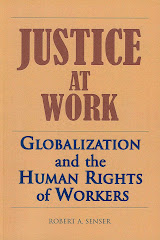
1. My newly published JUSTICE AT WORK: GLOBALIZATION AND THE HUMAN RIGHTS OF WORKERS. Its main theme: the present unbalanced global economy, especially its trade and investment regime, protects the rights and interests of business and business organizations, to the exclusion of the rights and interests of workers and worker organizations. Check it out at .

2. My Weblog, Human Rights for Workers, at http://humanrightsforworkers.blogspot.com, which deals mostly with the main theme of the book.
This is a continuing real-life drama. Why not join it?


Print Page Read more!

Friday, April 17, 2009

Oust U.S. financial oligarchy: economist

Every country has its dominant elites, oligarchs of one kind or another. The challenge is to change them when they get too powerful. The United States, too, has its oligarchy, the banking/financial industry, which has grown so powerful that it thrives on the chaos it created and blocks essential reforms. Ousting the oligarchy must be accomplished soon, or else we may well suffer not just a repeat of the Great Depression, but something worse.
That paragraph summarizes the unsettling message of “The Quiet Coup,” an article in the May issue of The Atlantic by Simon Johnson, a former chief economist of the International Monetary Fund (IMF). Now a professor at MIT, Johnson draws on his experience at the Fund to describe the typical plight of “emerging market” countries in a desperate economic situation.

“The biggest obstacle to recovery is almost invariably the politics of the countries in crisis….The powerful elites within them overreached in good times and took too many risks,” he writes. Then, in the downward spiral that follows “the oligarchs are usually among the first to get extra help from the government.” But an economic reform program succeeds “only if at least some of the powerful oligarchs who did so much to create the underlying problems take a hit.”

Johnson compares the situation of troubled emerging market countries with that of the United States, except that here it’s much worse, as he sees it. “Just as we have the world’s most advanced economy, military, and technology, we have its most advanced oligarchy” -– the banking/financial industry.

Economist Jagdish Bhagwati’s name for this oligarchy is the “Wall Street-Treasury complex,” a powerful network he describes as “unable to look beyond the interests of Wall Street which it equates with the good of the world.” Like Bhagwati, Johnson illustrates its influence by tracking the back-and-forth movement of its leaders between Wall Street and top federal government posts in both Democratic and Republican administrations.

In a key insight, Johnson writes: “The American financial industry gained political power by amassing a kind of cultural capital – a belief system…[that held] that what was good for Wall Street was good for the country…In a society that celebrates the idea of making money, it was easy to infer that the interests of the financial sector were the same as the interests of the country.”

What followed in the past decade is what Johnson calls “a river of deregulatory polices that is, in hindsight, astonishing.” Three items from his list of seven:

-- The insistence on the free movement of capital across borders.
-- Major increases in the amount of leverage [borrowing] allowed to investment banks.
-- A light (dare I say invisible?) hand at the Securities and Exchange Commission in its regulatory enforcement.

The environment, or at least public opinion, has now changed, but “financial elites have continued to assume that their position as the economy’s favored-children is safe, despite the wreckage they have caused.” And the government itself “has taken extreme care not to upset the interests of the financial institutions, or to question the basic outlines of the system that got us here.”

For Johnson, “the government’s velvet-glove approach with the banks is deeply troubling, for one simple reason: it [doesn’t] change the behavior of a financial sector accustomed to doing business on its own terms, at a time when that behavior MUST change.” Instead, big banks have a veto power over public policy, despite their loss of popular support.

The solution? Johnson’s advice, as he puts it, is similar to the advice that the IMF, and the U.S. government, has given to developing countries in deep economic trouble: temporary nationalization of hopelessly insolvent banks. Instead, the U.S. Treasury is trying to negotiate bailouts bank by bank, and “behaving as if the banks hold all the cards.”

Meanwhile, in foreign trade and investment policy, an area not examined by Johnson, the Obama administration has signaled that it will ask Congress to ratify the three still pending Free Trade [and investment] agreements negotiated by the Bush administration with Columbia, Korea, and Panama. There likely will be changes in the contents, but none in how the agreements extend Wall Street’s power in the global economy and hence in the United States also.

Johnson’s overall assessment: “The Obama administration’s fiscal stimulus [program] evokes FDR, but what we need to imitate here is Teddy Roosevelt’s trustbusting.” Its operating principle would be: “Anything that is too big to fail is too big to exist.’

The article’s closing analysis is dire:
“What we face now could, in fact, be worse than the Great Depression – because the banking sector is now so big. We face a synchronized downturn in almost all countries, a weakening of confidence among individuals and firms and major problems for government finances. If our leadership wakes up to the potential consequences, we may yet see dramatic action on the banking system and a breaking of the old elite. Let us hope it is not then too late.”
To learn more about Johnson’s ideas, see the Website he co-founded, BaselineScenario.com.

Print Page Read more!

Monday, January 19, 2009

The case for a huge economic stimulus

More than a third of the U.S. labor force will be plagued by periods of unemployment or underemployment next year if government spending does not surge substantially to spur demand for goods and services. So says a new Issue Brief published by the Economic Policy Institute.

In the absence of a large recovery package, the unemployment rate is expected to reach 10.2 percent in mid-2010, according to the Brief, and middle-income families would earn about $4,700 less in 2010 than they had in 2007,

But the overall statistics “don’t capture the pain” that would impact specific groups of people, warn Lawrence Mishel and Heidi Shierholz, the authors. Those especially hard hit next year would include:

-- Nearly one in five African-Americans in the labor force would be jobless.
-- So would 13.1 percent of Hispanics.
-- Underemployment would reach 18.8 percent of women workers.

In the Brief, entitled “Without Adequate Public Spending, a Catastrophic Recession for Some,” the authors recommend government spending on the order of $600,000,000,000 a year for two years to head off the “catastrophe” they consider otherwise inevitable.


Print Page Read more!

Thursday, January 15, 2009

For blacks, depression is already here

For most white people, it’s a recession, but for blacks, it’s already a depression. That’s a conclusion of a new report, “State of the Dream 2009: a Silent Depression,” released on Martin Luther King’s Day, January 15, by a Boston think tank, United for a Fair Economy (UFE).

“People of color have been experiencing a recession for five years,” says Amaad Rivera, UFE’s racial wealth specialist and one of the authors of the 70-page report. “By definition, a long-term recession is a depression.”

Why has this “silent depression” gotten relatively little attention? In large part, according to UFE, because the economic indicators we rely on are not sophisticated enough to mark the racial divide.

The facts, though, are there deep and not so deep in government documents, and the UFE report digs out many of them, as in a UFE chart showing a poverty rate in 2007 of 8.2% among whites and 24.5% among blacks.

Economic inequality and structural racism “were created, so they can also be eliminated,” the UFE report insists, by adopting reforms small and large, immediate and long range. A significant example: taxing work and wealth at the same rate would generate $95,000,000,000 a year in revenue.

“The current economic crisis requires more than a color blind stimulus,” says Dedrick Muhammad, UFE research associate and a co-author of the report. “It requires a complete economic restructuring that addresses the racial wealth divide.”

For more details, check the Website of United for a Fair Economy.

Print Page Read more!