Foreign Policy (FP) magazine’s December issue publishes its list of the world’s top 100 global thinkers for 2010. It honors President Obama as No. 3 “for charting a course through criticism.”
I for one would not rate Mr. Obama quite that high in what FP calls “this very smart crowd.” He lacks the necessary policy understanding of the 21st century global economy, as seems clear from his wobbly course on global trade and investment issues.
Missing from the FP list is a bold thinker and quiet doer, John Ruggie, a professor whom a 2005 FP survey called one of the most influential academics in the field of international relations. Since 2005, his main occupation has been as UN Special Representative for Business and Human Rights. During three years of work, he developed a new “Framework” on the duty of the State to protect against human rights abuses, on the Corporate responsibility to respect human rights, and on the need to provide remedies for violations – all toward better managing 21st century business and human rights challenges.
As a self-styled “principled pragmatist,” Ruggie establishes a “foundational principle” that corporate responsibility includes respecting the ILO’s eight core conventions,” but doesn’t leave it there. That commitment, he adds, belongs in the corporation’s own human rights policy statement to show it is exercising human rights “due diligence” in-house but also in relationships with partners, suppliers, and other entities.
In 2008 the Human Rights Council unanimously approved that “Protect, Respect, and Remedy” Framework. But how apply its principles in a world of 192 UN member states, 80,000 multinational enterprises, 800,000 subsidiaries, and countless millions of national firms, most of which are small and medium-sized enterprises.
Ruggie has now posted a 27-page-long set of Guiding Principles for implementing the framework. To gather feedback, he has created a special website, http://www.srsgconsultation.org/, which remains open until January 31. After that, the document will undergo final editing and translating in time for the June meeting of the Human Rights Council.
Wide acceptance of the new paradigm would mean a historic change in the culture of globalization. Just reading a brief summary like this one will not convert skeptics. A careful reading of the Framework and key supporting documents, however. will be instructive even to those who already support what constitutes the beginning of a social movement.
"Print Page
Read more!
Saturday, December 18, 2010
Who are the world’s top 100 global thinkers?


Monday, June 14, 2010
UN quizzes nations on CSR policies
“Has your national government… adopted a corporate social responsibility (CSR) policy or policies?”
That was the first of 16 questions in a survey that the UN sent last year to all 192 UN member countries. A report on the survey, prepared for John Ruggie, the UN Special Representative for business and human rights, was issued early this month under the title “Survey of State Corporate Social Responsibility Policies: Summary of Key Trends.”
During the five months after the survey’s distribution in April last year, only 29 States responded, and of these, only 10 indicated that they had, or were drafting, some form of national CSR policy. Two others said they had no intention to adopt such a policy.
It was a “low overall response rate,” the report conceded. Yet there was enough substance in the 10 responses to produce a 10-page report summarizing key trends, which do not necessarily reflect practices around the world.
Without divulging whether they had responded to the survey, the report notes that six States – Canada, China, Denmark, India, the Netherlands, and Norway – have recently adopted some specific form of CSR policy. Here are a few CSR details on three of them.
Canada, a world leader in mining at home and abroad, in 2009 released a strategy paper for the country’s international extractive sector. A CSR Counselor for that sector, reporting directly to the Minister of International Trade, monitors the practices of Canadian companies operating outside Canada and advises stakeholders on corporate performance.
China issued guidance in 2008 for its state-owned enterprises recommending a system of CSR reporting and protecting labor rights. The government has similar guidelines in the works for foreign-invested firms.
Norway last year adopted a White Paper on the government’s expectation that Norwegian companies operating abroad will respect human rights.
More than half of the report describes the many ways that the 10 nations (unnamed) responded to the survey’s specific questions. Examples:
Does the CSR policy:
-- cover the subsidiaries of corporations? Five do.
-- provide guidance on how companies integrate CSR into their operations? Six do.
-- refer to any binding legal operations on companies? Three do.
The survey provides only a partial snapshot of how the UN’s framework on business and human rights has penetrated the culture of its Member States. Second, it serves as a reminder to States of the specific CSR duties that the Human Rights Council’s 47 member States embraced two years ago. (For background on that event, see “Multinationals, Human Rights, and UN” at
http://humanrightsforworkers.blogspot.com/2008/04/multinationals-human-rights-and-un.html.)
Print Page
Read more!
Wednesday, June 02, 2010
Towards a ‘win-win’ situation on globalization and human rights
Corporations generally are in a “lose-lose situation” regarding human rights. They “are not adequately monetizing and aggregating the costs of conflicts with communities in which they operate, typically involving environmental and human rights concerns.” The result: harm to human rights and to the company itself.
That‘s a key finding discussed in a report to the UN Human Rights Council on June 1 by Professor John Ruggie, special representative for the UN Secretary General for business and human rights.
From his own studies and those of other experts, Ruggie has found that the harm to the corporation included revenue losses due to delays and disruptions; higher costs of financing, insurance, and security; and possible project cancellation.
Governments, through judicial and non-judicial mechanisms, “should form the foundation of a system of remedy for corporate-related system human rights abuse,” Ruggie writes, but these mechanisms all “remain underdeveloped – and too many judicial systems are inaccessible to those who need them most.”
Ruggie, whose day job is professor at the John F. Kennedy School of Government, has another year to go on a UN mandate that began in 2005. In the next 12 months, he and the team he assembled will put the finishing touches on a UN Framework for business and human rights -- essentially a paradigm to integrate human rights and globalization. As he recognizes in this report, however, “the international community is still in the early stags of adapting the human rights regime to provide more effective protection to individual and communities against corporate-related harm.” Print Page
Read more!
Saturday, April 24, 2010
Judges and their role in human rights violations by global firms
Governments need to improve the access that the judiciary gives to victims of corporate-related human rights abuses in the global economy. That was a key message of a new report by John Ruggie, UN Special Representative on Business and Human Rights.
Ruggie has a mandate to “operationalize” the human rights principles for business approved unanimously by the UN Human Rights Council two years ago. In the 126 paragraphs of his latest report, dated April 9, the 10 paragraphs devoted to “Judicial Mechanisms” for access to remedies are one of the two longest sections.
Essential to improving access to judicial remedy, Ruggie emphasizes, is that “both States and companies act in a manner supportive of the independence and integrity of judicial systems.
Three practical obstacles can “make it almost impossible for victims to access” even an effective judiciary:
-- Costs of legal advice and of the case itself should the claimant prove unsuccessful.In the paragraph that concludes this section, Ruggie writes: “Governments often point to the mere existence of judicial systems as proof that they are fulfilling their duty to protect. But, as the above discussion demonstrates, much more is needed.”
-- Limitations on “standing” (on who can bring a suit) and on the ability to bring group claims for compensation. Many instances of corporate-related harm involve a large number of indiidual claims that are grounded on the same underlying set of facts, each of which are too costly for a single claimant to pursue.
-- Disincentives – financial, social, and political – for lawyers to represent claimants in this area.
Then, in summing up all the types of “mechanisms” – State-based, judicial and non-judicial, company-based, as well as collaborative and international -- for obtaining remedies, Ruggie points out:
“Reality falls far short of constituting a comprehensive and inclusive system of remedy for victims of corporate-related human rights abuse.”
Read the full report at
http://www.reports-and-materials.org/Ruggie-report-2010.pdf Read more!
Thursday, March 04, 2010
Businness, human rights, and due diligence
You’re an employer, and want to avoid any unnecessary risks in your global production business. You certainly don’t want to become liable for failing to exercise due diligence in your human rights practices.
But what is due diligence?
An authoritative answer to that question has come from John Ruggie, the UN Secretary General’s special representative on human rights and business. Ruggie gave the keynote address to a conference sponsored on February 25 in Atlanta by the U.S. Council for International Business, the U.S. Chamber of Commerce, and the International Organization of Employers.
Ruggie identifies four components of human rights due diligence for companies:
1. A statement of policy articulating the company’s commitment to respect human rights;
2. Periodic assessments of actual and potential human rights impacts of company activities and relationships;
3. Integrating those commitments and assessments into internal control and oversight systems; and
4. Tracking as well as reporting performance.
The process “has to go beyond simply identifying and managing material risks to the company itself, to include the risks a company’s activities and associated relationships may pose to the rights of affected individuals and companies,” Ruggie points out, adding:
“In a world of 80,000 multinationals, ten times as many subsidiaries, and countless national firms,…[the process] necessarily will vary with circumstances.”
Ruggie offers several reasons why following a meaningful process of due diligence is well worth the effort it requires. One advantage is that it offers a corporate board “strong protection against mismanagement claims by shareholders, [which in the context of lawsuits]…can only count in its favor.”
In carrying out his mandate from the UN Human Rights Council, Ruggie will in the coming months be working with a number of organizations, including:
• The OECD as it updates its "Guidelines for Multinational Enterprises."
• The International Finance Corporation as it revises its Performance Standards.
• The European Commission, as it explores new approaches to ensuring responsible behavior overseas by European firms.
For the full text of Ruggie’s address, click
http://www.business-humanrights.org/Links/Repository/153835/
Print Page
Read more!
Thursday, December 10, 2009
Topmost business and human rights challenge for 2010
What is the No. 1 priority among the human rights challenges that business and governments must address next year?
The London-based Institute for Human Rights and Business says that governments face this challenge as the topmost among 10: “clarifying responsibilities ‘beyond borders.’” The Institute explains why:
“Pressure is mounting to lift the ‘corporate veil’which shields parent companies from liability for activities of their subsidiaries through stronger national and extraterritorial legal mechanisms. How should governments exercise jurisdiction beyond their borders when companies based in their countries or their subsidiaries transgress internationally recognized human rights standards abroad? How should companies operate in countries with weaker protection of human rights?”I agree with the Institute’s position and said so in the following comment I posted on the Institute’s Website today:
“This is indeed the topmost challenge. Specifically, for example, the U.S. government, as part of its duty to protect human rights, needs to determine what that duty means in the case of U.S. corporations operating abroad. Those global corporations have the right to the protection of the United States in their extraterritorial operations. At present that right has no matching legal responsibilities. It is time to correct that anomaly. Doing so would end the risks that the present vacuum now poses to the corporation itself.”On Human Rights Day, December 10, the Institute launched a “top 10 for 2010” campaign “as a reminder of the ongoing and emerging governance gaps and operational challenges requiring action by governments, business leaders, and civil society,” says Mary Robinson, former UN High Commissioner for Human Rights and chair of the Institute’s advisory board. (For the full list of 10 challenges, see the Institute’s Website at http://www.instittehrb.org.)
“Extraterritorial jurisdiction” stands out in the No. 1 challenge. John G. Ruggie, UN Senior Representative for Business and Human Rights, calls extraterritorial jurisdiction “the elephant in the room that polite people prefer not to talk about.” Talk about it he did last month in Stockholm, where he gave the keynote presentation at the European Union Presidency conference.
In his lengthy analysis, Professor Ruggie made an important distinction between
-- “true extraterritorial jurisdiction,” such as criminal legislation on child sex tourism, which has a clear nationality link to the perpetrator as the basis of jurisdiction, and
-- “domestic measures that have extraterritorial implications,” such as a human rights reporting requirement for the corporate parent and its foreign subsidiaries as well, the jurisdictional basis for which is territorial.
In the expanding global economy, governments have increasingly relied on both types, but have been delinquent in applying either to the area of business and human rights -- even when governments are supporting a business enterprise, such as providers of export credit or investment insurance.
“And so we have the oddity of home states promoting investments abroad – extraterritorially, if you will – often in conflict affected zones where bad things are known to happen,” Ruggie pointed out, “but not requiring due diligence from companies because doing so may be perceived as exercising extraterritorial jurisdiction.”
The European Commission has launched its study of the issue. So has the Netherlands. Ruggie, as part of his UN mandate, hopes “to promote an honest and non-doctrinal discussion.”
Print Page Read more!
Monday, November 16, 2009
Glaring contradictions in corporate social responsibility movement
Global corporations based in Europe are almost twice more likely than those based in the United States to have labor and human rights policies covering their global supply chains. But that doesn’t mean that the Europeans do better than their American counterparts in implementing their corporate social responsibilities.
The U.S.-Europe statistical discrepancy is revealed in a study released November 11 by the IRRC Institute: 43 percent of European companies have labor/human rights policies for their worldwide operations, whereas only 23 percent of American multinationals do. Moreover, those European corporate polices are more likely that the Americans’ to describe monitoring procedures, targets for improvement, and enforcement mechanisms.
At a conference on corporate social responsibility held in Stockholm on November 11, an international trade union leader, Jim Baker, gave concrete examples of glaring internal contradictions in the CSR movement. He cited this experience in particular:
“We have spoken with some European companies with interests in the U.S. who say they are committed to human rights, including a couple here in Sweden. We have asked them to disassociate themselves from the anti-union propaganda being used against modest legislation, the Employee Free Choice Act, to correct some of the abuses in U.S. labor law.Baker also described contradictatory behavior in the country of Georgia. There the government and trade unions, working with the most representative employers’ organization, proposed pro-worker reforms in the labor code.
“Although they say they are shocked by what is being said and done, not one has yet distanced itself from that anti-human rights corporate campaign.”
“Who is now blocking the reforms? The U.S. Chamber of Commerce in Georgia,” Baker said, adding that one of that chamber’s large patrons is a firm that, some years ago, made a lot of money doing CSR audits.
Baker, coordinator of the Council of Global Unions, was a speaker at a conference of the Swedish Presidency of the European Union, where John G. Ruggie, the UN Special Representative for Business and Human Rights, made the keynote presentation.
The Swedish Presidency formally renewed its support for Ruggie’s “Protect, Respect, Remedy” framework that the UN Human Right Council unanimously approved in June 2008. (For background, see my June 4, 2008. blog report on “This UN Work Seems Back on Track.)
“The Protect, Respect, Remedy framework gives us a path out of the make-believe world of CSR,” Baker said in his remarks. He went on to explain:
“The Ruggie framework makes it clear that business responsibility includes the respect of laws and international standards related to human rights….[It] is a good way to make sure that rights are respected in supply chains, in small and medium-sized enterprises and by competitors.”
Print Page Read more!
Friday, May 01, 2009
Crisis or not, business-human rights link holds
Should business and government shelve human rights concerns during the current global economic crisis? Of course not. It was the obsession with money as the supreme value, trumping all other values, that got us into this mess, and it would be folly to rely on that obsession now.
A senior UN official has added his voice against the temptation to make human rights a casualty of the crisis. John Ruggie, the Special Representative of the UN Secretary-General on human rights and transnational corporations, did so in his April 22 report to the Human Rights Council.
He buttressed his argument mainly with these points:
The business and human rights agenda matters now more than ever. “Any gains Governments believe can be had by lowering human rights standards for business are illusory, and no sustainable recovery can be built on so flimsy a foundation.”
“The same types of governance gaps and failures that produced the current economic crisis also constitute what the Special Representative has called the permissive environment for corporate wrongdoing in relation to human rights.” Governments promoting greater corporate responsibility, and corporations adopting human rights strategies, both reflect “the now inescapable fact that their long-term prospects are tightly coupled with the well-being of society as a whole.”
In his report, the first in his current three-year mandate, Ruggie noted the beginnings of a positive trend in corporate law: governments and courts are introducing “more public interest considerations” into what companies do and how they do it.
He cited Denmark, India, South Africa, and the United Kingdom as taking preliminary steps in that direction. As for the United States, "federal statutes require publicly listed companies to have robust programs to assess, manage, and report on material risks. None refers to human rights explicitly, but material risks clearly do encompass human rights issues."
To fill information gaps, 19 leading law firms from around the world have volunteered their services to survey corporate law provisions in over 40 jurisdictions.
Print Page Read more!
Friday, March 06, 2009
Parliament probing business and human rights
A joint committee of the British Parliament today issued a “call for evidence” on how corporations have complied with their responsibility to respect human rights.
The inquiry covers “the way in which businesses can affect human rights both positively and negatively, how business activities engage the relative responsibilities of the UK Government and individual businesses; and whether the existing UK regulatory, legal and voluntary framework provides adequate guidance and clarity to business as well as adequate protection to individual rights.”
Not just corporations but also “interested persons and bodies are invited to submit written evidence” of not more than 2,500 words by May 1, 2009.
The two-page long decision issued by the Parliamentary committee on human rights lists a page of questions that the committee “would particularly welcome evidence.” For this list, the committee uses the framework on human rights and business adopted by the UN Human Rights Council in June 2008.
The committee is requesting views for making its own proposals for possible legislation and for the on-going work of the UN special representative on human rights, John Ruggie. The Bush administration opposed this UN program, which has been ignored by the U.S. media.
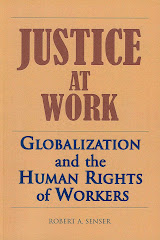
For background, see my reports under the category of John Ruggie. Also my new book, Justice at Work: Globalization and the Human Rights of Workers, has a long chapter on Ruggie’s work titled “Business and Human Rights.”
Print Page
Read more!
Friday, November 21, 2008
Big Business and the UN
That’s the title of an article of mine to be published in the December 1 issue of America, the Catholic weekly magazine published in New York. It describes a new United Nations initiative, headed by Harvard Professor John Ruggie, to make the UN Universal Declaration of Human Rights more universal in the global economy.
A different and longer version of the article will appear in my forthcoming book, Justice at Work: Globalization and the Human Rights of Workers.
Another article of mine, titled Buyer’s Remorse, Spatulas and the Conscience of the Consumer, was published in the August 4 issue of America.
Print Page
Read more!
Tuesday, October 14, 2008
Giving People Some Voice in Policy
John Ruggie, the UN general secretary’s special representative for business and human rights, has appointed Gus Ryder, general secretary of the International Confederation of Trade Unions (ITUC) to a global leadership group to advise him how to ensure that businesses worldwide respect human rights.
The group’s 15 members also include Kofi Annan, former UN general secretary and Mary Robinson, the former president of Ireland who also served as UN High Commissioner for Human Rights and is now executive director of the Ethical Globalization Initiative. The 13 other members are leaders from business, diplomacy, and civil society around the world.
Ruggie, a professor at Harvard’s Kennedy School of Government, has a UN Human Rights Council mandate to provide concrete guidance for governments, businesses, and other “stakeholders” on how they can make the UN Universal Declaration of Human Rights more universal in the global economy.
Ryder, 52, born in Liverpool, heads the world’s largest trade union body with a membership of 168,000,000 working men and women in 155 countries. The biographical list distributed with the September 22 announcement says that Ryder’s work “is based around the ITUC’s belief that our globalized world requires effective global governance.”
The UN has long debated how active it should be in promoting human rights in business. Ruggie succeeded in ending the stalemate in June this year, when he won the unanimous endorsement of the Human Rights Council for a three-year project seeking to embed human rights in the policies and practices of multinational corporations.
He succeeded because he made special efforts to consult business leaders across the globe. His new leadership group, which includes a former secretary general of the International Chamber of Commerce, Maria Livanos Cattaui of Swtzerland, continues that outreach.
(For background on this UN initiative, click here for one of my blog articles. For others, see “categories” in the right-hand column of this page, and click on John Ruggie.)
Is there a lesson here for Secretary Paulson?
U.S. Secretary Treasurer Paulson would be wise to follow Ruggie’s example. Paulson, a former top dog on Wall Street, is leading the bailout of Wall Street. In any other situation, that would be considered a conflict of interest. And it is indeed a conflict of interest, but it is unfortunately made necessary by the longtime practice of letting groups of wealthy insiders monopolize the nation’s financial policy.
The current crisis is evidence of how badly they have blundered. Appointing an advisory group of independent outside experts might be a start at making sure that the Paulson team dedicates itself exclusively to the national interest.
Print Page
Read more!
Thursday, August 07, 2008
Business and Human Rights To the Fore
An International Seminar on Business and Human Rights will be held in Paris December 4 and 5 to celebrate the 60th anniversary of the UN Universal Declaration of Human Rights.
Mary Robinson, former UN High Commissioner for Human Rights and chair of the Ethical Globalization Initiative, will chair the two-day seminar. Speakers will include Irene Khan, secretary general of Amnesty International, and John Ruggie, the UN General Secretary’s Special Representative on Human Rights and Business.
The purpose of the seminar, according to its announcement, is to review progress made on business and human rights and to “chart developments ahead.” Participants are expected to include “business, political, civil society, and trade union leaders as well as diverse learning from around the world.”
The December seminar is different from a “multi-stakeholder” consultation to be sponsored by the Human Rights Council at a date not yet determined. Its purpose, under the mandate for Ruggie that the Council adopted in June, is “to discuss ways and means to operationalize” the conceptual and action plan that the Council also adopted in June.
In the words of that mandate, the consultation will bring together Ruggie, “States, and business representatives and all relevant stakeholders, including non-governmental organizations and representatives of victims of corporate abuse.”
The agendas of the two meetings overlap, without duplicating each other. Many leaders will participate in both events.
As described in its newly released paper, Amnesty International, whose French branch belongs to the steering committee organizing the December seminar, endorses the work of Special Representative Ruggie and also offers him a full agenda of work that still needs to be done.
One important area is that of “extraterritorial dimensions of the state duty to protect,” which Ruggie has already studied at length. Amnesty urges him to plunge in further, and explains why:“The protection of human rights is undermined, because both company structure and globalized company operations facilitate corporate evasion of state jurisdiction…The legal framework regulating TNCs has not kept pace with the realities of globalization. This is in contrast to economic law, which is increasingly protecting economic interests beyond individual states’ jurisdictions.”
“Amnesty International,” it says in its paper, “is skeptical of the arguments of group that oppose extra-territorial regulation on the one hand, while fully supporting the development of international law and enforcement mechanisms in the areas of trade and investment on the other.”
Print Page
Read more!
Saturday, June 28, 2008
U.S. Investment in Vietnam and Human Rights
The governments of the United States and the Socialist Republic of Vietnam will soon launch negotiations for a treaty to protect American investment and investors in Vietnam. The proposed treaty, called a BIT for Bilateral Investment Treaty, offers a natural opportunity to include human rights provisions, but so far there is no sign that the present U.S. administration plans to do so.
The 40 BITs that the United States already has with other countries do not have any human rights provisions. A new BIT with Vietnam could change that pattern, however, if Congressional advocates of international human rights get mobilized.
According to a report adopted unanimously by the UN Human Rights Council in June, the present BIT pattern creates an “imbalance” that weakens the host government’s obligations on human rights. The report, authored by Professor John Ruggie of Harvard, states:
“Investor protections [under BITs] have expanded with little regard to States’ duties to protect [human rights], skewing the balance between the two. Consequently, host States can find it difficult to strengthen domestic social and environmental standards, including those related to human rights, without fear of foreign investor challenge, which can take place under binding international arbitration.”
A joint U.S.-SRV statement on June 25 announced the decision to initiate the BIT negotiations. Separately, it also “noted the benefit of an open and candid dialogue on issues relating to human rights.” But it said nothing about the impact that U.S. investment in Vietnam – topping $12,000,000,000 in 2007 – has on the rights of Vietnamese workers and others.
The U.S. will use its standard “model agreement” as the starting point for negotiations with Vietnam. It defines “investment” so broadly that it includes patents, copyrights, trademarks, and other forms of intellectual property rights, and lays down strong enforcement mechanisms, including access to international arbitration for the investor.
Another “model BIT” has been developed by a Canada-based NGO, the International Institute for Sustainable Development (IISD). After extensive research, IIISD found that existing BITs are “one-sided instruments” that guarantee extensive protection of of the rights of foreign investors but without any corresponding investor responsibilies. The IISD model corrects that imbalance. (See “Linking Global Rights with Responsibilities": scroll down to the next-to-last item.)
Congressional concerns about this issue is reflected in the Trade Reform, Accountability, Development, and Employment Act, introduced on June 4. Among its provisions is that BIT protections of investor rights could no longer override a country’s efforts to protect the rights of its own workers.
It is probably too late to enact that bill into law, but it’s not too late to hold hearings on the proposed U.S. Bilateral Investment Treaty with Vietnam. Up till now, Congress has rubber-stamped BIT after BIT without drawing any public attention. It’s time to let the sunshine in.
Both Senators Obama and Clinton have pledged to review the labor provisions of trade agreements under a Democratic administration. They don't have to wait that long. They can insist that the Senate review the proposed BIT with Vietnam for its impact on the human rights of Vietnam's workers.
So one big question is: Will Congress rubberstamp the U.S.-Vietnam BIT without studying how it impacts the rights of Vietnam's working men and women? Another is: Will it rubberstamp that BIT without studying how facilitating more investments to Vietnam will facilitate the transfer of American jobs to the Socialist Republic of Vietnam?
Print Page Read more!
Tuesday, June 24, 2008
To Embed Human Rights in Multinationals
Australia’s Parliament has agreed to a policy fostering the integration of human rights into the operations of Australian multinational enterprises. The Parliamentary motion to that effect, adopted on June 23, had the support of the government and all political parties, major and minor.
The United States would benefit from a similar initiative. Australia’s decision grows out of factors that also resonate in the United States: an increased awareness 1) that some multinationals are engaged in behavior overseas thatis not tolerated at home, and 2) that present international rules don’t cope with the problem. (See “Where business and human rights intersect” by Andrew Hewett, executive director of Oxfam Austratlia.)
In Canberra the policy calls for “the development of measures to prevent the involvement or complicity of Australian companies in activities that may result in the abuse of human rights.” In Washington, legislation calling for the same thing probably could not be enacted this year, but a bill, and hearings on it, would serve as a helpful preparation for action by Congress and the new Administration next year.
Australia’s decision follows in time, and in spirit, a report on a “Framework for Business and Human Rights” adopted on June 18 by the UN Human Rights Council. That report, authored by Professor John Ruggie of Harvard, outlines a three-pronged plan to realize the State duty to protect human rights, the business responsibility to respect human rights, and the joint obligation to establish better access to remedies for human rights violations.
Under this plan, the most difficult challenge arises from what Ruggie calls “weak governance zones,” the areas where the government is unable or unwilling to exercise its authority and in which multinationals have expanded and prospered. The Ruggie report, recognizing the importance of filling this vacuum, puts all options on the table, including home State regulation of the multinational corporation’s foreign operations.
Traditionally, that option – “exercising extraterritorial jurisdiction” of business -- is a No-No. After extensive study by experts, Ruggie identified this consensus: international law does not require home States to regulate corporations abroad, but does not flatly prohibit it (i.e., permits it under certain circumstances), and there is an increasing tendency to encourage it.
As a stakeholder in the global economy, the government of Australia is beginning to take advantage of the latitude it has to exercise a duty it has at home and abroad. The United States, with a much larger stake, should do likewise.
Print Page
Read more!
Wednesday, June 04, 2008
This UN Work Seems Back on Track
“We’ve had a train-wreck. Please get the train back on track.” That’s what a representative from a developing country told Professor John Ruggie of Harvard when he took over his job as Special Representative of the UN Secretary General for Business and Human Rights three years ago.
Now everything is back on track. At least it appeared to be on June 3 when Ruggie presented a report of his work to UN Human Rights Council in Geneva.
Back in 2005 two big stakeholders in globalization – the major international business organizations and leading human rights organizations – were sharply divided over what, if anything, the UN should do about ending human rights violations by multinational corporations. Now they seem to be on track together in supporting a proposal that Ruggie laid out in oral and written reports still under discussion by the Human Rights Council.
Ruggie has proposed an extension of his mandate in order to move “the discussion from the level of general principles to greater operational detail.”
I don’t yet have the Council decision, but in the meantime the full report and a massive amount of other material – much more than you’ll want to read – can be found on the Business and Human Rights website:
http://www.business-humanrights.org/Documents/RuggieHRC2008
I have doggedly covered this human rights controversy from its very beginning. A certain amount of doggedliness was needed to pursue a story almost completely ignored by the media. “Global Norms Put Heat on Business,” published on January 6, 2004, was the first of my 12 reports on my Human Rights for Workers website. Then, before this brief articlet, I had four detailed ones on this weblog. (See the "categories" list at the right and check the "John Ruggie" label.)
Three of them turned out to be the first media analysis of the report that the Council is now discussing. You’ll find them listed last (under Robert Senser, Human Rights for Workers) in the chronologically arranged “responses, commentary & related articles” at
http://www.business-humanrights.org/Documents/RuggieHRC2008
I have doggedly covered this human rights controversy from its very beginning. A certain amount of doggedliness was needed to pursue a continuing story almost completely ignored by the media. “Global Norms Put Heat on Business,” published on January 6, 2004, was the first of my 12 reports on my Human Rights for Workers website. Then, before this brief article, I had four detailed ones on this weblog.
Three of them turned out to be the first media analysis of the report that the Council is now discussing. You’ll find them listed last in the chronologically arranged “responses, commentary & related articles” at
http://www.business-humanrights.org/Documents/RuggieHRC2008
Print Page
Read more!
Saturday, May 17, 2008
New World vs. Old World Trade Policies
-- The flow of foreign direct investment (FDI) into developing countries (including China) grew more than 10-fold in the past 15 or 16 years. It reached $379,070,000,000 in 2006.
-- The services sector – banks, communication, education, hotels, restaurants, and public utilities, for example – now outpaces manufacturing in attracting FDI. In 2005 the services sector accounted for about three-fifths (61 percent) of global FDI stock (up from 49 percent in 1990).
-- Although the number of multinational corporations with headquarters in developing countries is increasing, they still are dwarfed by those based in industrialized economies. The total foreign assets of the top multinationals based in developing economies, for example, in 2005 amounted to the total foreign assets of a single U.S. multinational, General Electric, the largest multinational in the world.
-- Foreign affiliates of the 78,000 multinational corporations based in the United States, Europe, and Japan have tripled their workforce. In 2006 the number of people on their payrolls stood at 73,000,000 (not counting people hired by contractors and subcontractors), up from 25,000,000 in 1990.
Those are a few of the fascinating statistics in Development and Globalization: Facts and Figures, just issued by the United Nations Conference on Trade and Development (UNCTAD). They illustrate the transformations the world has undergone since 1990.
What implications do these and other transformations have for world trade and investment policies? The question is seldom addressed. But there are some exceptions.
Awareness is growing that at least the investment chapter of the typical trade agreement needs revision. UNCTAD’s 2007 Trade and Development Report, for example, criticized most bilateral “North-South” free trade agreements for restricting the options that poor countries have for adopting FDI policies suitable for their own circumstances.
On October 1-2, over 30 negotiators representing more than 25 countries assembled in Singapore for the 1st Annual Forum of Developing Country Negotiators. There they discussed (as a forum report put it) “their common challenge: finding the appropriate balance between the need to attract more foreign direct investment and the need to serve a wide range of public policy objectives, including economic development.”
That same challenge facing developing countries is analyzed in a report expected to be approved by the June meeting of the Human Rights Council. The report; written by Professor John Ruggie of Harvard, devotes seven paragraphs to the “adverse effects” of the current one-sided policy of protecting foreign investors and investments. These protections, Ruggie writes, have been expanded “with little regard to States’ duties to protect to protect [human rights], skewing the balance between the two [the State and the foreign investor].”
“The State Duty to Protect” human rights is a major theme of the Ruggie report, titled Protect, Respect and Remedy: a Framework for Business and Human Rights. Pope Benedict XVI stressed the same theme, mostly using the same terms, in his address to the UN General Assembly on April 18.
When will U.S. policymakers listen to these voices? Until they do, expect the backlash against globalization to continue, or even to intensify. See previous postings this month.
Print Page
Read more!
Thursday, April 24, 2008
Multinationals, Human Rights, and UN – III
(Reporting on the Ruggie Report – III)
Can anything concrete come out of the report that Professor John Ruggie prepared for the June session of the UN Human Rights Council? After all, the report offers just a “framework” for business and human rights, not a program of action.
Yet the report is far from a compilation of abstractions. I find that it contains a bundle of specific policy ideas that, if taken seriously by the Council and even only a few major UN members, will improve the protection of individuals, organizations, and weak governments against what Ruggie calls “corporate-related human rights harm.”
Take Ruggie’s incisive criticism of the present foreign investment system. He describes how trade and investment laws have expanded the legal rights of foreign investors without matching responsibilities, and thereby undermined the State’s duty to protect human rights, “skewing the balance between the two.”
This imbalance creates human rights predicaments for both “host States” and “home States.” A major example cited by Ruggie: “host States can find it difficult to strengthen domestic social and environmental standards, including those related to human rights, without fear of foreign investor challenges, which can take place under binding international arbitration” – that is, under a procedure that often favors the investor, a flaw not mentioned by Ruggie.
His report provides enough information on this imbalance to strengthen already existing campaigns to correct it. And the various issues that Ruggie highlights should be instructive to Congress next year when it formulates U.S. trade and investment policy to replace “trade promotion”legislation and other policies conducive to moving jobs offshore. Ruggie’s insights will also be useful in the almost certain renegotiation next year of the 15-year-old North American Free Trade Agreement (NAFTA), which set the pattern for the imbalances written into subsequent U.S. bilateral trade agreements.
Another concrete matter covered in Ruggie’s “framework” concerns the Paris-based Organization for Economic Cooperation and Development (OECD), of which the United States and 39 other industrialized states are members. The OECD Guidelines for Multinational Enterprises are “currently the most widely applicable set of government-endorsed standards related to corporate responsibility and human rights,” as Ruggie points out.
In analyzing the Guidelines, he explains why and how they should be revised to make their human rights provisions more specific, and how their administration needs improvement. The case he makes is sure to assist trade union leaders and others who have long pressed for similar reforms.
So the report does indeed have much potential value on the practical level. Moving from the potential to the actual, of course, will depend on a variety of “actors,” or “stakeholders,” including the institution that commissioned the report, the Human Rights Council.
Ruggie concludes his report with this sentence: “The Human Rights Council can make a singular contribution to closing the governance gaps in business and human rights by supporting the framework, inviting its further elaboration, and fostering its uptake by all relevant social actors.”
Note the term that appears in that sentence and elsewhere in the report – governance gaps. The gaps exist “between the scope and impact of economic forces and actors, and the capacity of societies to manage their adverse consequences….How to narrow and ultimately bridge the gaps in relation to human rights is our fundamental challenge.”
He restates, and reemphasizes, that challenge in his concluding paragraphs: “As has happened throughout history, rapid market expansion has also created governance gaps in numerous policy domains: gaps between the scope of economic activities and actors, and the capacity of political institutions to manage their adverse consequences. The area of business and human rights is one such domain.”
The greatest value of Ruggie’s 28-page report, in my view, is that he contributes much toward an evolving paradigm of business and human rights under globalization. Policymakers need such a conceptual framework to make sustainable progress toward integrating business and human rights in principle and in practice.
Print Page
Read more!
Tuesday, April 22, 2008
Multinationals, Human Rights, and UN - II
(Reporting on the Ruggie Report – II)
“Unfeasible, unnecessary, and counter-productive.” That’s how the U.S. Council for International Business denounced a 2003 document titled the “Norms on the Responsibilities of Transnational Corporations and Other Business Enterprises with Regard to Human Rights,” or Norms. The opposition of the U.S. government, too, was vigorous, so much so that Amnesty International publicly called upon U.S. Secretary of State Condoleezza Rice to put an end to U.S.’s “undermining” the Norms.
The document that provoked so much controversy, pro and con, was the handiwork of the UN Subcommission for the Promotion and Protection of Human Rights, made up of 26 independent human rights experts. A U.S. academic, David Weissbrodt, professor of law at the University of Minnesota, was the expert most responsible for researching and drafting the Norms.
Polarization, human rights organizations vs business, doomed the Norms, but not the basic idea behind it. Three years ago (in April 2005) UN Secretary-General Kofi Annan appointed Professor John Ruggie of Harvard to carry on what is essentially the same project. His mandate includes “identifying and clarifying standards of corporate responsibility with regard to human rights.”
Where to find those standards? Weissbrodt culled them from three dozen UN treaties and other international instruments, including ILO conventions and recommendations. Ruggie started by looking elsewhere. He commissioned a study of 320 cases of alleged corporate-related human rights abuse reported on the website of the Business and Human Rights Centre during a 33-month period that ended in December 2007. He then had each case coded for the rights the alleged abuses impacted from among those listed in seven key UN human rights documents, including the four core worker rights conventions of the ILO.
Ruggie’s empirical study identified 12 labor rights and 17 non-labor rights. That means “there are few if any internationally recognized rights [that] business cannot impact – or be perceived to impact – in some manner.” Ruggie’s conclusion: there are no limits to the rights that companies “should take into account.” On this basis, he judges that the Norms would be inadequate, even for protecting a corporation’s own interests, since they identify only “a limited set of rights for which [a corporation] may bear responsibility.”
As a result, in the report that will be considered at the June session of the Human Rights Council, Ruggie lays a heavy human rights burden on corporations. Part of it is the moral and legal responsibility of exercising "due diligence."
“To discharge the responsibility to respect [human rights] requires due diligence,” Ruggie emphasizes. One of his specific recommendations is that companies should look for guidance in the Universal Declaration of Human Rights and the core worker rights conventions of the ILO. “The principles they embody comprise the benchmarks against which other social actors judge the human rights impacts of companies.”
Drawing on his recent research and consultations, Ruggie sets down four elements of a company’s basic due diligence process:
Written policies: To give the aspirational language meaning, more detailed guidance in specific functional areas is necessary.
Impact assessments: Many problems arise because companies fail to consider the potential human rights implications before new activities are launched. After getting launched, activities should reviewed on an on-going basis.
Integration: Isolating human rights considerations in a company is a mistake that can lead to inconsistent or contradictory actions by product developers, lobbyists, sales teams, or procurement officials. Leadership from the top is essential to embed respect for human rights throughout a company.
Tracking performance: Monitoring and auditing processes are needed to get updates of human rights performance. Confidential channels, such as hotlines, can provide useful feedback.
How will organized business react to Ruggie’s ambitious new framework? No explosion so far. Nobody should be surprised by this report, though. In his speeches, interviews, and previous reports, Ruggie has been clear about where he was heading. His style throughout the past three years has been a model of openness as he went about -- convening 14 multi-stakeholder consultations on five continents.
-- initiating more than two dozen research projects, some with the assistance of global law firms and other legal experts, nongovernmental organizations (NGOs), international institutions, and committed individuals.
-- generating more than 1,000 pages of documentation as the foundation of his framework.
-- receiving about 20 formal “submissions” (comments) from governments and other stakeholders..
-- presenting two extensive reports on his mandate to the Commission on Human Rights and its successor, the Human Rights Council [in 2006 and 2007], prior to this one]
Print Page
Read more!
Monday, April 21, 2008
Multinationals, Human Rights, and UN - I
As the United Nations prepares to celebrate the 60th anniversary of the Universal Declaration of Human Rights this December, a report commissioned by the UN is challenging governments and business to focus on corporate-related abuses of human rights.
Titled “Protect, Respect, and Remedy: a Framework for Business and Human Rights,” the just-released report is on the agenda of the UN Human Rights Council’s June session in Geneva. Its author, Professor John Ruggie of Harvard, is the Special Representative of the UN Secretary General on the issue of human rights and transnational corporations.
His report describes and endorses “ways to reduce or compensate for the governance gaps created by globalization, because they permit corporate-related harm to occur even where none may be intended.” Governance gaps? It is a key concept of the report. Ruggie defines it as the vacuum “between the scope and impact of economic forces and actors, and the capacity of societies to manage their adverse consequences.” He goes on to explain what it means in one crucial area.
“Take the case of transnational corporations,” he writes, and goes on to illustrate how the gaps have evolved under recent globalization:
[Corporate] legal rights have been expanded significantly over the past generation. This has encouraged investment and trade flows, but it has also created instances of imbalances between firms and States that may be detrimental to human rights. The more than 2,500 bilateral investment treaties currently in effect are a case in point.
While providing legitimate protection to foreign investors, these treaties also permit those investors to take host States to binding international arbitration, including for alleged damages resulting from implementation of legislation to improve domestic social and environmental standards – even when the legislation applies uniformly to all businesses, foreign and domestic. A European mining company in South Africa recently challenged that country’s black economic empowerment laws on these grounds.
At the same time, the legal framework regulating transnational corporations operates much as it did long before the recent wave of globalization. A parent company and its subsidiaries continue to be construed as distinct legal entities. Therefore, a parent company is generally not liable for wrongs committed by a subsidiary, even where it is the sole shareholder, unless the subsidiary is under such operational control by the parent that it can be seen as its mere agent.
Ruggie gives examples of how “the transformative changes in the global economic landscape” are not reflected in current laws, regulations, and bureaucratic procedures. Also vital in contributing to the governance gaps is the reluctance of the host and home countries to risk taking on the transnationals.
“This dynamic is hardly limited to transnational corporations,” Ruggie adds. “To attract investments and promote exports, governments may exempt national firms from certain legal and regulatory requirements or fail to adopt such standards in the first place.”
Under international law, Ruggie points out, “States have a duty to protect against human rights abuses by non-State actors, including business, affecting persons within their territory or jurisdiction,” as also discussed in his earlier (2007) report on his mandate. In this report he finds that “there is increasing encouragement at the national level for home States to take regulatory action to prevent abuse by their companies.”
Here, in opening a long section on “the state duty to protect,” Ruggie makes an implied criticism of human rights experts. “Within governments and beyond,” those experts have a good understanding of the “general duty” of States to protect human rights. But “less internalized is the diverse array of policy domains through which States may fulfill this duty with respect to business activities…at home and abroad.”
In other words, governments have available human rights tools that often remain unused or under-used. Ruggie devotes five pages to them. He urges viewing them as “an urgent policy priority …necessitated by the escalating exposure of people and communities to corporate-related abuses, and the growing exposure of companies to social risks they clearly cannot manage adequately on their own.” Three examples:
-- Revising international investment agreements to ensure that the rights protecting investments abroad are balanced with responsibilities to respect the host country’s domestic environmental and social standards.
-- Adopting policies more proactive in preventing harmful corporate involvement in “conflict zones,” including the use of Security Council-approved sanctions as appropriate to each situation.
-- Redefining fiduciary duties, as the UK recently has done, to require corporate directors to “have regard” to matters such as “the impact of the company’s operation on the community and the environment.”
In concluding his special section on the State duty to protect human rights, Ruggie reaffirms: “The human rights regime rests upon the bedrock role of States. That is why the duty to protect is a core principle of the business and human rights framework. But meeting business and human rights challenges also requires the active participation of business directly.”
He then turns to his second principle, the corporate responsibility to respect human rights. So will I, in my next posting.
4/21/08
Reporting on the Ruggie Report - I
Print Page
Read more!
Tuesday, April 15, 2008
The Latest on Business and Human Rights
What are the steps that governments could take to bring multinational corporations fully under the rule of law? That paraphrases one of the controversial questions that Professor John Ruggie of Harvard will answer in a report that he has prepared as the Special Representative of the UN Secretary General on Human Rights and Business.
The report, which will be considered by the June meeting of the UN Human Rights Council in Geneva, is expected to be released in the next week or two. Though it won’t make a splash in the media, it is eagerly awaited by many business people and human rights types.
I have been following, and writing about, the controversy ever since it exploded in the former Human Rights Council (then called a commission) when an advisory group of experts published a document entitled “Norms on the Responsibilities of Transnational Corporations with regard to Human Rights,” or Norms for short, in 2003.
The proposed Norms, distilled from UN treaties and agreements, met sharply divided reactions. At one extreme, leaders of organized business strongly opposed them, mainly because they seemed to be obligatory. At the other end, many human rights people (including me) generally favored them as a way to balance the global rights of business with some matching responsibilities.
Professor Ruggie was appointed in July 2005 to resolve the controversy. A political scientist wise in the ways of humans, societies, and the UN, Ruggie has succeeded in calming tempers. For nearly three years now, he has been vigorously proactive, talking with all groups having a stake in the controversy, persuading many of them to comment in writing, arranging for authoritative reports on specific points, and publicly communicating his approach in a series of speeches and articles. One of his first acts was to bury the term “Norms,” which had become overburdened with emotions.
A by-product of Ruggie’s openness and transparency is that the complex issues involved are now on the public record, thanks to an archive maintained by Business and Human Rights Resource Center, headquartered in London with offices in Hong Kong, South Africa, and the United States, and world accessible through a voluminous Website.
So we can already know where Ruggie stands on most points at which business and human rights intersect. Most refreshingly, his stance is one that recognizes the complexities of his project, and does not oversimplify them with easy slogans appealing to one side while infuriating the other.
At an international business forum held at the World Bank last October, Ruggie discussed his perspective on business’s twin roles as rule makers and what he calls “rule takers.” Here is an excerpt from his remarks, lengthy because his insights are not easy to summarize and because they tip off what will almost certainly be a major aspect of his upcoming report:Business already is deeply involved in global governance—quite apart from its influence on individual governments. Employers associations, along with labor, have been constitutionally represented in the ILO since 1919. Today, business participates as a rule maker in such diverse areas as setting global telecommunications standards and protecting intellectual property rights.
Through bilateral investment treaties and host government agreements, companies can seek to insulate their direct foreign investments from future legislative or regulatory changes in host countries, including policies that promote human rights. And they are able to proceed directly to binding international arbitration, bypassing the host country’s courts, if they believe that their investments are adversely affected by such regulatory changes.
But while business has become a direct participant in the system of global governance, it has proven a far greater challenge to render it subject to international rules for harms committed abroad—to make business a global rule taker, in other words. For example, a parent company generally is not legally liable for wrongs committed by an overseas subsidiary, even where it is the sole shareholder, unless the subsidiary is under such close operational control by the parent that it can be seen as its mere agent. And sourcing goods and services from contracted suppliers generally is considered an arms-length market exchange, even for sole suppliers, not a related-party transaction.
To be sure, each legally distinct entity within a corporate group or network is subject to the laws of the countries in which it operates. But host country governments and courts often are unable or unwilling to confront major global corporate players. And the group or network as a whole is not governed directly by international law.
In short, we see an emerging trend whereby business as rule maker increasingly operates in a single global economic space; but business as rule taker largely continues to operate in the world of separate national jurisdictions, with only a thin overlay of relatively weak international institutions and legal instruments.
In the area of human rights, the main bridges between these two worlds are lawsuits where they are permitted, thus far primarily under the US Alien Tort Claims Act; “naming and shaming” campaigns by NGOs; and self-governance or multi-stakeholder initiatives that corporations adopt voluntarily.
To put it simply: we need stronger bridges. History suggests that such a pronounced divergence between rule maker and rule taker may not be politically sustainable—that pushback against globalization driven by increased populism, protectionism and various forms of fundamentalism is likely to occur unless ways can be found to establish more effective transnational means of governance, covering all key international players, including business.
Many who speak for victims of corporate related human rights abuses have advocated drafting a binding international legal instrument as their preferred answer. But let us recall that the recently adopted United Nations Declaration on the Rights of Indigenous Peoples was twenty-two years in the making—and it is not now, nor will it soon become, a legally binding treaty. So whatever long-term aspirations one has, and however meritorious they may be, victims cannot wait a quarter century—they need help now.
My own approach to this challenge is to build up from what we’ve got—and aim to close “law free” zones where they exist.
Call that a carefully charted path between opposing arguments. It is more accurate, I believe, to say that Ruggie is trying to establish a common ground -- a new paradigm -- for business and human rights that the corporate world would be wise to recognize. His upcoming report promises to outline a major step in that evolving process.
Many people see no need for such a new paradigm for business. They accept the prevailing paradigm as a good one, subject perhaps to some tinkering, but essentially the best achievable, at least for this generation. Naturally, they oppose Ruggie’s enterprise and any cooperation with it.
But many others, although agreeing that the prevailing paradigm does not promote an inclusive globalization, contend that Ruggie’s paradigm is unsatisfactory for one reason or another. They, too, can make a contribution by presenting a paradigm that might be better.
For me this is not a one-time story, but a developing one with dramatic consequences for the future, whichever way it goes. I’ll be following it closely. So keep tuned to Human Rights for Workers Too by bookmarking http://humanrightsforworkers.blogspot.com/. See you there again soon.
Print Page
Read more!

 Posts
Posts