Showing posts with label Thomas Palley. Show all posts

Tuesday, October 13, 2009

How to win a Nobel Prize in economics

Early October is a good time to root for your favorite economist to win a Nobel Prize. Mine this year was Thomas Paley, an economist with broad and long experience in think tanks, the labor movement, and governmental agencies. Unfortunately, he didn’t make it. Instead, two other American scholars were awakened by early morning phone calls from Stockholm October 12 notifying them they had won the 2009 Noble prize in economics.

The Swedish Royal Academy of Sciences cited both of them, Elinor Ostrom, a professor of political economy at Indiana University, and Oliver Williamson, an economist at the University of California at Berkley, for their “analysis of economic governance,” particularly for contributing to the understanding of how institutions act in situations not covered by detailed contracts or law.

“Whereas economic theory has comprehensively illuminated the virtues and limitations of markets, it has traditionally paid less attention to other institutional arrangements,” the Nobel press release explains. Attachments to the release describe how Ostrom and Williamson have contributed to filling that void – theoretical and actual -- in economic governance.

Thereby, the Nobel committee passed over economists who have done ground-breaking research to fill another gap – theoretical and actual: the gap in global economic governance, which today has gained an immediacy from the economic crisis gripping much of the world. Among the scholars who have focused on this area are Thomas Paley and Dani Rodrik, professor of international political economy at Harvard’s Kennedy School of Government.

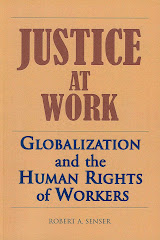
My own decades-long personal exploration of the global economy, as described in my book, “Justice at Work: Globalization and the Human Rights for Workers,” and on this Weblog, has convinced me

-- that the global economy undervalues work, workers, and worker organizations and
-- that economists traditionally also undervalue work, workers, and worker organizations.
The economist who, in my limited view, departs most sharply from that tradition is Thomas Palley, author two books, dozens of articles in academic journals, and numerous policy papers. His most recent work is a timely policy paper for the New Century Foundation titled “America’s Exhausted Paradigm: Macroeconomic Causes of the Financial Crisis and Great Recession.” I summarized the main points of that paper in my August 25, 2009, posting on this Blog under the heading: “Rx: a new economic model that would value work and workers.”

Let me try summarizing that summary.

Palley’s key point, as I saw it, was that the “neo-liberal” policies adopted after 1980 under Ronald Reagan put workers in a box, figuratively and literally. The box’s anti-worker policy pressures come from four sides:
--globalization (chiefly free trade and unfettered movement of capital),
-- a retreat from full employment,
-- labor market flexibility (i.e., to fight unions, minimum wages, unemployment benefits, and other worker rights), and
-- “small government” (deregulation, privatization, and outsourcing, all to the disadvantage of workers).
In commending Professors Williamson and Ostrom, the Nobel panel noted that both scholars were “instrumental in establishing economic governance as a field of research.” Indeed, the selection itself adds to that legitimacy.

Were someone like Tom Palley similarly rewarded, the selection would also serve to stimulate research in global economic governance, where the role of workers and their organizations suffers from wholesale neglect.

“What Do Unions Do?” by two Harvard economists, Richard B. Freeman and James L. Medoff, published in 1984, was an economic assessment of American unionism of that era. It badly needs updating. More accurately, a new book is needed to reveal a new paradigm – how workers and their unions are involved in 21st century global economic governance.

One chapter, or more, could be devoted to an empirical study of the trade union movement in Malaysia and its historic campaigns for Malaysian workers and often against the Malaysian government and the foreign multinationals that profited from “labor market flexibility.” In defiance of the government, for example, the Malaysian Trades Union Confederation has long publicly supported adding requirements for enforceable labor standards to international trade agreements.

Many other countries have a wealth of labor material ready to be mined by researchers in the 21st century model of global economic governance. The research is worth doing for its own sake, and – who knows? – could even lead to a pre-dawn phone call from Stockholm.

Print Page Read more!

Tuesday, August 25, 2009

Rx: a new economic model that would value work and workers

Stripped down to its basics, the economic model to which we are addicted undervalues work and workers, a failing that is largely responsible for our sick economy. Thank God, some bright minds are working to free us from that addiction. They are shaping the outlines of a model – a paradigm -- that seriously values work and workers.

One of the few economists addressing that enormous challenge is Thomas Palley, with a Yale PhD and varied experience that now includes an assignment at the New America Foundation, a Washington-based think tank. In that role, he has written a policy paper released July 22 under the title “America’s Exhausted Paradigm: Macroeconomic Causes of the Financial Crisis and Great Recession.”

“Macroeconomics” is jargon for the big economic picture, and as Palley emphasizes in an email: “It’s critical that we get the big picture right. Without that, we will be pushed toward small picture reforms that do not solve the fundamental problems.”

Tracing Origins of Today's Flawed System

The big picture is very big indeed, and Palley’s report is itself only an overview. Here I present my highlights of only one part of that overview. I focus on his critique of the neo-liberal economic policies adopted after 1980 under Ronald Reagan as a “flawed growth model” that has continued to infect policies of subsequent administrations, Republican and Democratic alike, including the present one.

Palley, with well documented backup, contrasts the new model to the one that the United States followed in the four decades after World War II. Prior to 1980, the United States benefited from policies that led to what Palley calls a “virtuous circle of growth,” in which wages grew with productivity. “Rising wages meant robust aggregate demand, which contributed to full employment, [which] in turn provided an incentive to invest, which raised productivity, thereby supporting higher wages.”

The rejection of that model after 1980 – and to this very day -- put workers figuratively and literally in a box, a box with anti-worker policy pressures coming from four sides, which Palley designates as small government, labor market flexibility, retreat from full employment, and globalization.

Small government policies, advocated under the cover of liberating people from government interference, fundamentally undermine the legitimacy of government. The policies include deregulation, light-touch regulation, privatization, and outsourcing public services, all to the advantage of corporations and the disadvantage of workers.

Labor market flexibility
is the name of a program enabling employers to fight unions, minimum wages, unemployment benefits, and other worker rights. In neo-liberal economic theory, flexibility generates more employment, but in the real world has led to wage stagnation and widening inequality.

Abandonment of full employment
means the Federal Reserve’s actions that put a higher priority on low inflation than on the goal of full employment. The switch was facilitated by the economic profession’s embracing the theory of a “natural” rate of unemployment, thus providing political cover for higher actual unemployment, a condition that undermines the bargaining power of workers on wages.

Globalization, with a combination of free trade and the unfettered cross-border movement of capital, puts American workers into competition with a huge foreign labor force, in which workers have markedly lower wages and working conditions. At the same time, intergovernmental agencies, especially the World Bank and the International Monetary Fund, promote global policies that put foreign workers into the same neo-liberal box as American workers. Thereby, the neo-liberal policies not only undermine demand in advanced countries. They also fail to compensate for this by creating adequate demand in developing countries. A prime example is China, with its rising income inequality.

Palley’s critique covers not only the flawed economic growth model but also the United States’ “flawed engagement with the global economy.” That and the concluding sections of his paper deal with critical issues such as the following:

-- Why concentrating on micro tales of villainy (Madoff’s massive Ponzi project, huge banker bonuses paid by taxpayers) can distract from addressing the fundamental economic problems.

-- How NAFTA established the global template that U.S. corporations wanted, to the detriment of the U.S. economy, most visibly to its manufacturing sector and its workers.

-- How the U.S. policy of encouraging and facilitating new investment abroad decreases U.S. jobs while withholding from foreign workers their rightful share of gains in increased productivity.

-- Why the significance of granting Permanent Normal Trade Relations (PNTR) to the People’s Republic of China in 2000 is not about trade.

-- Why economic stagnation is the logical next stage of the prevailing paradigm.

For reasons of space and time, this posting does not deal with those and other issues that Palley analyzes. I intend to do so in coming weeks. There is no way I can avoid them, since they are so intricately woven into current events affecting work and workers.

For a fuller understanding of Palley’s position, read the text of his paper on the New America Foundation Website. Click here.

And watch a You Tube video of Palley’s oral presentation of his critique, also available on New America Foundation Website.


Print Page Read more!