President Obama will soon be outlining a new “framework” for international trade. Ambassador Ron Kirk, the President’s trade representative, confirmed that on June 2 in remarks to the U.S.-China Business Council in Washington.
Recognizing that trade “has the potential to lift up workers in America and around the world,” Obama holds that future trade agreements need to have strong, enforceable labor and environmental standards, Kirk said.
Hanging over U.S.-China relations is the fact that China alone accounts for about half of the U.S. trade deficit with the whole world. In the first quarter of this year, the United States imported $64,810,000,000 in goods from China, while exporting only $14,426,000,000.
Ambassador Kirk did not cite these figures, but spoke of “the extraordinary opportunities for job creation here in the United States if we shrink our trade imbalance with China, and if China further opens its market to U.S. goods and services.”
Complicating those two if’s is that about a quarter of the U.S. imports from China is in “intra-firm” trade, that is, cross-border transactions between different branches of the same firm.
Print Page
Read more!
Wednesday, June 03, 2009
Coming: a new U.S. ‘framework’ for trade


Wednesday, May 20, 2009
Workers punished in war against unions
Private employers in the United States are relying more than ever on coercive and punitive tactics against workers seeking their legal and moral right to union representation.Those are some highlights of scandalous employer behavior, legal, illegal, and quasi-legal, described in the study No Holds Barred: the Intensification of Employer Opposition to Organizing released May 20.
Punishments include firing, threatening to fire, threatening to close the worksite, reducing wages and benefits, close monitoring of personal activities, and various forms of harassment, which in combination create an atmosphere of fear.
Further, employers often frustrate unionization by delaying the secret ballot vote that the National Labor Relations Board (NLRB) conducts to decide on union representation. In the most egregious cases, those elections were stalled by three to five years.
Evcn when the NLRB does hold an election and even when the union “succeeds in making it through all the hoops that it takes to win the election,” employers can fight on by actively resisting the workers’ right to a collective bargaining contract. In fact, according to NLRB data for the 1999-2003 period, 52 percent of newly formed unions had no collective bargaining contract one year after a successful election, 37 percent none after two years.
“Our labor law system is broken,” Cornell University professor Kate Bronfenbrenner. author of the five-year study, concludes toward the end of her 31-page report published by the American Rights at Work Foundation and the Economic Policy Institute.
A Three-Front War
Yes, the report documents that the system is broken. But it also offers the latest evidence that many individual employers and the key employer organizations in the United States are waging an aggressive war against unions and against a basic human right – the right of workers to form a union and to have it operate as a union.
So it should be no surprise that American organized business is also waging that war on two other fronts (neither mentioned in the new report):
-- It is fighting tooth and nail against the Employee Free Choice Act, which would go a long way toward fixing a broken system.
-- It is internationalizing that anti-union and anti-worker war by its relentless opposition to having free trade and investment agreements protect the rights and interests of workers and worker organizations in the way those agreements already protect the rights and interests of business people and business organizations.
In an interview published May 20 in the New York Times, Randall K. Johnson, a U.S. Chamber of Commerce vice president, questioned Dr. Bronfenbrenner’s objectivity, but did not address the substance of her report. As of 2 p.m. May 20, I could find no relevant statement on the Chamber’s Website.
Print Page Read more!
Tuesday, May 19, 2009
Campaigning against 'toxic' economics
In the ‘90s college students taught their elders in academia that sweatshops were an evil in which the schools were complicit by selling sweatshop-made products in their own bookstores. Will this generation of college students again teach their elders, this time to the fact that the economic textbooks commonly used in their classrooms are promoting dangerously “toxic” economic policies?
“Toxic textbooks helped cause the economic meltdown,” states a petition being circulated worldwide to press for reforming what it calls the “mass miseducation” of millions of students each year “in a quaint ideology...cunningly disguised as a science.”
The campaign is aimed particularly at students because reform by the profession itself won’t happen “without massive pressure from the student body,” writes Steve Keen, an economist at the University of Western Sydney, Australia.
Textbook reforms are blocked by “vested interests,” including economic departments whose reputations are intertwined with the textbooks they use, endorse, and (in some cases) write. A new Website, Toxic Textbooks, and a Facebook group with the same name, Toxic Textbooks, have been created to help mobilize people, especially students, “to overcome these vested interests.”
So far the campaign has not made a recommendation on alternative textbooks. The Website has a question mark under a section titled “non-toxic textbooks.”
Here is what I posted to the Facebook discussion of “What and where are the alternatives?”:It is probably impossible quickly to find a full-blown alternative text book, or create a single Website that formulates the key points of an alternative economic paradigm. We will have to make do with pluralism in textbooks and Websites. Patch work? Well, it's a good way to start.
This is a continuing real-life drama. Why not join it?
I would like to point to two of my own contributions to this initiative:
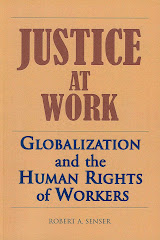
1. My newly published JUSTICE AT WORK: GLOBALIZATION AND THE HUMAN RIGHTS OF WORKERS. Its main theme: the present unbalanced global economy, especially its trade and investment regime, protects the rights and interests of business and business organizations, to the exclusion of the rights and interests of workers and worker organizations. Check it out at
2. My Weblog, Human Rights for Workers, at http://humanrightsforworkers.blogspot.com, which deals mostly with the main theme of the book.
Print Page
Read more!
Saturday, May 09, 2009
It's no time to relax worker rights pressures
The current economic crisis has the potential of exposing and correcting two “fatal flaws” of the corporate social responsibility programs, says Garrett Brown, a health and safety expert and longtime campaigner for worker rights.
In a May 7 article for a professional health and safety publication, Brown identifies those flaws as follows:
1. “The schizophrenic business model that demands the lowest possible production costs at the same time [demanding] full compliance with national laws and corporate ‘codes of conduct,’ andThat’s the potentially good news. The bad news, Brown writes, is that the deepening economic crisis “threatens to accelerate to light speed the ‘race to the bottom’ in working conditions that two decades of globalized production has meant for most workers around the world.”
2. “The lack of any meaningful participation by workers.”
He argues that the economic crisis is all the more reason to pressure governments and companies to develop worker participation, particularly in enforcing occupational safety and health standards in offices and plants.
In the May 7 column he writes: “Even in the best of times, safe workplaces are next to impossible without genuinely empowered workers –and are completely impossible at times of economic crisis when downward pressures intensify.”
As one example of downward pressures, he cites recent actions taken by China’s government to appeal to foreign investors: freezing scheduled increases in minimum wages, reducing or suspending employer payments into the social insurance system, restoring export tax credits, and passing word that the new labor protection laws of 2008 won’t be seriously enforced.
Brown has been the coordinator of a health and safety support network with projects in Central America, China, Mexico, and Indonesia since 1993. His article, titled “Corporate Social Responsibility,” appears in the Industrial Safety and Health News.
Print Page Read more!
Tuesday, May 05, 2009
Stop squelching real unions, Vietnam
As part of a campaign to suppress any labor union independent of the Communist Party, the Socialist Republic of Vietnam has imprisoned at least eight trade unionists, two of them women, on “national security” charges in the past three years.
In a report released May 4, Human Rights Watch publicized the wide scope of the government crackdown, denounced it, and urged the United States to pressure Vietnam to end suppression immediately.
The government campaign of harassing, detaining, and imprisoning union activists is aimed particularly at two worker organizations: the United Worker-Farmers Organization of Vietnam and the Independent Workers Union of Vietnam, whose launching was announced in late 2006 during a brief period when authorities seemed to tolerate a budding civil society.
It was a temporary public posture prior to Vietnam’s joining the World Trade Organization and getting U.S. approval for that accession.
Of the eight trade unionists imprisoned since then, five have been released. One who is still behind bars, Le Thi Cong Nhan, in her early 30s, wrote a comprehensive essay in 2006 titled “Legislative Aspects of Industrial Actions and the Need for Independent Unions in Vietman.” For this and other human rights activities, the Hanoi People’s Court in May 2007 imposed a four-year prison sentence, later reduced to three years (plus three years of house arrest), on charges of “disseminating propaganda against the government.”
The Human Rights Watch report, “Not Yet a Workers’ Paradise: Vietnam’s Suppression of the Independent Workers’ Movement,” 32 pages long, is available on the HRW Website at
http://www.hrw.org/en/reports/2009/05/03/not-yet-workers-paradise.
Print Page
Read more!
Friday, May 01, 2009
Crisis or not, business-human rights link holds
Should business and government shelve human rights concerns during the current global economic crisis? Of course not. It was the obsession with money as the supreme value, trumping all other values, that got us into this mess, and it would be folly to rely on that obsession now.
A senior UN official has added his voice against the temptation to make human rights a casualty of the crisis. John Ruggie, the Special Representative of the UN Secretary-General on human rights and transnational corporations, did so in his April 22 report to the Human Rights Council.
He buttressed his argument mainly with these points:
The business and human rights agenda matters now more than ever. “Any gains Governments believe can be had by lowering human rights standards for business are illusory, and no sustainable recovery can be built on so flimsy a foundation.”
“The same types of governance gaps and failures that produced the current economic crisis also constitute what the Special Representative has called the permissive environment for corporate wrongdoing in relation to human rights.” Governments promoting greater corporate responsibility, and corporations adopting human rights strategies, both reflect “the now inescapable fact that their long-term prospects are tightly coupled with the well-being of society as a whole.”
In his report, the first in his current three-year mandate, Ruggie noted the beginnings of a positive trend in corporate law: governments and courts are introducing “more public interest considerations” into what companies do and how they do it.
He cited Denmark, India, South Africa, and the United Kingdom as taking preliminary steps in that direction. As for the United States, "federal statutes require publicly listed companies to have robust programs to assess, manage, and report on material risks. None refers to human rights explicitly, but material risks clearly do encompass human rights issues."
To fill information gaps, 19 leading law firms from around the world have volunteered their services to survey corporate law provisions in over 40 jurisdictions.
Print Page Read more!
Sunday, April 26, 2009
Myopia Still Hampers WTO
It is up to the United States “to make history” by leading the way to a revival of the stalled Doha Round of trade negotiations, says Pascal Lamy, director-general of the World Trade Organization.
In making that case in a Washington talk on April 24, Lamy emphasized that open trade needs to be “accompanied by the right domestic policies.” His list of those policies includes:
-- “better worker training, greater mobility in labor markets, more expansive social safety nets."
-- “investing in critical areas such as health care, education, and clean energy.”
-- “greater investment in physical, social, and government infrastructure, which helps increase the benefits of trade.”
“The presence of these domestic policies,” he explained, “provides a layer of comfort to workers who are then better prepared to face global competition since they know there are social safety nets that will catch them when they fall.”
In warning against protectionist measures, Lamy said: “It is not less trade that the United States needs, but more and better domestic policies,…policies which help translate trade into benefits for the people. This is where the task of reconciling the people with trade must start [emphasis added].”
While detailing the domestic policies that need to be changed for the sake of workers, he neglected to mention any WTO policies that might need change to take account the rights and interests of workers. These are controversial of course, but so are the domestic policies he advocates.
Ironically, at least in the United States, the business groups most eager to restart the Doha negotiations are also those most zealous in opposing the domestic policies that Lamy deems necessary to give “comfort” to working men and women.
In his talk, given at the Peterson Institute for International Economics, Lamy called upon U.S. business, academics, and political leaders to rally behind the WTO during what he called “the first global crisis in the history of mankind.” Yet, except for his ideas on needed domestic programs, he relied on the same free trade rationale that has been persuasive for 60 years but now is seriously questioned by influential economists and others in rich and poor countries alike.
Back in 1993, a Heritage Foundation memorandum analyzing the pre-WTO General Agreement on Tariffs and Trade (GATT) called it “the closest thing to a uniform commercial code for world trade.” The WTO is still devoted to devising and enforcing an improved global code for commerce, but the world needs more than that.
Lamy’s talk reflects some innovative WTO ideas on the internal policies of the United States and other countries. Especially in the present crisis, Pascal would be wise to start rethinking the WTO’s own policies.
* * *
I have long criticized the WTO for its unbalanced agenda. See, for example, “The WTO's Lop-Sided Agenda for the World,” in December 2001. For a more recent analysis, see the blog posting of April 20, immediately below this.
Print Page
Read more!
Monday, April 20, 2009
President Obama’s basic choice on trade
As the Obama administration wrestles with shaping its policy on the World Trade Organization (WTO), the old questions about fairness and equal treatment pop up once again.
Fairness? (I can hear the loud objections.) Why sidetrack the WTO into controversies about fairness and equal treatment?
It may come as a surprise to some that the WTO is already committed to equal treatment. That commitment is so basic that it is expressed in two principles that the WTO calls “the foundation of the multilateral trading system.”
These two principles, both formulating “trade without discrimination,” are:
“1. Most-favored-nation (MFN): treating other people equally….Grant someone a special favor (such as a lower customs duty rate for one of their products), and you have to do the same for all other WTO members.”Those two principles, here quoted from an official document, “Understanding the WTO,"are written into all three key WTO agreements, the General Agreement on Tariffs and Trade (GATT), the General Agreement Trade in Services (GATS), and the Agreement on Trade-Related Aspects of Intellectual Property Rights (TRIPS).
“2. National treatment: treating foreigners and locals equally. Imported and locally produced goods should be treated equally….The same should apply to foreign and domestic services, and to foreign and domestic trademarks, copyrights, and patents.”
Why does equality of treatment have such a fundamental role in the WTO as in the trading system as a whole?
Because it is fair to those whose rights and interests it is designed to protect – the business people and firms engaged in international commerce. The laws of individual countries were not – and are not -- adequate to offer that protection. After World War II, policymakers of leading nations agreed to correct that particular gap, and created the first versions of GATT the agreement and GATT the organization, both focused on business.
Even at the beginning, some leaders recognized that the focus on business was one-sided and needed to be corrected to include the rights and interests of workers and their organizations. Those efforts failed then, and have failed ever since.
The challenging trade issues now facing the Obama administration can be reduced to three statements:
1. The world trade and investment system does not protect the rights and interests of workers and worker organizations as it does the rights and interests of business and business firms.
2. That imbalance is unfair, and is increasingly recognized as unacceptable -- a trend that partly accounts for the widespread disenchantment with globalization.
3. The challenge is to decide what actions, short range to long range, are necessary to correct that imbalance.
Adopting a WTO agreement on Trade-Related Aspects of International Labor Standards (TRAILS) would be a historic achievement, but not a cure-all. Biased ideas toward work, workers, and worker organizations are imbeded in our culture. Curing them requires a multi-faceted approach.
* * *
This crisis should not go to waste
“Anonymous” makes the following comment about my previous post (below), titled “Oust U.S. financial oligarchy: economist”
“I'm so not listening to economists these days, Bob. Let's hear from people who are breaking out new mobilization ideas - the grass-roots cannot be rallied with what this-or-that economist says. Get the agit-prop, resistance-inspiring and activists' victories stories out there, before this moment passes!”
My view: Let a thousand flowers bloom. Including those among economists.
Print Page Read more!
Friday, April 17, 2009
Oust U.S. financial oligarchy: economist
Every country has its dominant elites, oligarchs of one kind or another. The challenge is to change them when they get too powerful. The United States, too, has its oligarchy, the banking/financial industry, which has grown so powerful that it thrives on the chaos it created and blocks essential reforms. Ousting the oligarchy must be accomplished soon, or else we may well suffer not just a repeat of the Great Depression, but something worse.That paragraph summarizes the unsettling message of “The Quiet Coup,” an article in the May issue of The Atlantic by Simon Johnson, a former chief economist of the International Monetary Fund (IMF). Now a professor at MIT, Johnson draws on his experience at the Fund to describe the typical plight of “emerging market” countries in a desperate economic situation.
“The biggest obstacle to recovery is almost invariably the politics of the countries in crisis….The powerful elites within them overreached in good times and took too many risks,” he writes. Then, in the downward spiral that follows “the oligarchs are usually among the first to get extra help from the government.” But an economic reform program succeeds “only if at least some of the powerful oligarchs who did so much to create the underlying problems take a hit.”
Johnson compares the situation of troubled emerging market countries with that of the United States, except that here it’s much worse, as he sees it. “Just as we have the world’s most advanced economy, military, and technology, we have its most advanced oligarchy” -– the banking/financial industry.
Economist Jagdish Bhagwati’s name for this oligarchy is the “Wall Street-Treasury complex,” a powerful network he describes as “unable to look beyond the interests of Wall Street which it equates with the good of the world.” Like Bhagwati, Johnson illustrates its influence by tracking the back-and-forth movement of its leaders between Wall Street and top federal government posts in both Democratic and Republican administrations.
In a key insight, Johnson writes: “The American financial industry gained political power by amassing a kind of cultural capital – a belief system…[that held] that what was good for Wall Street was good for the country…In a society that celebrates the idea of making money, it was easy to infer that the interests of the financial sector were the same as the interests of the country.”
What followed in the past decade is what Johnson calls “a river of deregulatory polices that is, in hindsight, astonishing.” Three items from his list of seven:
-- The insistence on the free movement of capital across borders.
-- Major increases in the amount of leverage [borrowing] allowed to investment banks.
-- A light (dare I say invisible?) hand at the Securities and Exchange Commission in its regulatory enforcement.
The environment, or at least public opinion, has now changed, but “financial elites have continued to assume that their position as the economy’s favored-children is safe, despite the wreckage they have caused.” And the government itself “has taken extreme care not to upset the interests of the financial institutions, or to question the basic outlines of the system that got us here.”
For Johnson, “the government’s velvet-glove approach with the banks is deeply troubling, for one simple reason: it [doesn’t] change the behavior of a financial sector accustomed to doing business on its own terms, at a time when that behavior MUST change.” Instead, big banks have a veto power over public policy, despite their loss of popular support.
The solution? Johnson’s advice, as he puts it, is similar to the advice that the IMF, and the U.S. government, has given to developing countries in deep economic trouble: temporary nationalization of hopelessly insolvent banks. Instead, the U.S. Treasury is trying to negotiate bailouts bank by bank, and “behaving as if the banks hold all the cards.”
Meanwhile, in foreign trade and investment policy, an area not examined by Johnson, the Obama administration has signaled that it will ask Congress to ratify the three still pending Free Trade [and investment] agreements negotiated by the Bush administration with Columbia, Korea, and Panama. There likely will be changes in the contents, but none in how the agreements extend Wall Street’s power in the global economy and hence in the United States also.
Johnson’s overall assessment: “The Obama administration’s fiscal stimulus [program] evokes FDR, but what we need to imitate here is Teddy Roosevelt’s trustbusting.” Its operating principle would be: “Anything that is too big to fail is too big to exist.’
The article’s closing analysis is dire:
“What we face now could, in fact, be worse than the Great Depression – because the banking sector is now so big. We face a synchronized downturn in almost all countries, a weakening of confidence among individuals and firms and major problems for government finances. If our leadership wakes up to the potential consequences, we may yet see dramatic action on the banking system and a breaking of the old elite. Let us hope it is not then too late.”To learn more about Johnson’s ideas, see the Website he co-founded, BaselineScenario.com.
Print Page Read more!
Thursday, April 16, 2009
Doubting WTO chief Pascal Lamy‘s Doha data

The top executive of the World Trade Organization (WTO) got an unusual public rebuke April 14 during an informal session in Geneva of the WTO trade policy review board, made up of representatives of the organization’s full membership.
India’s trade envoy, Ujal Singh Bhatia, challenged a forecast that WTO Director-General Pascal Lamy made in his latest report on trade and the current economic and financial crisis. Bhatia specifically questioned Lamy about how he arrived at the figure of $150,000,000,000 as the potential “stimulus” benefit that would result if the stalled Doha Round succeeded.
He cautioned against repeating figures “not supported by hard data.”
“In the last few years I have seen numbers ranging from $400,000,000,000 to $40,000,000,000,“ Bhatia said, citing a statement of economist Peter Galbraith that “the only function of economic forecasting is to make astrology look respectable,” according to a report of the Business Standard of India.
In his remarks at the meeting, Ambassador Peter Allgeier, deputy U.S. trade representative, said that the U.S. remains committed to conclude “an ambitious and balanced” Doha Development Agreement. According to a USTR release, he added: “In this regard, we support India’s request for details on the $150,000,000,000 figure in the report for estimated tariff savings from DDA.”
In his response, Lamy defended his figure as neither “rocket science” nor “astrology” but based on “the revenues foregone” from the tariff cuts proposed last July as part of the Doha round. His report to the meeting explains in detail why “The Doha Development Round is the best stimulus package.”
Print Page
Read more!
Wednesday, April 15, 2009
Your Federal tax burden eased
Although people complain much about taxes, the fact is that, for taxpayers in most income groups, the share of their income going to Uncle Sam is close to their lowest levels in decades.
That may not be very comforting for people who filed their IRS returns this spring, but facts are facts, and the Center on Budget and Policy Priorities laid them out blandly in a report on April 14.
Take a median-income family of four. It paid only 5.9 percent of its income in federal income tax in 2007, slightly higher than the 2003 all-time low of 5.3 percent. In fact, that family’s tax rate was lower in 2007 than in any year between 1956 and 2002.
Of course, the highest-income households fared better, and those at the top of the pyramid are faring much better. For example, in 2010, when the 2001-2008 tax cuts are fully in effect, households with annual incomes of more than $1,000,000 a year will receive tax reductions averaging $168,000, whereas households in the middle fifth of the income distribution will average $1,150.
The Center on Budget and Policy Priorities is an equal opportunity collector and interpreter of vital national statistics. This report draws on, analyzes, and updates data from the Treasury Department, the Congressional Budget Office, the Brookings Institution, the Tax Policy Center, and other sources, including groundbreaking work on income inequality by two economists, Thomas Piketty and Emmanuel Saez.
Print Page
Read more!
Monday, April 13, 2009
More 'informal' Asian workers = more exploitation
Companies in Asia are relying more and more on labor in the “informal sector,” to the point that “informal workers” now comprise as much as two-thirds of the region’s labor force.
So says the Hong Kong-based Asia Monitor Resource Center (AMRC) in a new report, “Rights for Two-Thirds of Asia.” The 274-page publication tracks the labor law and practices prevailing in the “unregistered” activities in the industrial, agricultural, and services sectors of 14 Asian countries, and finds that increased number of informal workers, most of them female, means increased exploitation of the most vulnerable.
“Overall, the Race to the Bottom penalizes virtually everyone in the labor force, particularly those in the informal majority – in both the formal and informal economies,” writes Rene E. Ofreneo in the introductory chapter of what is the latest edition of the AMRC’s Asian Labor Law Review.
Ofreneo, a professor of industrial relations at the University of the Philippines, poses a question raised in a 2006 UNDP report: The fast-growing Asian-Pacific region has embraced free trade, but has free trade embraced free trade? “The answer by the [22] contributors to the 2008 Labor Law Review is a uniform No,” she points out.
The most remarkable part of that failure is this. The informal workers are no longer just street vendors, home workers, or farm helpers.
They are also women and men who once did regular jobs such as packaging, maintenance, and security for a company and who now do the same work in the same office or factory. The only difference is that they are now working under an imposed “contract” status with fewer benefits and no job security.
When I was in Bangkok a few years ago, I learned of a bank that unilaterally decided to switch a part of its work force into a “contract” status, partly to cut them off from its unionized employees and thereby deprive them of benefits under its collective bargaining contract.
Now “the irregularization mania [is] sweeping Asia,” according to the AMRC. In fact, “the regulars, or standard employees, are now outnumbered by the ‘irregular’ or ‘non-standard agency, temporary, casual, part-time, migrant, and subcontracted workers.”
Looking at the big picture, Ofreneo attacks the policies of the World Bank and of the United States and Europe, which long preached their gospel of a regularization-free labor market. The World Bank still does, through a widely circulated annual publication, “Doing Business,” which holds up a development model with minimal labor legislation.
“One undeniable root cause” of today’s global financial meltdown, in the AMRC’s view, “is precisely the irrational exuberant belief in the so-called growth creating potentials of free financial, goods, and labor markets sans regulations.”
“Rights for Two-Thirds of Asia,” priced at $25, was prepared in cooperation with the Committee for Asian Women and Homenet Southeast Asia.
Print Page
Read more!
Wednesday, April 08, 2009
West Wing cast joins pro-union campaign
With business organizations pouring uncounted millions into their fight against the Employee Free Choice Act, three top members of the West Wing cast came to Washington recently to lend their support to that proposed bill.
The three West Wingers – Martin Sheen, Bradley Whitford, and Richard Shiff – recorded a video to help kick off labor’s “Faces of the Employee Free Choice” campaign.
“The Employee Free Choice Act,” Martin Sheen says in the video, ”means a stronger America for all of us.” Here what they all said.
What can you do?
Check the American Rights at Work organization to learn how you can help. Click here.
Print Page
Read more!
Thursday, April 02, 2009
The TRUST GAP: yesterday's and today's

The TRUST GAP
Pharaoh in all his glory would have envied today’s CEOs their perquisites and ever-sweetening pay. Too busy living the cosseted life, America’s managerial elite have lost touch with the humble employee. Workers’ faith in top management is collapsing. CEOs who don’t come down from the heights are in trouble.
Those words appeared on the cover of the December 4, l989, issue of Fortune magazine, which I just found in a file of material I collected back then while writing an encyclopedia article on exorbitant executive pay.
Fortrune’s graphic indictment of 1989 applies today, but with crucial differences. The managerial elite still live as modern-day Pharoahs, but now they are joined by their peers in the shadowy financial world. And it is not just the faith of the humble workers that has collapsed; the public trust, the trust of the people at large. is in shambles. And, whereas the “trouble” of two decades ago faded away without serious repercussions, the crisis today is shaking the nation.
The contrasts with the past are striking. In 1990 the average CEO made 107 times more than the average worker. Now, according to the latest data, that ratio is 334 times to one. But until now exorbitant CEO compensation has not provoked a populist reaction, partly because of a widespread belief that, after all, the bosses earned it. That assumption has been shattered for at least two reasons.
First of all, even companies in bankruptcy or near it have brazenly rewarded their chiefs with sky-high pay and matching bonuses. The bonuses, especially, ignited unprecedented outrage.
Secondly, in recent years our great leaders of American enterprise have presided over a massive export of U.S. jobs, particularly to a neo-Communist state, China, to the point that our respected National Association of Manufacturers (NAM) is really the U.S. Association of Asian Manufacturers.
These Pharaohs, who would never tolerate a governmental role in supervising elections for corporate boards, are militantly opposing the Employee Free Choice Act, a union-friendly bill in Congress. The NAM and its allies are zealously devoted to maintaining the present restrictive system, which requires the federal government to run a referendum before a union is allowed to exist and operate in any workplace.
There is a strong case for freeing up that system. It is supported by an impressive number of noted economists, even Professor Jagdislh Bhagwati.
Print Page Read more!
Thursday, March 26, 2009
New Labor Secretary Inherits a Mess
Under a Labor Department that has been mismanaged for years, uncounted numbers of workers – perhaps millions -- became victims of wage theft by employers. In testimony before a Congressional committee, the Government Accounting Office (GAO) yesterday described how sloppy enforcement of the law left low-wage workers particularly vulnerable to having employers steal their earnings.
Following up on scandals reported in the media, the GAO assigned a team of undercover agents to pose as workers or employers to test how the field offices of the department’s wage and hour division handled 10 types of complaints typically voiced across the country.
Here are three examples given of how department employees dealt with fictitious violations of minimum pay, child labor, and other issuest under their jurisdiction.
n A receptionist in Virginia paid less than the minimum wage: the department’s investigator accepted without question the employer’s refusal to pay back wages and counseled the office worker to file a private lawsuit.
n A meat packer in California using children to run heavy equipment: four months after receiving this anonymous tip, the wage and hour division office had still not conducted any investigative work, and never recorded the complaint in the department’s data base.
n A house painter in Texas who did not receive his final paycheck: the division employee accepted the employer’s word that he would pay, and closed the case as “agreed to pay” despite the painter’s claim that he got not a cent.
The department’s statistics on back wages collected, and the number of employees receiving their back pay, are overstated, according to the GAO, because “an unknown number” of complaints recorded as resolved did not in fact result in the worker’s receiving the back pay due
More than 100,000,000 workers are covered under federal labor laws enforced by the wage and hour division (WHD). The GAO’s overall assessment was that the WHD had “an ineffective system that [particularly] discourages wage theft complaints.
The new Secretary of Labor, Hilda L. Solis, who has been in office less than two weeks, vowed to take the GAO findings seriously. The understaffed WHD will be adding 250 new investigators.
Under Secretary Solis, the Department of Labor is set to return to the mission for which it was founded in 1913: “to foster, promote, and develop the welfare of working people.”
Print Page
Read more!
Sunday, March 22, 2009
A new book appearing on Amazon.Com
I was happily surprised today to learn that my book, Justice at Work: Globalization and the Human Rights of Workers, can be ordered through amazon.com. Later, it will also be available for on-line purchase at Barnes and Noble and Borders.
Whether bookstores will stock it depends on demand, which is still unknown, as is its easy availability outside the United States.
To my further surprise, amazon com is also selling used copies of my earlier book, Primer on Interracial Justice, published in 1982 by Helicon Press, which I have not bragged about of late because it is out of print, as well as out of date. And amazon.com is also marketing copies of a (copyrighted) review article of mine on how Solidarity won freedom of association, published by the Monthly Labor Review of the U.S. Labor Department.
As before, Justice at Work can be ordered through Xlibris, but the delivery time is not as rapid as through amazon.com.
My only disappointment is that amazon.com does not yet carry the image of my book cover. The cover is a co-production of my wife, our son Thuy, and myself. I am proud of it, and hope you will find that the book’s content matches its quality.
UPDATE: Amazon now carries the image of the book's cover. Take a look.
Print Page
Read more!
Saturday, March 21, 2009
Fighting Sweatshops, Recession or No Recession
In the midst of a global recession, isn’t it time to suspend campaigns against sweatshops? Not at all, says Jim Ready, a 10-year veteran in the struggle for worker rights.
In fact, he has intensified his anti- sweatshop campaign, Team Sweat, with new initiatives that include:
· Inserting an ad on Facebook that is attracting a thousand hits a day;
· Launching a new Weblog called Team Sweat.
· Working on a documentary that includes an interview with Nobelist Joseph Stiglttz.
· Planning a May Day demonstration in New York City.
That’s on top of work schedule already heavy with varied activities, all focused on Nike, the No. 1 apparel distributor in the world, which has its many wares produced by 800,000 workers in 700 factories in 52 countries throughout the world.
Keady can rattle off Nike statistics because he himself is a Nike shareholder and attended Nike’s shareholder meeting in Oregon in September last year. During the meeting he attempted to put on the record Nike's failure to pay a living wage, but management edited out most of the content of Ready's statement/query to the board of directors.
After the official meeting, Keady had a brief conversation with Mark Parker, CEO of Nike Inc., followed by a three-hour meeting with five members of Nike’s executive team. According to his Web report, he pushed hard on two key issues:
1. The current wages paid to Nike’s workers in Indonesia are not enough for these workers to meet their basic living needs. He based this claim partly on his own personal experience in 2000, when he and a colleague lived on $1 a day for two months. (See “Learning How You Survive on $1 a day.")
2. The ultimate goal of the campaign is to have Nike’s Indonesia workers become actual Nike employees, rather than subtracted workers.
There was a “lively discussion” covering a lot of ground, but not the issue of turning subcontracted workers into employees, an ideal that the executives dismissed by ignoring it. One result from that give-and-take was what Keady regarded as a commitment that members of Nike’s executive team would, sometime in the next months, visit Nike plants in Indonesia with Keady to hear Nike workers themselves make the case for increasing wages and holding negotiations for a collective bargaining contract. So far that joint inquiry has not taken place, although it may in July, when Keady will making be his latest fact-finding visit to Indonesia, where Nike still employs some 110,000 workers.
Keady remains optimistic. “We have momentum,” he says, in the context of his 10- year campaign.
In a phone conversation with Keady today, I wondered what motivates him to keep on. “A big part of it is my faith,” he says. He is grounded in a liberation theology that values working toward the kingdom of God in the here and now, through our daily work.
Keady is also energized by the sessions he has with groups of college students and others, 20 to 40 of them a year. These are interactive, starting with asking people to check the label of origin on the clothes they wear, followed by a multi-media presentation depicting the plight of the foreign workers, mostly young female, who make those clothes.
He finds that the typical audience is shocked by the facts. At the end of his most recent session, at Canisius College in Buffalo, he got a standing ovation at the end, and dozens of students approached him afterwards, wanting to get involved.
Those sessions are stimulating in another way. He hears challenging questions, the most recent centering on the recession and whether having a sweatshop job isn't better than having no job at all. He has thought through an insightful response. Its most telling part, in a nutshell, goes like this: Paying a living wage to those still working would have little effect on Nike’s revenues ($18,600,000,000 in 2008) and would aid the nation’s economic recovery by its multiplier effect throughout the economy.
The either/or question, Isn’t a sweatshop job better than no job at all?, has a seductive appeal, I find. Certainly, for an unemployed person (and dependents) a sweatshop job is better than no job, at least in the abstract, but not always in real life. What if the sweatshop is rife with sexual abuse? Or if sweatshop conditions endanger your health and safety?
Keady points out that Catholic social teaching is clear about this type of "choice." "Church teaching," he insists, "tells us that if a person, out of fear or desperation, accepts working conditions that they would not normally accept, then that is an injustice. If it is an injustice, then people of faith have a moral obligation to fight to end that injustice."
The either/or choice also has a policy dimension. Even if economic conditions are so bad that many persons have a sweatshop job as their only choice, should that grim reality determine the policies of governments and non-governmental groups?
That’s a common good issue, different from the issue of individual good. There is a difference, often slighted. Women of 55 with abusive husbands may have no choice except to stay married, but that should not require abandoning public or private efforts to end wife abuse.
Print Page
Read more!
Sunday, March 15, 2009
Business schools’ guilt for our financial mess
Could it be that “the way business students are taught may have contributed to the most serious economic crisis in decades?”
That question is now on the minds of analysts, “and even educators themselves,” reports Kelley Holland in the March 15 business section of the New York Times.
For one educator, Rakesh Khurana , a professor at Harvard Business School, business schools are at fault for failing to teach students that they are professionals, stewards with long-term economic goals, not agents of shareholders responsible for maximizing shareholder wealth.
“A kind of market fundamentalism took hold in business education,” Khurana said. “The new logic of shareholder primacy absolved management of any responsibility for anything but financial results.”
Holland’s quick survey did not uncover a consensus on whether business schools contributed to the current disorder in the global market. One professor of finance does plan to incorporate the changed world into his class this fall. Among other things, he will add a discussion of whether the market is always right when it values things. “You would not have had that discussion three years ago,” he said, inadvertently revealing that business school educators are part of A.I.G.’s backstory.
The Times article fell short of the clarity of a 2002 Washington Post article titled “When It Comes to Ethics, B-Schools Get an F” by Amitai Etzioni of George Washington University. Etzioni based his criticism on his own experience and on an Aspen Institute study of 2,000 graduates of the top business schools.
“B-school education not only fails to improve the moral character of the students; it actually weakens it,” he wrote. For more, see my Website article, “How Business Schools Teach Enron Ethics.”
Print Page
Read more!
Wednesday, March 11, 2009
Pioneering worker rights as human rights
Yes, the Universal Declaration of Human Rights treats the basic rights of workers as human rights, but who takes that seriously? Roy J. Adams, a prominent Canadian teacher and author, does. And he did so long before even human rights organizations did.
In August Adams will pull up stakes from his home base at McMaster University in Hamilton, Ontario, and move 1,400 miles west to the University of Saskatchewan in Saskatoon. There, at the College of Law, he will hold the Ariel F. Sallows chair of human rights -- a milestone in academic history, since he is apparently the first teacher of labor law to be appointed to teach human rights law.
“One more indication that labor rights are being acknowledged as human rights,” as Adams puts it.
Another sign of that trend is his book, “Labour Left Out: Canada’s failure to protect and promote collective bargaining as a human right,” published by the Canadian Center for Policy Alternatives two years ago. A past president of the Canadian Industrial Relations Association, Adams has been a visiting professor or lecturer at universities and schools in 12 countries across the globe.
For more on Adams’ career as industrial relations teacher and human rights advocate, check his home page at http://www.business.mcmaster.ca/hrlr/profs/adamsr/.
Print Page
Read more!
Friday, March 06, 2009
Parliament probing business and human rights
A joint committee of the British Parliament today issued a “call for evidence” on how corporations have complied with their responsibility to respect human rights.
The inquiry covers “the way in which businesses can affect human rights both positively and negatively, how business activities engage the relative responsibilities of the UK Government and individual businesses; and whether the existing UK regulatory, legal and voluntary framework provides adequate guidance and clarity to business as well as adequate protection to individual rights.”
Not just corporations but also “interested persons and bodies are invited to submit written evidence” of not more than 2,500 words by May 1, 2009.
The two-page long decision issued by the Parliamentary committee on human rights lists a page of questions that the committee “would particularly welcome evidence.” For this list, the committee uses the framework on human rights and business adopted by the UN Human Rights Council in June 2008.
The committee is requesting views for making its own proposals for possible legislation and for the on-going work of the UN special representative on human rights, John Ruggie. The Bush administration opposed this UN program, which has been ignored by the U.S. media.
For background, see my reports under the category of John Ruggie. Also my new book, Justice at Work: Globalization and the Human Rights of Workers, has a long chapter on Ruggie’s work titled “Business and Human Rights.”
Print Page
Read more!

 Posts
Posts