An experienced American trade negotiator, Robert B. Cassidy, is speaking out with a candor rare among high-ranking trade bureaucrats. Cassidy, a former assistant U.S. Trade Representative,is discussing the mistakes of the past and the lessons that should be learned from them by the Obama administration.
In remarks before a packed audience at the Economic Policy Institute (EPI) in Washington on January 27, Cassidy, now in private practice, offered “five overarching lessons” to guide any overhaul of U.S. trade policy.
Fortunately, EPI provides the full text of Cassidy’s talk on its Website, from which this report draws his five lessons and a brief explanation of each, as follows:
First: Trade policy should be based on U.S. economic self-interest, not as the equivalent of corporate self-interest, nor as a subset of foreign policy. Cassidy cites the free trade agreement with Korea as one motivated largely by foreign policy objectives, in this case to surround China with bilateral FTAs.
Second: Trade policy as such has only limited reach. Global monetary, fiscal, and competition policies are more important. As the “only country capable of standing up to China,” the United States should take the lead in the WTO in challenging China’s manipulated exchange rate.
Third: The advisory and decision-making processes of trade policy “need to be balanced,” that is enlarged beyond State, Treasury, and Commerce (plus Agriculture occasionally) to include Labor and environmental interests. The present race to the bottom on labor standards should be abandoned, and indeed can be abandoned fully consistent with WTO principles.
Fourth: We need to get our trade relationship with China on a more balanced footing by asserting our interests more aggressively. On our imports of tainted foods, why are we relying on China to safeguard the health of our citizens?
Fifth: Reconsider “trade promotion authority” to make negotiations more transparent and negotiators more responsible in pursuing our objectives.
The administration, according to Cassidy, should take advantage of a “short window of opportunity” to ensure that the benefits of trade “flow to the broader U.S. economy. . . and help achieve other goals such as improved labor standards and environmental objectives.”
Print Page
Read more!
Wednesday, January 28, 2009
Five lessons for new U.S. trade policies


Why union membership remains low
The number of workers belonging to unions in the United States grew by 428,000 last year to 16,100,000, mostly thanks to increased membership in the ranks of teachers, police officers, firefighters, and other local government employees.
The 2008 union membership rate in the public sector generally – 36.8 percent –stood in stark contrast to the rate in the private sector – 7.6 percent. In other words, government workers were nearly five times more likely to belong to a union than employees in the private sector.
Collective bargaining contracts covered about 1,700,000 workers who themselves refrained from joining a union. These holdouts were distributed about half and half between the public and private sectors.
Exhaustive data on union membership is contained in the latest annual report, “Union Members in 2008,” issued by the U.S. Labor Department’s Bureau of Labor Statistics (BLS), based on monthly household surveys conducted by the Census Bureau.
The BLS report, which covers 12 pages, does not explain why unions are stronger in the public than in the private sector. Numerous surveys, however, show not only that private business is much more unreceptive to unions than government agencies, but also that U.S. law permits companies to put that attitude into action.
A new Human Rights Watch briefing paper focuses on labor law and practice in the U.S. private sector, without drawing a contrast with the public sector. After reading the 12-page report, however, I cannot help marveling that even 8,255,000 of private sector workers still belong to unions.
U.S. labor law “is weak and riddled with loopholes,” and employers take advantage of that weakness in the law and in its enforcement to vitiate the right of workers to organize. The HRW briefing paper supports those two findings with detailed evidence. For example:
-- Penalties for firing pro-union workers and for otherwise breaching the law are so small that employers dismiss them as a worthwhile cost of doing business.
-- The government run election procedures by which workers vote for or against a union are heavily slanted against the union.
-- Even if workers succeed in winning an election, an employer can stall reaching a collective bargaining agreement to the point of making the victory meaningless.
HRW is among a growing number of organizations supporting Congressional approval of the Employee Free Choice Act. For Human Rights Watch, that passage is “a human rights imperative.”
Print Page
Read more!
Monday, January 19, 2009
The case for a huge economic stimulus
More than a third of the U.S. labor force will be plagued by periods of unemployment or underemployment next year if government spending does not surge substantially to spur demand for goods and services. So says a new Issue Brief published by the Economic Policy Institute.
In the absence of a large recovery package, the unemployment rate is expected to reach 10.2 percent in mid-2010, according to the Brief, and middle-income families would earn about $4,700 less in 2010 than they had in 2007,
But the overall statistics “don’t capture the pain” that would impact specific groups of people, warn Lawrence Mishel and Heidi Shierholz, the authors. Those especially hard hit next year would include:
-- Nearly one in five African-Americans in the labor force would be jobless.
-- So would 13.1 percent of Hispanics.
-- Underemployment would reach 18.8 percent of women workers.
In the Brief, entitled “Without Adequate Public Spending, a Catastrophic Recession for Some,” the authors recommend government spending on the order of $600,000,000,000 a year for two years to head off the “catastrophe” they consider otherwise inevitable.
Print Page
Read more!
Thursday, January 15, 2009
For blacks, depression is already here
For most white people, it’s a recession, but for blacks, it’s already a depression. That’s a conclusion of a new report, “State of the Dream 2009: a Silent Depression,” released on Martin Luther King’s Day, January 15, by a Boston think tank, United for a Fair Economy (UFE).
“People of color have been experiencing a recession for five years,” says Amaad Rivera, UFE’s racial wealth specialist and one of the authors of the 70-page report. “By definition, a long-term recession is a depression.”
Why has this “silent depression” gotten relatively little attention? In large part, according to UFE, because the economic indicators we rely on are not sophisticated enough to mark the racial divide.
The facts, though, are there deep and not so deep in government documents, and the UFE report digs out many of them, as in a UFE chart showing a poverty rate in 2007 of 8.2% among whites and 24.5% among blacks.
Economic inequality and structural racism “were created, so they can also be eliminated,” the UFE report insists, by adopting reforms small and large, immediate and long range. A significant example: taxing work and wealth at the same rate would generate $95,000,000,000 a year in revenue.
“The current economic crisis requires more than a color blind stimulus,” says Dedrick Muhammad, UFE research associate and a co-author of the report. “It requires a complete economic restructuring that addresses the racial wealth divide.”
For more details, check the Website of United for a Fair Economy.
Print Page
Read more!
Wednesday, December 24, 2008
Competition gone bezerk
“Companies [today] are competing with everyone from everywhere for everything.” So say the authors of Globality, a new book about the latest phase of globalization. The Economist quotes those words approvingly in its most recent report on globalization, “A Bigger World.”
Both the book and the Economist favor the global economy as it is, not as it should be. They reflect the perspective of a leading economist, N. Gregory Mankow, former chairman of the Council of Economic Advisors. He holds that when you invoke ethics or morality, you leave the economics department and go over to the philosophy department.
Over at LaSalle University in Philadelphia, a professor of economics, David George, has published a fascinating study, "On being ‘competitive’: the evolution of a word." Diligently, he tracks the six-decade-long evolution of “competitive” as the label for a limited characteristic, or idea, into a universal ideal with frequent perverse results. For example:
“Amazingly, the firm that is least able to be described as ‘competitive’ by the old definition (a single firm in a sea of many firms) now is most able to be described as ‘competitive’ under the new definition (a victorious or most [competitive] firm).”
Most significantly, George shows that "competitiveness" has acquired an excessively high positive value in the business and the public mind. This poses a serious temptation to the Obama administration as a priority goal of its global economic policy. If Obama succumbs, he would be continuing the disastrous policies of the Bush administration.
Let’s leave the world of Real-World Economics Review, where George’s study appears, for the real world where the consequences of the new meaning of competitive are often very perverse. What does it mean to be competitive with everyone from everywhere for everything? When unfettered competition drives economic policy?
It means, as some Southern senators have proposed, cutting the wages of Detroit auto workers to the level of those who work for Japanese-owned non-union plants in the South. It means, too, something that pro-competitive advocates won’t discuss: gradually bringing the wages of all American workers, white- and blue-collar employees, in line with the wages of workers in China and other competitive countries in our bigger world.
But it also means far more than that. American workers cannot be truly competitive until they meet many more conditions of the bigger world, such as:
—cutting or eliminating company health care benefits, a process that has already begun.
—reducing government inspection of labor conditions, another process that is far along.
—trimming private pension plans, also well under way
—eliminating on-job discrimination programs against women and minorities
Those are just a few examples of the consequences of modern competitiveness, of how the “competitive” bandwagon imperils the whole range of human achievements gained (despite stiff resistance) in the United States.
No wonder globalization is in crisis. Competition has gone bezerk.
The sage of Singapore, Lee Kuan Yew, saw it coming. In a special section of the Economist 15 years ago, he predicted what globalization held in store for the United States. “America’s top 10% will enjoy the highest incomes in the world. But the wages of its less-educated citizens will drop to those of workers in the developing countries.”
That trend did not disturb Lee, a self-confessed social Darwinist. He and his government vigorously opposed any global regulation that would, for example, put limits on employing under-age boys and girls full time in factories.
Pope John Paul II extolled a different approach. In an address to more than 200,000 people on May Day eight years ago, he declared: “Globalization is a reality present today in every area of human life, but it is a reality which must be managed wisely. Solidarity too must become globalized.”
Which brand of globalization will the Obama administration follow? I wish I knew.
Print Page Read more!
Saturday, December 13, 2008
Corruption in politics and in business
Reflecting on the stranger-than-fiction scandal in the Illinois governor’s office, Virginia’s political scientist/philosopher, Larry Sabato, published this comment on his Website two days ago:
A system of government or politics can be at least as corrupting as human nature itself. We have studied politicians in close proximity for years, and as much as it may disappoint the cynics, we have not found politicians to be venal as a class. While there are a number of individual exceptions, most professional politicians, especially those already in public office, want to do good or seek to do the right thing, if doing good is an option that does not result in their political demise.
However, if the "normal and customary" practices of campaigning engaged in both parties are seedy, and if a candidate believes "everybody's doing it, and if I don't do it, I may lose," then most politicians will suspend their ethical codes. They will willingly accept a distasteful means that ensures what they regard as the good and essential end of their continued power. In other words, otherwise ethical people are put at a disadvantage by a corrupting system and almost forced to do unto others as they are being done to.
Strict ethicists will correctly argue that the truly honorable person would not stoop to conquer, whatever the provocation. Yet reasonable reformers must keep in mind that the professional politician has a "power gene" in his or her genetic code that overrides all usual inhibitions to achieve victory or maintain power--and genetic engineering, however advanced it may become, will never be able to change that reality.
That analyis, first published in 1996 in Dirty Little Secrets, which Sabato co-authored with Glenn Simpson, is relevant today beyond the political scene.. Reread those paragraphs with business people replacing politicians. And change the kind of DNA involved: replace victory or maintain power with competitive drive.
After making those changes, you have a pretty good insight into today’s Wall Street scandals and how unregulated competition corrupted even many otherwise ethical people.
But the Sabato/Simpson closing sentence above is too pessimistic. Serious time behind bars can be a great deterrent, if seriously applied to enough guilty politicians and business people.
Print Page Read more!
Monday, December 08, 2008
The global durability of sweatshops – II
Life for garment workers in Bangladesh is a daily struggle for survival. A 2006 study by a British human rights group, War on Want, documented the “shameful” labor conditions at six factories producing clothes for three leading British retail chains. Now, a new War on Want study finds that nothing has changed in two years. Still the order of the day at those factories are extremely low wages, poor working conditions, arduous hours (up to 80 a week), and a “fierce” management opposition to unions.
“In fact,” says John Hilary, executive director of the War on Want, “given the damaging effects of the global food crisis, workers are now in an even worse position than they were before.”
Two of the retailers, Tesco and Asda, were founding members of the Ethical Trading Initiative, set up 10 years by companies, NGOs, and unions to improve labor conditions. The largest of the three, Primark, joined in 2006. In a press statement, Primark called the latest charges unsubstantiated and claimed that the practices of its suppliers are continually audited.
The new report, “Fashion Victims II,” criticizes the government and the retailers for relying on “the voluntary approach of ‘corporate social responsibility’” as the answer to sweatshops. Now War on Want insists that it is time “to stop companies from using sweatshop labor” by passing legislation regulating the operations of United Kingdom companies both in the UK and abroad.
War on Want’s Website supplies a sample letter to Members of Parliament urging them “to regulate UK companies and allow workers to seek justice in the UK.” In the United States, it is time to send the same letter, with Americanized changes, to members of both Houses of Congress and to the White House.
Print Page
Read more!
Wednesday, December 03, 2008
The global durability of sweatshops
Even after 15 years of antisweatshop campaigns and corporate social responsibility programs, sweatshops are still alive and well throughout the global economy, both in developing and developed countries. So says Garrett Brown, a health and safety expert who speaks from the perspective of a California state OSHA inspector and a coordinator of worker rights projects in Mexico, Central America, Indonesia, and China since 1993.
Brown made that assessment last month in an address to a conference of industrial hygienists in Tampa, Florida. Although he focused on the state of on-the-job health and safety, he also presented an overview of how workers are faring in today’s global production and distribution system. Among the specifics he cited were these:
—Most factories in the global system have a constantly shifting work force. In China, for example, “good” factories have annual turnover rates of 35-40 percent; “bad” factories have turnover rates of 90 percent or more.
—China’s contract factories often have two worksites: a “trophy factory,” clean, well lit, and code compliant for the benefit of visiting clients and monitors, and the “shadow factory” nearby where production actually occurs under sweatshop conditions, outside the purview of monitors or government inspectors.
—Another way used to game the system, in China and elsewhere, is to maintain three different books on financial accounting and the wages and hours of worker: one for internal use only, one for the government, and one set for outside monitors of compliance with codes of conduct. Some large factories producing for (say) four international brands may provide four separate books, each customized for the code of conduct requirements of the specific clients.
Even “high road” employers, the minority with corporate social responsibility (CSR) programs, have made only slight improvements in their treatment of workers, according to Brown. He blames their “schizophrenic” business model of trying to maximize implementation of codes of conduct while also exerting pressures to minimize production costs.
In his Tampa talk on November 10, Brown described this schizoid scenario as typical:
On Tuesday. a brand’s CSR staffers lecture the factory manager to obey all the country’s labor laws and regulations and to meet old and new requirements of the brand’s code of conduct, or else—. On Thursday, the brand’s buyers tell the manager to maintain the same product quality while requiring him to cut contract costs by x percent this year and by xx percent the next, or else—.
The main purpose of Brown’s presentation was to encourage occupational health professionals to be educators and advocates to improve health and safety in the global supply chains.
“Industrial hygienists,” he said, “can take the lead in this effort within our own companies, especially transnational corporations with global supply chains; within our professional associations; as citizens, constituents, and consumers; and as champions of a ‘big picture’ perspective and a pro-worker approach.”
The Website of the Maquiladora Health & Safety Network, which Brown coordinates, has the full text of his Tampa presentation at http://mhssn.igc.org/PCIH08_GBrown.pdf, as well as a wealth of other information on the global production system and the need to reform it.
Print Page
Read more!
Wednesday, November 26, 2008
Exposing the High Costs of Trade
International trade is a Good Thing. Our opinion leaders say it is. The Washington Post says it is. So trade is clearly a win-win process, right?
No, sorry. It isn’t.
“The trade story is not win-win but rather good news-bad news,” Economist John Bivens explains in a new book, Everybody Wins, Except for Most of Us, subtitled “What Economics Teaches about Globalization.”
Trade, he writes, is “good news for national incomes, bad news for many if not most individuals and families.” Why? “Because trade “redistributes their income away from them and up the income ladder.”
That’s not a secret. It’s a truth “predicted by standard economic theory and proven by empirical studies,” Bivens points out. Economic integration across borders does make countries “a bit richer,” but its “more powerful effects [are] on the distribution of income within each economy.”
Cheerleaders for free trade, however, fail to make the basic distinction between trade’s effect on national income and on family income
Bivens not only clearly explains the theoretical distinction but also calculates its practical effect on American workers in dollar terms. He finds that for a full-time median-wage earner in 2006 the annual trade-related losses totaled about $1,400; for a typical household with two earners, the loss was $2,500. He goes on:
“These losses are as high or higher than other economic costs commonly presented as much more damaging to American families, such as the cost of health care, spikes in gasoline and fuel oil prices, the cost of a child’s four-year college education, or the funds needed to remedy a possible shortfall in the future of Social Security.”
Does the incoming Obama administration fully understand what is at stake?
That’s not yet clear.
Clearly, Obama and some of his key people do understand that globalization is a serious issue, but it is another matter whether they grasp the gravity of the real harm to ordinary American workers (as well as to workers in poor countries) – and how globalization impacts specific problems, like health care. Without such an deep understanding, it will be easy to be frozen into inaction by charges of “protectionism.”
A foreign trade union friend asked me the other day whether I had a “channel” to the Obama administration. I don’t. If I did, I’d try to get Obama or his chief economic advisor to read at least the executive summary of Everybody Wins Except for Most of Us, just published by the Economic Policy Institute.
Print Page Read more!
Friday, November 21, 2008
Big Business and the UN
That’s the title of an article of mine to be published in the December 1 issue of America, the Catholic weekly magazine published in New York. It describes a new United Nations initiative, headed by Harvard Professor John Ruggie, to make the UN Universal Declaration of Human Rights more universal in the global economy.
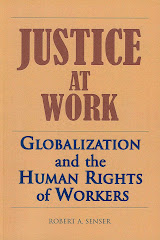
A different and longer version of the article will appear in my forthcoming book, Justice at Work: Globalization and the Human Rights of Workers.
Another article of mine, titled Buyer’s Remorse, Spatulas and the Conscience of the Consumer, was published in the August 4 issue of America.
Print Page
Read more!
Tuesday, November 18, 2008
Pro-Obama think tank on trade reform
The Obama administration is getting some strong advice from the Center for American Progress, a think tank headed by transition co-chair John D. Podesta. Among other things, the advice deals with creating “a new and different trade policy –- one that takes a strategic approach to making globalization more inclusive and sustainable.”
How to implement that approach is the subject of a Center report by Ira Shapiro, a former general counsel in the Office of the U.S. Trade Representative (USTR), and Richard Samans, a senior fellow at the Center for American Progress.
Their newsiest recommendation:
-- Resist the temptation to lead a revival of the collapsed “Doha Round” of the World Trade Organization (WTO)
-- Do remain a “committed leader” of the multilateral trading system, while also making “new trade arrangements” within the WTO and outside of it.
Their most intriguing recommendation concerns “the special case of Asia” and how the United States could regain “its economic position” there. The report suggests that the Obama administration “reach out to the more advanced countries in Asia as potential partners in a vanguard, global club of advanced economies that agree to pursue deeper economic integration through both free trade and basic consistency of structural, regulatory, and exchange rate policies and institutions.”
“Basic consistency” would include comparable labor, environmental, consumer, and investor protections, the report emphasizes. It envisions that the pioneering members of this arrangement would be the United States, Australia, Singapore, South Korea, and Japan, and that it might serve some nations’ self-interest to have “a counterweight to China’s increasing economic and political clout.”
Whether that particular idea flies or not, the report makes a reasonable case for a “more flexible approach” that regards fundamental policy consistencies as “a sounder organizing principle for [free trade agreements] than geographical proximity or bilateral ties.” The approach thus departs from a founding principle of the current trade regime: that all countries, whether democratic or dictatorial, are treated the same and get the same trade rights and privileges.
Here is what the report says about several of the current trade issues facing the new administration:
NAFTA: Because of global changes in the 15 years since the North American Free Trade Agreement went into effect, “it is perfectly appropriate” for Canada, Mexico, and the United States not only to evaluate the agreement but to explore other topics of mutual interest (e.g., better regulatory coordination on food safety).
Colombia FTA: Before this can be ratified, Colombia will have make “sufficient progress” in ending violence and in prosecuting those engaging in violence.
South Korea FTA: South Korea must address impediments to U.S. beef and auto exports
Presidential trade promotion authority: Without it (including some version of “fast track”), other nations won’t take U.S. negotiators seriously, but this executive power needs to be balanced by a strengthened role for Congress, even to the point of it helping choose countries for trade agreements.
The report, part of a book titled “Change for America: a Progressive Blueprint for the 44th president,” is aimed at the Office of United States Trade Representative (USTR) and what it should do about “responding to the changing global challenge.”
For the new President, the “blueprint” in the 17-page trade section is obviously subject to change because of competing priorities, not only within the ten-chapter book, but also because of the financial debacle that happened after the book was drafted.
Print Page
Read more!
Monday, November 10, 2008
Remembering a Monstrous Evil
Yesterday was the 70th anniversary of Kristallnacht, the night that Hitler launched a massive attack against Jews throughout the German Reich. We, about 100 of us from the Northern Virginia Hebrew Congregation and neighboring St. Thomas a Becket Catholic Church, met in the Jewish sanctuary last night to try to help make sure that Kristallnacht is not forgotten.
“Kristallnacht,” the Night of Broken Glass, is a feeble term for the unbelievable horrors that occurred all through the night of November 9, 1938, and the following day. In a massive outburst of Nazi-provoked violence and terror in Germany and Austria, Jews found themselves attacked by many of their own neighbors, their homes wrecked, their synagogues destroyed, while police stood by. It was the beginning of the Holocaust.
Two panelists--Nicole Rubloff, a member of the Hebrew congregation, and Father John Langan, S.J.. Georgetown University professor of philosophy and Catholic social thought--reviewed Kristallnacht and its causes and effects..
What they did not satisfactorily answer—at least not for me—is how this “monstrous evil” (Father Langan’s term) could have happened in Germany, one of the most advanced societies in the world. The panelists tried their best, of course, and so did some audience members, but they were really trying to explain the unexplainable.
For me, the discussion left unshaken my long held fear that what happened in Germany could happen anywhere, though not necessarily in the same form against the same victims. No country should feel so great, so smug, to think that it is completely safe from the possibility of a massive outburst of virulent hate.
That fear is based partly on what I know of myself. Had I been a German living in Germany at the time, would I have joined in the Kristallnacht horrors? I feel fairly certain I wouldn’t have. Would I have publicly expressed outrage? I feel less certain about that.
Would I have been among the millions who saluted and cheered Hitler at Nazi rallies? I hope not. More important, would I have dared to help organize people to oppose the Nazis and their madness? No, I’m afraid not.
It could be that I am too harsh on myself in my introspections, and that I am overgeneralizing. I hope so.
The event last night was the 26th annual “Interfaith Dialogue” sponsored by my parish and our neighboring Hebrew Congregation. Last night’s crowd of 100 was one of the largest of the five or six that I lave attended. As usual, almost every one there was above 40, most of us well above 40.
For information about Kristallnach, see the website of the United States Holocaust Memorial Museum.
Print Page
Read more!
Saturday, November 08, 2008
A 'tipping point' for fair-trade policy?
In the North Carolina elections for the House of Representatives November 4, Democrat Larry Kissell, a civics teacher who had worked in textile factories for 27 years, defeated a five-term Republican incumbent, Robin Hayes, who had cast one of the two last-minute votes that passed the Central American Free Trade Agreement (CAFTA) in 2001.
That other decisive pro-CAFTA vote had come from Phil English, a veteran Republic congressman from Erie, Pa. He too lost his seat this month to a Democrat, Kathy Dahlkemper.
For Todd Tucker, research director of Public Citizen’s Global Trade Watch division, those two victories are part “of an unprecedented shift in the U.S. political landscape away from the disastrous trade and globalization policies of the past.” For the division’s director, Lori Wallach, the 2008 election was “a veritable tipping point for fair trade issues.”
In the House of Representatives, 33 new “fair traders” won, for a net gain of 26, meaning that in January 2009 the new House will have about 140-150 “hardcore free traders” from both parties, according to Global Trade Watch’s count. In the Senate, five new fair-trade supporters were victorious, notably North Carolina state Senator Kay Hagan, who ousted GOP Senator Elizabeth Dole. The outcome of several other Senate and House races may increase those numbers.
The latest details are reported in a Global Trade Watch report, “Fair Trade Gets an Upgrade.”
Those numbers, impressive as they are, aren’t the only indicators of whether U.S. trade policy will become worker-friendly. A major clue will come from President Obama’s choice for U.S. Trade Representative, the senior official with a great deal of leeway in interpreting and enforcing U.S. trade policy.
Print Page
Read more!
Monday, November 03, 2008
No more false choices. . . .
. . . is the title of a perceptive op-ed article in today’s New York Times by two of Senator Obama’s economic advisors. They debunk three widely held “false choices” facing the economy, and then propose alternatives to the either/or categorization. One important polarizing dichotomy they target is “free trade versus protectionism.”
The article’s special significance is that it is written by Robert E. Rubin, a former U.S. treasury secretary who is currently a Citigroup executive, and Jared Bernstein, a senior economist at the Economic Policy Institute. The two express agreement on trade as follows:
“With respect to trade, the choice is not trade liberalization versus protectionism. Instead, as trade expands, we must recognize that protecting workers is not protectionism. We must better prepare our people to compete effectively and help those who are hurt by trade—not just displaced workers, but those who find their incomes lowered through global competition. This means investing more of the benefits of trade in offsetting these losses, through more effective safety nets, including universal health care and pension coverage.”
But the two economists then go on to disagree on a key issue:
“Beyond that, while we share a commitment to helping workers deal with our new global challenges, one of us (Mr. Bernstein) would advocate provisions in trade agreements that are intended to protect workers, both here and abroad, and the other [Mr. Rubin] would have considerable skepticism about the likely effectiveness of those provisions for our workers.”
In other words, since we are facing “new global challenges” in international trade, Bernstein advocates addressing them domestically and globally. Rubin, even while recognizing new global challenges, advocates addressing them only domestically, with better U.S. safety nets.
Two apparently different approaches. Can either work effectively?
The domestic approach, concentrating on U.S. measures alone, could work if U.S. legislation were globalized, truly globalized. That would mean adding a worker-friendly dimension to a wide set of U.S. laws. Tax laws, for example, would provide incentives for businesses to invest in the United States instead of abroad. Tariffs would be raised to cover more than the cost of building and maintaining our sea and airports, but also some of the cost of new safety nets. Corporate laws would be revised to make U.S.-based multinationals accountable for their treatment of workers in foreign countries, both those on their own payroll and those on the payrolls of contractors of the multinationals.
Rubin is right to be skeptical about labor provisions added to trade agreements, if he has in mind the provisions in existing agreements and the limited provisions adopted so far (as in the Peruvian free trade agreement). But Bernstein seems to favor a broader approach, one that would “protect workers, both here and abroad.”
To be serious about meeting the new global challenges facing workers here and abroad, it is pitifully inadequate to improve only the labor chapter of a trade agreement. The whole trade agreement, every single chapter of it, must be analyzed from a brand new perspective, one sharply different from the prevailing paradigm among negotiators.
At present, all trade agreements, including overall accords on the scope of trade agreements, are dominated by negotiators who have this objective uppermost in mind: How can we protect the rights and interests of business and business organizations in the global economy? The resulting document, whether bilateral, regional, plurilateral, or multilaternal in reach, is then judged by that one-sided standard.
That standard needs to be balanced by another: How can we also protect the rights and interests of workers and their organizations in the global economy? To its great shame, the World Trade Organization, like its predecessor bureaucracy, has steadfastly refused to put that question on its agenda. Worse, the WTO’s bosses, the political leaders of the world’s nations, are complicit in that shameful taboo.
Let me propose an addition to the list of economics false choices. The issue of what approach to take under the new global challenges is not global versus national. The most effective approach is to work at both.
Print Page Read more!
Wednesday, October 15, 2008
Why the fixation on the Dow?
One out of nine workers in the United States is either employed or underemployed. Together, they number 17,136,000 men and women.
Did you see that number flash on your TV screen? And how often, if ever, have you seen a TV chart on how the real median income of American families dwindled in the past eight years while CEO compensation soared?
But you can hardly turn on a TV without learning the latest movement of the stock market. You see repeated shots of the Dow’s fluctuations in real time, as though the board on Wall Street were monitoring the nation’s health.
Even as an indicator of the economy’s health, the Dow index is very imperfect. The media obsession with it is a distraction that obscures how the economy is hurting ordinary American workers.
Remember, most people (51.4 percent of American households) don’t own stock in any form, and two-thirds of those with stock own less than $5,000 worth. The media track their interests superbly well. But what about the 66 percent of the country’s civilian population 16 and over who are in the labor force? That adds up to 154,000,000 men and women. Yes, many own some stock, but all of them, including the workers who own stock, depend on their jobs for their earnings, not on Wall Street.
The Economic Policy Institute regularly issues analytical reports based on labor data collected by the U.S. Bureau of Labor Statistics and other sources. The information in the first paragraph is drawn from an October 15 EPI “snapshot” report.
Print Page
Read more!
Tuesday, October 14, 2008
Giving People Some Voice in Policy
John Ruggie, the UN general secretary’s special representative for business and human rights, has appointed Gus Ryder, general secretary of the International Confederation of Trade Unions (ITUC) to a global leadership group to advise him how to ensure that businesses worldwide respect human rights.
The group’s 15 members also include Kofi Annan, former UN general secretary and Mary Robinson, the former president of Ireland who also served as UN High Commissioner for Human Rights and is now executive director of the Ethical Globalization Initiative. The 13 other members are leaders from business, diplomacy, and civil society around the world.
Ruggie, a professor at Harvard’s Kennedy School of Government, has a UN Human Rights Council mandate to provide concrete guidance for governments, businesses, and other “stakeholders” on how they can make the UN Universal Declaration of Human Rights more universal in the global economy.
Ryder, 52, born in Liverpool, heads the world’s largest trade union body with a membership of 168,000,000 working men and women in 155 countries. The biographical list distributed with the September 22 announcement says that Ryder’s work “is based around the ITUC’s belief that our globalized world requires effective global governance.”
The UN has long debated how active it should be in promoting human rights in business. Ruggie succeeded in ending the stalemate in June this year, when he won the unanimous endorsement of the Human Rights Council for a three-year project seeking to embed human rights in the policies and practices of multinational corporations.
He succeeded because he made special efforts to consult business leaders across the globe. His new leadership group, which includes a former secretary general of the International Chamber of Commerce, Maria Livanos Cattaui of Swtzerland, continues that outreach.
(For background on this UN initiative, click here for one of my blog articles. For others, see “categories” in the right-hand column of this page, and click on John Ruggie.)
Is there a lesson here for Secretary Paulson?
U.S. Secretary Treasurer Paulson would be wise to follow Ruggie’s example. Paulson, a former top dog on Wall Street, is leading the bailout of Wall Street. In any other situation, that would be considered a conflict of interest. And it is indeed a conflict of interest, but it is unfortunately made necessary by the longtime practice of letting groups of wealthy insiders monopolize the nation’s financial policy.
The current crisis is evidence of how badly they have blundered. Appointing an advisory group of independent outside experts might be a start at making sure that the Paulson team dedicates itself exclusively to the national interest.
Print Page
Read more!
Thursday, October 09, 2008
What the Presidential debates have ignored
While the administration and media focus on the Wall Street debacle, they ought to pay attention also to the steadily deteriorating situation on Main Street. They should start cracking down on unfair trade practices that already cost Americans 5,600,000 jobs last year, and are costing millions more this year.
“Ending unfair trade practices can significantly improve the fundamentals of the domestic economy and restore sustainable broadly shared growth of jobs and income,” says Robert E. Scott, director of international programs of the Economic Policy Institute (EPI).
A new briefing paper authored by Scott reports that the net job loss due to the massive trade deficit has jolted all 50 states and the District of Columbia. The hardest hit of all, with a 7.5 percent loss in employment, is Michigan , where the McCain campaign recently suspended its presidential campaign.
“Elimination of the U.S. trade deficit over the next few years can create millions of new jobs in manufacturing and other trade-related sectors of the economy and help the domestic economy recover from the devastating effects of the current downturn,” Scott wrote in the October 2 briefing paper.
Strangely, the U.S. unbalanced trade policy did not come up in the two Presidential debates so far. Are the moderators filtering out the public’s questions?
You can find the text of the EPI briefing paper at http://www.epi.org/content.cfm/bp222.
Print Page
Read more!
Monday, October 06, 2008
It’s a crisis of trust
Fear, fear in general. and a deep fear of losing more. That’s how I hear some TV pundits diagnose the continuing bad news from the stock and credit markets.
But I agree with the market analyst who blamed the present crisis on a lack of trust. How can you do business with others when you have found that you can’t really trust them?
The $700,000,000,000 bailout is supposed to prime the system’s pump, but can it do so if the public doesn’t trust those who have run, and still run, the system that they so badly mismanaged.
Nearly 10 years ago Free Press published Trust: the social virtues and the creation of prosperity by Francis Fukuyama. Economic life, Fukuyama maintained, depends on social trust, the unspoken, unwritten bond between fellow citizens that facilitates transactions and underpins collective activities. He warned that the U.S. drift toward greedy, overly self-centered individualism holds more peril for the future of America than any competition from abroad.
I wonder how many of our best business schools have their students, the future business leaders of America, read a book like Trust. Or like Lying by Sissela Bok.
Print Page
Read more!
Saturday, October 04, 2008
A Transnational Cultural Lag
The number of people working for foreign subsidiaries of multinational corporations headquartered in the United States and other industrialized countries has nearly quadrupled in the past quarter century. The increase—from 21,524,000 to 81,615,000 workers—includes only people on payrolls, not the uncounted hundreds of millions more employed by the contractors and subcontractors of the multinationals.
Those figures are reported in the latest annual report of the United Nations Conference on Trade and Development (UNCTAD), titled “World Investment Report 2008: Transnational Corporations and the Infrastructure Challenge.” As is common outside the United States, UNCTAD prefers the term transnational corporations to multinational corporations.
It’s not just a semantic quibble. Transnational expresses the realities more fully.
Take General Electric, the world’s top non-financial corporation (ranked by assets). It has 765 foreign subsidiaries or affiliates that have 164,000 employees and a total of $442,278,000,000 in assets. Thus, GE is more than a company with separate branches located in a multitude of countries (160 in all). GE is a cross-border production, marketing, and distribution system whose global presence and activities are better captured by being called a transnational. (For most of the data, click here, and scroll to table 3.)
Ditto for the estimated 79,000 transnationals in the world and the 790,000 foreign affiliates they control. Each contributes to an assortment of global production, marketing, and distribution chains, in which the foreign affiliates hold at least $68,716,000,000 in assets—33 times more than they held 25 years ago.
Those foreign affiliates also exported $5,714,000,000 in goods last year—eight times more than in 1982. The UNCTAD report does not include how much of this was intra-firm trade, or cross-border trade between two units of the same transnational corporation. Government agencies in the past have estimated that intra-firm trade accounts for 40 percent of international trade. (It follows that cross-border trade within GE and other U.S. based transnationals accounts for a large chunk of the U.S. trade deficit—a fact ignored in official U.S. news releases on trade imbalances.)
UNCTAD reports are rich in significant data that are seldom mined by the media. Very little of the above information and analysis is contained even in UNCTAD’s own news releases on the new 411-page report, which was issued on September 29.
The trends outlined in the report are examples of the magnitude of global changes in the past quarter century, changes that, together, make the 21st century global economy different in kind, and not just in degree, from the 20th century international economy.
Have the rules of this new world been adapted to that great change? That’s a fundamental question. It is not addressed in this report.
Human Rights for Workers has addressed the question before, and will again. Briefly: Yes, global rules have been improved to protect the rights of businesses and their organizations. No, they still do not cover the rights of working men and women and their organizations. The international labor market, for most of the world’s working men and women, is still a lawless jungle.
A University of Chicago sociologist, the late William Ogburn, had a term for this sort of situation: cultural lag, meaning the tendency whereby a society’s values and habits fail to keep pace with technological and other forms of significant material change. He held that cultural lag often caused social “disequilibrium” until society adjusted to the changes of modernization. That failure to adapt explains why globalization has fueled so much distrust and so many protests.
Congress will soon hold hearings on the financial debacle and the $700,000,000,000 in public money allotted to rescue Wall Street. Those hearings—and the needed curative legislation—must not ignore the transnational cultural lag and the disequilibrium it causes.
Print Page
Read more!
Wednesday, October 01, 2008
The Lingo and the Ideas Behind the Bailout
Imagine this. You find yourself in a theater watching a drama in which the actors speak various foreign languages that you don’t understand. You’d walk out, right?.
That imaginary situation helps explain people’s reaction to the great Bailout drama. It’s all Greek to them. They’d walk out, except in this case they -– we -- can’t. We’re not in the audience but on the stage.
We are all participants, one way or another, in this real-life crisis, but few among us really understand the lingo or the ideas it hides. So what’s happening is a mystery to us. Yet we are faced with a clear warning from the highest authorities of the land: there will be dire consequences to all of us if we don’t agree to their solutions.
We are told to trust the proposed $700,000,000,000 proposal of the President and his experts from Wall Street. But these are the very guys that brung us here. No wonder people are frustrated and negative and skeptical.
At least, and at the very least, we need to get some demystification of the insider jargon of the authorities. So I was glad to see the Washington Post start to make a contribution toward filling that urgent need. On September 26 the Post business section ran two useful features:
--“A Glossary of Terms Behind the Terms Behind the Headlinez,” with definitions of 17 terms, and
--“Q&A: The Crisis and Your Pocketbook,” with answers to two questions, the second one from a homeowner who is keeping up mortgage payments but asks “Why should my tax money be used to help fix a problem I did not create?”
On September 28,I wrote the Post ombudsman, Deborah Howell, a letter of congratulations on this initiative. I resisted telling her it’s about time. In a positive mood, I suggested that both columns should run at least once a week, because the crisis won’t be over soon.
I made these other suggestions on the Glossary of Terms:
First, define more terms. For example, derivatives, credit market, bond market, securities, asset backed securities, Federal Reserve Bank, highly leveraged, credit crunch, and other terms that are being used on TV and in your paper. Make distinctions: e.g., the difference between the capital market and the credit market.
Second, continue defining the terms you've already explained, expand them, and reword some to make them more understandable. For example, liquidity. Use a definition that explains a bank chairman's statement [which the Post quoted]: "We're drowning in liquidity."
Also, provide an Internet way for readers to question your definitions and ask for others.
Regarding the Question and Answer column, I wrote:
I hope that you answer more of the questions that you encourage readers to submit to your Website [washingtonpost.com/yourmoney]. Surely there are more than two. And don't shy away from answering questions more fully. For example, your answer to question 2 neglects an important point: If Congress fails to approve a solid rescue plan, the resulting crash would hurt even families who keep up their mortgage payments, according to the Bush administration. If you don't believe the Bush administration, explain why you don't.
To be responsible, you ought to acknowledge that it was a failure of strong regulation that has brought us to the brink. The guilty should be held responsible, yes, but most of what they did was perfectly legal because no laws outlawed such actions.
I should have added these points, but didn’t:
-- The unethical, corrosive behavior is still legal.
-- And it is being taught in some of our best business schools, according to Peter Morici, economist at the University of Maryland. In fact, on his own shelves, he has a copy of a text being used, he said in a TV interview.
-- How about an investigative report on how the ideas taught in our business and economics classes contribute to financial crises, past, present, and future?
Update: A September 30 email from Ombudsman Howell said: “I’d like to put this in my weekly memo to the staff. OK?”
OK.
Further update: For a good discussion of the Bailout quandry, see the Weblog of economist Dani Rodrik here.
Print Page Read more!

 Posts
Posts