-- Invest $250 billion per year for the next six years to rebuild our nation’s crumbling roads, bridges, ports, airports and public transportation systems. -- Favor workers over Wall Street. Ensure the Federal Reserve’s policies and priorities promote full employment—jobs for all who want them. -- Implement a financial transaction tax to discourage short-term speculation and reduce the chance of financial crises. -- Free government from corporate interests by reinstating the firewalls between investment and banking. -- End the Bush tax cuts for the wealthiest 2% of Americans. The Bush tax cuts are the largest single contributor to our current revenue shortfall. A NEW DOCUMENT, “Prosperity for All,” written for a leading think tank, contains the above policy recommendations, and dozens more. It is not for nothing that the introduction to the paper says the authors “present a bold new vision of our economy.” You can download the document from the Economic Policy Institute’s website (EPI.org). On July 31, in its downtown Washington headquarters, the EPI hosted a special briefing by one of the co-authors, Professor Andrew Hacker. The event, including a discussion period, was moderated by EPI President Lawrence Mishel. Read more!
Sunday, August 05, 2012


Saturday, February 25, 2012
Now on the Spot: Mining Industry
Mining Industry, Laggard on Worker Rights Abuses, Moving to Fore
First it was the garment/shoe industry epitomized by Nike that was in the hot seat. More recently it was the electronic gadget industry headed by Apple.
Now it is the global mining industry’s turn to come under scrutiny for its serious violations of worker rights. On March 4 – March 7, the world’s largest annual gathering of people, companies and organizations connected with mineral exploration will take place in Toronto, when the Prospectors and Developers Association of Canada will seek to put the industry’s social responsibility at the front and center of the agenda.
Many mining multinationals operate very differently in developing countries from their behavior in home countries in North America and Australia, writes Paul Klein, the CSR reporter in Forbes. Klein lists some
issues to be explored in his article on “Why the Future of Mining Depends on Social Change”:
How can companies improve social services for people impacted by mining operations?
How will doing this support business objectives, such as increasing access to qualified help and reducing the risk of work stoppages?
To buttress his point, Klein quotes R. Anthony Hodge, president of the International Council on Mining and Metals: “It’s leadership of a different sort, very powerful but collaborative and inclusive, not domineering.”
Hodge conceded that there is s “minority” that strongly resists. Applying consumer pressure faces difficulties since the industry is made up of producers almost unknown to the public with no brand name equivalent to Nike or Apple.
Read more!
Sunday, February 19, 2012
New Era of Social Justice? It's Up To Us
“We must commit to a new era of social justice.” Juan Somavia, director general of the International Labor Organization, declared in a message this month marking February 20 as the World Day of Social Justice.
“The world has choices,” Somavia concluded. “We can continue to apply policies which produced the present crisis and wait for at least 88 years to eradicate extreme poverty at the present rate. Or we can begin to conceive and realize a vision of society and of growth based on the dignity of human beings capable of delivering economic efficiency, sustainability and decent work for all in a new era of social justice.”
While acknowledging the many problems in the global and national economies, Somavia sees hope in a positive trend:
“The motifs of injustice and indignity are woven into the protests on streets, squares, blogs and tweets, and in less public expressions. The root causes may differ. But there is a widespread feeling that too many people, economies and societies have been on a rigged course leaving them on the losing end. “
On the negative side, he cited these statistics:
-- one out of three workers in the world -- some 1.1 billion – are either unemployed or living below the US$2 a day poverty line
-- 75 million youth are unemployed and nearly three times as likely as adults to be jobless
-- half of total employment is some form of vulnerable employment where women are worse affected
The World Day of Social Justice is a relative newcomer on the UN list of annual observances, having been established by the UN General Assembly in 2007.
The full text od Somavia’s message can be found at
http://www.ilo.org/global/about-the-ilo/press-and-media-centre/statements-and-speeches/WCMS_173451/lang--en/index.htm
Read more!
Thursday, February 09, 2012
e-Focus on Global Job Crisis
UN asks outside experts to join e-discussion
on global job crisis
“The world employment outlook is grim. Unemployment stands at more than 200,000,000 and is increasing. Two workers in five worldwide live below the poverty line of $2 per person per day and many do not take home wages for their work. . . .Women and young people are disproportionately affected with youth unemployment two to three times the adult rate worldwide. Without concerted action at the global and national levels to address these challenges, growing economic and social exclusion might lead to greater unrest and instability.”
That’s how the top officers of the three top world organizations sized up the global siiuation early this year. Grim assessments by the three are not new; a strong determination by the trio – the United Nations, the UN Development Program, and the International Labor Organization -- to work together in a concerted fashion is unprecedented.
So is their invitation to outside experts to join an “e-discussion on Jobs, Decent Work, and Inclusive Growth” from February 8 to March 14. By the half way mark in that six-week period, more than <330 >persons had registered as participants.
“The year2012 will be an important turning point for addressing the worst consequences of the global jobs crisis,” Juan Somavia, director-general of the International Labor Organization, wrote in the February 2 letter also signed by the top officers of the UN Development Program and the United Nations.
In July, ministers from around the world will convene for the Annual Ministerial Review at the UN Economic and Social Council in New York, to asses their progress on the international development agenda.
“By interacting on-line with experts, practitioners, and scholars from around the world to formulate critical and concrete recommendations for the 2012 Annual Review,” the letter said, “you can help to ensure that the agreement reflects a diversity of contexts, experiences, and perspectives.”
If you want to join the e-discussion. you can register by writing support@UNteamworks.org. Read more!
Saturday, January 21, 2012
Would You Want To Be In The Top 1%. . .
...Who wouldn’t? Well, I wouldn’t. So what’s so strange about me?
The gross inequalities in income and wealth in the United States are so much in the limelight that they longer can be dismissed as a cause of only the “left.” How much to tax the ultra-rich remains ultra-controversial, but the gap itself is a fact.
It would be a comfortable life for me on the 1% side of the divides, where the average annual income stands at over $300,000 plus investment income. Still. . .
Once, decades ago, I goofed a great opportunity. I was offered a job with a major media corporation headquartered in New York City, and in my interview I displayed a reluctance about moving there. In the years since then, I often regretted passing up that opportunity.
Think of it! I could have moved up in that empire and become one of its TV stars. Maybe.
More likely, in my desire to succeed in that competitive environment, I would have absorbed its values and suppressed mine. It is a fantasy to think I would have
-- launched my Website, Human Rights for Workers, in 1998, as I did
-- maintained it as a blog starting five years ago,
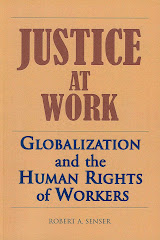
-- published its best material in a book, Justice at Work,
-- participated in demonstrations against the suppression of worker rights in China, Vietnam, and Indonesia.
In short, I would not have been me.
I would have been someone else. As a One Percenter I would imbibe the social and political standards of that peculiar environment, and so why wish to be or to become one of them? Why?
Read more!
Friday, January 13, 2012
Thoughts for Food
Ah! For a freshly baked loaf of good rye bread! Two slices of one would make the most delicious sandwich you’d ever taste
So it was with some excitement that I looked forward to a day in January that the hospital menu item promised “ham and cheese on rye,” but let me down by producing something else – sliced whole wheat bread. I ate only the ham and cheese.
Funny how life in a hospital focuses the mind. mine at least, on alternatives available on the outside where free choice reigns Not that the food here is bad. But in mass preparation and distribution it does lose some of its savor.
Still, as I write I keep an ear open for food carts rattling down the corridor with trays of food, The menu promises stuffed cabbage rolls and mashed potatoes. Not quite a match for lunch, which was a tasty combination of tuna, rhree-bean, and pasta salads.
Hope I am not overweight when I am discharged from the Cameron Glenn Rehab Center on February 5. My lsarger concern: paying all my doctor and medical bills not covered by Medicare and Medicaid.
Anyone know of a private source that will come to the rescue of a worker rights advocate who in 25 or more years of campaigning has never made an appeal for funds?
Read more!
Friday, January 06, 2012
Adventures on 2 Continents
While repairing my bleeding brain cells, my doctors fed my head so many medications that at times my mind soared far and wide. Most notably I went snowskiing in Belgium and water boating in Cambodia. Both adventures have lived on in my mind to make my hospital days, and especially nights, a bit more endurable.
The Cambodian episode had its own nightmarish wrinkles. There I was, floating down the Cambodian River, the lone occupant of a river boat that I did not control, nor own. I was peripherally concerned about getting it back to its owner, Scott, who happens (in real life) to be my speech therapist. My overriding concern was to avoid crashing into the colorful buildings that lined the river in downtown Phnom Phen, the country’s capital.
Suddenly, miraculously, the river hit a flat spot, where it bumped against a modern haven for boats in distress, at least for mine. Its sole occupant: my wife! She told me to stop dreaming and to step out of the boat to safety. I didn’t believe her. Eventually, I staggered into her arms and into the real world.
My out-of-the-world experience in the hills of Belgium was no less memorable, largely because of the presence of Abdulai, a hospital worker whom I had befriended earlier while recovering from surgery in Reston. The dirty tasks of cleaning up pants dirtied by my inability to reach a toilet in time –he handled these gladly. He even did so for me in the midst of a snowstorm before leading me to safety.
Now, happily, he still works at the Reston hospital where I am undergoing therapy. Thank God for his humane view of care –giving.
Having picked up word that I was a writer, Abdulai asked how many books I had written. “One? Where can I buy it? I want to read it.” His eagerness was such that I had only one option: to promise him one of the two copies of “Justice at Work: Globalization and the Human Rights of Workers” that I have with me.
Weirdly, it was in the Cambodian nightmare that I first learned that my book had been reprinted in a large quantities because of mass orders in the States and Asian countries.
Read more!
Saturday, December 03, 2011
My Absence
I'm writing this post—with the help of my son Thuy—to explain my absence in this space. Early in October I suffered a fall, and as the result I spent 20 days in the intensive care unit at George Washington University Hospital. The doctors and nurses there are first-class professionals, and I am fortunate to have such good care. For the past few weeks, I've been working hard in my recovery to regain my strength, with the help of many therapists (speech, physical, occupational and nutritionists). I miss writing, and I have many ideas that I hope to share with you in the near future. Thank you for your support and happy holidays. Please keep up the good fight. Read more!
Tuesday, September 27, 2011
Distinguishing your right to property
So you support the right to property. Fine. But there are two kinds of right to property. Though often confused, they are so distinctly different that they are in conflict with each other.
-- One is the fundamental right of every human being to own property. (See article 17 of the Universal Declaration of Human Rights)
-- The other is the unrestricted right asserted by property owners to exploit their property to the detriment of others.
President Obama announced on September 20 that the U.S. government is joining a global effort seeking to ensure that the vast riches of the world’s extractive industries are not limited to property owners alone. Named the Extractive Industries Transparency Initiative (EITI), it a coalition of governments, civil society, and companies
About 3,500,000,000 people live in countries rich in oil, gas, and minerals – natural resources that can, under good governance, generate large revenues to foster economic growth and reduce poverty. “However,” as EITI points out, “when transparency and accountability is low, such resource revenue may result in poverty, corruption, and conflict.”
EITI has a set of 21 requirements that a government must meet to achieve EITI Compliant status. A board and international secretariat administer the standard for companies to publish what they pay and for governments to disclose what they receive. So far 29 countries have met that transparency standard. Norway was the first OECD country to do so.
The EITI Website explains:
“Transparency alone will not guarantee sound management of extractive resources but is very likely to lead to greater benefits for the people and more efficient management of the sector. The challenges for North Africa and the Middle East and other resource rich countries are immense, but the EITI is a good place to start – focusing on the industries and the revenues that could be harnessed to transform these societies.”
Read more!
Monday, September 26, 2011
Tracking down the slaves who work for you

Our world has about 27,000,000 million slaves – men, women, and children -- who are forced to work without compensation in the vast production and distribution chain upon which ordinary consumers are inevitably dependent for everyday products. That is the conclusion reached by a U.S. State Department–funded project announced on September 23.
The project reveals the extent of the link: slave labor is used, for example, to mine mica, the mineral used to provide sparkle in cosmetics, and coltan, a component in electronics, and to make products like soccer balls from China and cotton from Uzbekistan.
Besides, through a newly launched Website, slaveryfootprint.org,the project encourages corporations to investigate their wide-ranging supply chains -- their contractors and subcontractors -- for use of slave labor.
The initiative was announced at a New York City news conference by Ambassador at Large CdeBaca of State’s Office to Monitor and Combat Trafficking in Persons. More details can be found on Facebook at http://www.facebook.com/madeinafreeworld/.
#
Read more!
Wednesday, September 21, 2011
How U.S. China policy is tilted against American workers
What will it take for the U.S. government to reform its unbalanced China policy?
A new study by the Economic Policy Institute (EPI) lays down the hard facts on a trade relationship with China that is by far the most unbalanced in the world. For example:
Between 2001 and 2010, the outsized trade deficit with China cost at least 2,800,000 U.S. jobs, 1,900,000 them in manufacturing.
Included in that total for all sectors were 453,100 jobs lost or displaced from 2008 to 2010 alone.
World trade in advanced technology products – once hailed as a source of comparative advantage for America – is now dominated by China. Hardest hit are the computer and electronic parts industry.
China’s entry into the World Trade Organization in 2001 tilted the economic playing field further in favor of multinational companies, which “have enjoyed record profits on their foreign direct investments.”
The impact on American workers is not limited to lost opportunities to get jobs. Competition with China has also driven down wage levels of employed workers, especially in manufacturing. All workers with less than a four-year college degree are the most adversely affected.
The report, written by EPI’s Robert E. Scott, attributes the rapidly growing trade deficit largely to China’s manipulation of its currency in a way that effectively subsidizes China’s exports, “making U.S. goods less competitive in that country and in every country where U.S exports compete with Chinese exports.
In his last two paragraphs Scott evaluates the U.S.-China relationship:
“Is America’s loss China’s gain? The answer is not clearly affirmative. China has become dependent on the U.S. consumer market for employment generation, suppressed the purchasing power of its own middle class with a weak currency, and, most important, now holds over $3 trillion in hard currency reserves instead of investing them in public goods that could benefit Chinese households. Its vast purchases of foreign exchange reserves have stimulated the overheating of its domestic economy, and inflation in China has accelerated rapidly in the past year. Its repression of labor rights has suppressed wages, thereby artificially subsidizing exports.Read more!
“The U.S-China trade relationship needs a fundamental change. Addressing the exchange rate policies and labor standards issues in the Chinese economy are important first steps.”
Friday, September 16, 2011
Time to halt this madness before it’s too late
A small group of people have pulled a fast one. They have manipulated the legislative process to entangle a small group of people in an impossible situation where any decision they make is bound to be disastrous.
Where in the constitution does it empower a small group of people to choose economic suicide for the United States of America?
Read more!
Wednesday, September 14, 2011
Trust in policymaking role of banks and other financial institutions not merited, says UN agency

Given their “irresponsible behavior” in the economic crisis, banks and other private financials institutions do not inspire trust in the role they still have in shaping the recovery. So says an intergovernmental agency, the UN Conference on Trade and Development (UNCTAD), in its report on “Post-Crisis Challenges in the World Economy,” released September 6.
“Little has been learned about placing too much confidence in the judgment of financial market participants, including rating agencies, concerning the macroeconomic situation and the appropriateness of macroeconomic policies,” the annual UNCTAD report states.
“In light of the irresponsible failure of many private market actors in the run-up to the crisis, and costly government intervention to prevent the collapse of the financial system, it is surprising that a large section of public opinion, and many policymakers, are once again putting their trust in those same institutions to judge what constitutes correct macroeconomic management and sound public finance.”
The report emphasizes the importance of wage growth to recovery, since wage income is the main driver of domestic demand in both developed and emergent market economies. “However, in most developed countries, the chances of wage growth…are slim.” Declining wages dampen the private spending needed for recovery.
The thrust of the report is that, in the current crisis, the focus on cutting budgets and debt is counterproductive.
A new Census Bureau report underlines the urgency of the situation. More Americans are now living in poverty than at any time since records began to be kept 50 years ago. As a Financial Times news story put it:
“The aftermath of the recession has been a ‘two-speed’ recovery for Americans, as the wealthiest maintain their spending habits and lifestyles while a record number of their fellow citizens are mired in poverty.”
UPDATE
The Director-General of the International Labour Organization, Mr. Juan Somavia, said the time has come to “place the real economy in the driver’s seat of the global economy, with a financial system at its service”.
“This means putting productive investment in the real economy at the heart of policymaking; an enabling environment for sustainable enterprises; and less availability of unproductive and risky financial products”, Mr. Somavia told members of the European Parliament during an address in Strasbourg. Read more!
Monday, September 12, 2011
'Balanced' is the keyword for coping with economic storm
There we were, my wife and I, driving through a furious rainstorm, on the periphery of Hurricane Irene. About 15 minutes from home, when traffic slowed to a crawl, I began worrying without speaking. Would a breakdown of our sump pump, which failed in a storm three years ago, again flood the basement?
Further down Route 7, police cars blocked us from the flooded road ahead, and waved us into a detour. Soon the worry about a flooded basement faded into: do we have enough gas to make it home? After another restless half hour, we thankfully reached a familiar crossroads. Soon we were home, bedraggled but safe, and sump pump working as it was meant to.
Many millions, all along the East coast, weren’t so lucky. Within our own county, hundreds had to be evacuated from their homes. Swift-moving waters swept four people to their deaths, including a 12-year old boy. Rescuers had to pluck dozens from their stranded cars.
While the East coast was suffering a drastic surplus of water, most of the Southern region was enduring a devastating shortage. In Texas, the hardest hit, the combination of drought and wild fires has so far cost farmers and ranchers $5,200,000,000 in losses; raging fires have destroyed more than 1,500 homes. Five other Southern states were also affected by what one expert called the driest, hottest summer on record in the area since 1895.
Learning from Two Parallel Crises
I’ve long considered the extremes in the nation’s weather as offering a metaphorical lesson for its extremes in income. Both kinds of extremes have corresponding losses in lives and property.
For extremes in weather -- long spells of dry heat in one region, devastating floods in another -- the consequences are widespread and visible, but solutions lie largely beyond human reach. For extremes in the disparities between rich and poor, the consequences are less visible but even more widespread. The great difference between the two types is that solutions to gross disparities in income and wealth are within human reach, but only if enough people recognize the perils and have the will to take effective concerted action.
For positive results in dealing with the economic crisis, the keyword is “balance,” a quality lacking in the deficit debate and in its mindless outcome. The Congressional supercommission will fail in its mandate if it proceeds without a vision that the results must be balanced.
Economist Benjamin M. Friedman, for one, understands what that means, using a synonym for balanced: “broadly based.” As he writes in his book, “The Moral Consequences of Economic Growth”:
“Economic progress needs to be broadly based if it is to foster social and political progress. That progress requires the positive experience of a sufficiently broad cross section of a country’s population to shape the country’s mood and direction.”
But that requirement, he points out, has not been met for more than a quarter century. “Except for a brief period in the late 1990s, most of the fruits of the last three decades of economic growth in the United States have accrued to only a small slice of the population….After allowing for higher prices, the average worker in American business in 2004 made 16 percent less each week than thirty-plus years earlier. For most Americans, the reward for work today is well below what it used to be.”
These days the average pay for work – when it is available -- remains more or less stagnated at the 2004 level. Meanwhile, according to numerous reports, corporate executive pay has continued to grow. CEO pay, according to AFL-CIO studies, has grown to 343 times the median pay of workers, by far the largest gap in the world.
“Only with sustained economic growth, and the sense of confident progress that follows from the advance in living standards for most of its citizens, can even a great nation find the energy, the wherewithal, and most importantly the human attitudes that together sustain an open, tolerant and democratic society.” – Benjamin M. Friedman, in the last sentence of his book.
Read more!
Saturday, September 10, 2011
Where Art meets work and the rights of workers
Rare are artists who feature work and workers. Judy Taylor of Maine is one of the rarities. I have just today become aware of her and a mural of hers that the governor of Maine banned from the walls of the state’s department of labor.
As a non-credentialed art critic, I find the mural on her website,
http://judytaylorstudio.com/pubart1.html
so awesome that I can hardly type this report. I could not reach her immediately to get permission to reprint her copyrighted work.
But, while the original 11-panel mural is now packed up and hidden at an undisclosed location, nearly full-size reproductions are on display until September 20 at the VisArts Kaplan Gallery in Rockville, Md. In publicizing the event, titled “Celebrate Labor: Where Art and Politics Meet,” the gallery’s Website, at http://www.visartsatrockville.org/index.php/upcoming-shows?task=view_event&event_id=14, prints three of her panels portraying “the secret ballot,” “the first Labor’s Day,” and “the Woods Worker.”
Each of the 11 panels is an allegory for a struggle or an achievement in the history of the worker, especially in Maine. Panel 8, for example, depicts a pregnant woman receiving advice from Francis Perkins, a Maine icon who was the first U.S. cabinet member.
Taylor, commissioned to do the mural for $60,000, finished it in 2008, two years before a Republican, Paul LePage, became governor, and found the mural offensive. Ironically, his ban has awarded it national publicity. Belatedly, I featured the news on my Facebook page, and will display more of the panels as soon as I get permission to do so.
Read more!
Tuesday, September 06, 2011
Exploring human rights and global economy
The New School for Social Research will hold a conference on Human Rights and the Global Economy November 9 and 10 in New York City. The wide range of subjects to be discussed include trade and intellectual property; the dimensions of human trafficking; responsibilities that flow from benefitting from global injustice; climate change and global justice; and human rights obligations of corporations.
“This public conference will engage both speakers in conversation about human rights,” says Arien Mack, professor of psychology at the New School, who is founder and director of the Social Research conference series.
For information about the conference, consult the web page at
http://newschool.edu/cps/human-rights-global-economy/
Read more!
Monday, September 05, 2011
'The Chinese Invasion'
Almost every American-themed trinket sold in the Smithsonian Institute is made in China.
San Francisco is importing its new bay bridge from China.
New York City awarded Chinese state-subsidized firms contracts to renovate the city’s subway system, refurbish the Alexander Hamilton Bridge over the Harlem River, and build a new Metro-North train platform near Yankee Stadium.
David Sirota, in an op-ed published in Truthout September 2, cited that spate of “mind-blowing” recent news headlines as evidence of “the Chinese invasion.” To that list, he added a reminder that the Martin Luther King monument in Washington was designed by a Chinese sculptor and assembled by low-wage Chinese workers.
Imagine the contradiction: a memorial for a civil rights leader who deplored “starvation wages” and died supporting a sanitation union’s strike is built by non-union serfs from China! The Chinese invasion, Sirota wrote, is caused by an America “no longer willing or able to invest in its own future.”
He attributed this shocking situation largely to our “golden age of big-money politics,” in which multinational corporations are “buying off our lawmakers.” But you can’t buy what’s already been sold.
Our China policy reflects the way most of our leaders really think, based on what they learned in the best universities about the sanctity of free markets. President Obama’s embrace of free trade and free investment agreements is consistent with what he imbibed at Harvard and Chicago.That line of thinking has penetrated even some union leaders. At the June International Labor Conference in Geneva, a representative of the All-China Federation of Federation of Trade Unions (ACFTU), a component of China’s state/Party power structure, was elected to the governing body of the ILO, thanks to a decision of a divided Workers’ Group.
The International Union of Food and Hotel Workers (IUF) statement on that development was headed: “ACFTU representing workers’ interests….—that cannot be serious!” Read more!
Saturday, September 03, 2011
Jobless crisis: its catastrophic impact on the whole country
Persistent high unemployment in the United States is having a “catastrophic” long-term impact on the entire country. In other words, the negative impact is not limited to workers who are currently unemployed (14,000,000 men and women), but is also affecting the rest of the population, even those with jobs.
The grim facts about the nation’s job crisis are detailed in a new briefing paper, “Sustained, High Joblessness Causes Lasting Damage to Wages, Benefits, Income, and Wealth,” just released by the Economic Policy Institute.
Current discussion of unemployment and the need for job creation “vastly understate both the damage done…and the extent of the population affected,” say the authors of the paper, Lawrence Mishel and Heidi Shierholz.
They debunk the claim that the problem is just “structural” – that employers can’t find the workers with the skills needed in the current economy. “It is not that this country is lacking the right workers; it is lacking work,” they write, and supply the supporting data illustrating “a profound lack of demand for workers, not that employers can’t find the people they need.”
Among the evidence they present on the pain of the crisis:
The share of children with an unemployed or underemployed parent has doubled in three years – from 6,400,000 in 2007 to 13,000,000 in 2010).
The monthly jobless rate puts one month’s unemployed workers in the foreground. In the background are the unemployed the other months. For the workforce overall, almost one in three workers were unemployed or underemployed at some point in 2009.
For more than a year, the share of the unemployed who have been without a job for over six months has hovered around 45%.
All education categories – college-educated workers included – have seen their unemployment rates roughly double over the last four years.
Forecasters do not expect export growth sufficient enough to substantially reduce unemployment in the next few years. The Congressional Budget Office expects the unemployment rate to be over 8% well into 2014.
In their concluding paragraphs, Mishel and Shierholz briefly supplement their factual analysis with judgments. The persistence of high unemployment, they write, “is unacceptable in a modern, developed economy, and the means to address it are no mystery: stimulate demand which will create jobs.”
They list the programs that Congress could adopt to rejuvenate the labor market. Some of them are: repair and upgrade the nation’s 100,000 public school buildings; additional spending on transportation infrastructure, and fiscal relief to the states.
But they recognize a huge obstacle: the debt ceiling agreement of August 2011, which “all but rules out deficit-financed stimulus of an appropriate magnitude.” Renegotiate or repeal it, they advise.
“All of these policies,” they write in their final paragraph, “are in our power to accomplish as the world’s largest economy. We can make the choice to pursue them and deflate the high unemployment that will otherwise scar the country and its workers for a generation.”
Will we make the right choice? I fear that we won’t, and one reason is the negative role of some powerful Catholics in Congress. A new campaign has the potential to become a movement that could bring people’s attitudes and actions more in line with Catholic principles. See my blog posting of September 1 on the St. Francis Pledge to Care for God’s Creation.
For information about this campaign, see the Website of the Catholic Climate Covenant at http://catholicclimatecovenant.org/.
Read more!
Thursday, September 01, 2011
St. Francis Pledge to care for God's creation
A nation-wide initiative is under way to rally Catholic support behind two causes – protecting the environment and protecting the poor and vulnerable.
The first step in that direction – “your first step” – is to “take the St. Francis Pledge,” says an announcement of the campaign. The pledge is to
• PRAY and reflect on the duty to care for God’s Creation and protect the poor and vulnerable.
• LEARN about and educate others on the causes and moral dimensions of climate change.
• ASSESS how we-as individuals and in our families, parishes and other affiliations-contribute to climate change by our own energy use, consumption, waste, etc.
• ACT to change our choices and behaviors to reduce the ways we contribute to climate change.
• ADVOCATE for Catholic principles and priorities in climate change discussions and decisions, especially as they impact those who are poor and vulnerable.
Pledges are being made in four categories: individual/family, parish, school, and organization.
I first learned of the campaign in a September 1 email attaching “Notes for Neighbors” from a department of the U.S. Catholic Bishops Conference. The note about the pledge explained:
“This October 4, celebrate the Feast of St. Francis by taking the St. Francis Pledge! Please encourage families, parishes, schools, and others in your diocese to take the pledge. The Catholic Coalition on Climate Change has developed new tools to assist parishes, schools, individuals, and organizations in caring for creation and learning more about Church teaching on climate change as articulated by Pope Benedict XVI and the U.S. Catholic Bishops and as embodied in the life and witness of St. Francis of Assisi.”
Read more!
Sunday, August 28, 2011
Trade pact to be negotiated, and opposed, during Labor Day week
Government officials from at least nine Pacific Rim counties will gather in Chicago September 6-15 to pump some life into negotiations for a new Trans-Pacific Partnership (TPP) free trade agreement. On September 5, Labor Day, unions and other critics of the agreement will hold a rally in Chicago’s Grant Park, near the downtown hotels housing the visiting delegations.
Frustrated by a stalemate in the World Trade Organization, the Bush administration almost a decade ago started concentrating on bilateral and regional channels to seek its objectives. So far, success has proved just as elusive, even with the support of the new Obama administration.
Widespread public opposition to FTAs of any kind prompted President Obama’s trade representative, Ambassador Ron Kirk, to launch an unprecedented 50-state “outreach” in 2010 to sell TPP. According to a November 2010 Pew Research Center poll, now only 35% of Americans believe that free trade agreements benefit the United States.
TPPFTA negotiations began in earnest on March 15 last year with the governments of eight countries -- Australia, Brunei Darussalam, Chile, Malaysia, New Zealand, Peru, Singapore, and Vietnam, yes, Vietnam – on board with the U.S.
On March 14, Richard L. Trumka, president of the AFL-CIO, and the presidents of the Australia, New Zealand, and Singapore labor movements, issued a joint declaration on how the TPPFTA fails to meet the standards for a fair agreement. The shortcomings they cited were chiefly in the areas of transparency, worker rights, investment, environment, procurement, intellectual property, and consumer protection.
In a memo for reporters on August 26, the Citizens Trade Campaign summarized its case against TPPFTA. “With high U.S. unemployment,” it stated, “pressure builds for a fair deal or no deal.” (http://www.citizenstrade.org)
The American Enterprise Institute, like other business organizations, strongly favors the agreement, to the point of considering it a possible model for all 21st century trade pacts. (http://www.aci.org)
No one expects negotiations to be concluded by its deadline of November this year. The issues are so complex, and bound to become more so as other Rim nations join the current nine, that it doesn’t not seem possible – or desirable – for TPPFTA to be wrapped up even by November 2012. If ever.
Read more!

 Posts
Posts